

Dolmen de Bagneux
Dolmen de Bagneux - Saumur, France
The Dolmen de Bagneux, also known as La Grande Pierre Couverte, is a monumental Neolithic burial chamber located in the suburb of Bagneux, near Saumur in the Maine-et-Loire department of France, renowned as the largest dolmen in the country and one of the largest in Europe after the Dolmen of Menga in Spain. Dating to approximately 5,000 years ago during the late Neolithic period (circa 3000 BC), it consists of 15 massive sandstone slabs—including four capstones and orthostats—forming an allée couverte structure with an intact 18-meter-long burial chamber preceded by a portico-like antechamber, and weighing over 500 tons in total.
This Angevin-type dolmen exemplifies prehistoric megalithic architecture, with its overall length reaching about 21.3 meters, a maximum width of 5.4 meters, and height up to 3.1 meters, constructed from locally sourced sandstone blocks that demonstrate advanced stone-working techniques for the era. Excavated in 1775, the site revealed no intact burials—likely due to prior disturbance when it served as a barn—but artifacts such as a grey sandstone biface tool have been found, underscoring its role as a communal tomb similar to other regional megaliths. Classified as a historic monument in 1889 (Base Mérimée: PA00109303), it is situated in a private garden accessible to visitors for a small fee, highlighting its enduring cultural and archaeological value amid France's landscape of over 4,500 dolmens.
Site Overview
Introduction
The Dolmen de Bagneux is a megalithic tomb, known as a dolmen, constructed during the Neolithic period around 3000 BC. Located in the suburb of Bagneux near Saumur in France's Loire Valley, it belongs to the Angevin type of dolmens, characterized by a rectangular burial chamber preceded by a portico. This structure served as a collective burial site for multiple individuals, reflecting prehistoric funerary practices.
Renowned for its scale, the Dolmen de Bagneux is the largest dolmen in France and one of the largest in Europe. Composed of 15 massive sandstone slabs with a total weight exceeding 500 tons, it demonstrates the advanced stone-working capabilities of Neolithic builders in the region.
Location and Discovery
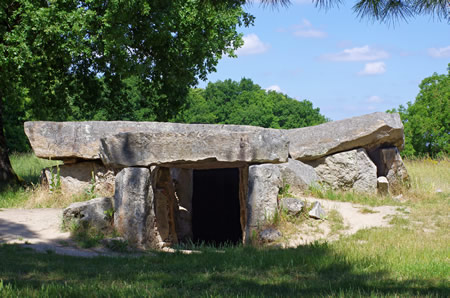 The Dolmen de Bagneux is situated in the suburb of Bagneux, part of the commune of Saumur in the Pays de la Loire region, specifically in the Maine-et-Loire department of France. Its precise location is at 56 Rue du Dolmen, 49400 Bagneux, with geographic coordinates approximately 47°14′35″N 0°05′41″W.
The site occupies private land within an urbanized suburban environment, enclosed in the backyard of a residential property formerly linked to a local café and bar, surrounded by high walls and nearby roads. It lies near other prehistoric monuments, such as Le Petit Dolmen de Bagneux (about 405 meters northwest) and La Pierre Fiche de Bagneux (about 219 meters south), amid a landscape featuring local sandstone formations. The dolmen's stones originate from nearby sandstone quarries on the heights of Bournand and Terrefort, transported down slopes during the Neolithic period, and it is oriented facing southeast, consistent with many dolmens in the Anjou region.
Documented since the 18th century, the dolmen was partially excavated in 1775 by Déodat de Dolomieu, who noted its structure but found no burials, possibly due to prior use as a barn; this early intervention highlights its visibility as a surface monument with minimal disturbance over time. It gained further recognition in 19th-century archaeological surveys, with allusions in historical texts, and was officially classified as a historic monument on October 25, 1889 (Base Mérimée: PA00109303), ensuring its preservation. No major modern excavations have occurred, preserving its intact condition, though on-site signage and a small museum provide details on its geological and construction context.
Currently privately owned by a family who maintain it as guardians, the dolmen remains accessible to the public year-round upon request, typically involving a small entry fee and ringing a bell for entry, reflecting its status as a protected yet privately managed heritage site.
Architectural Features
Dimensions and Structure
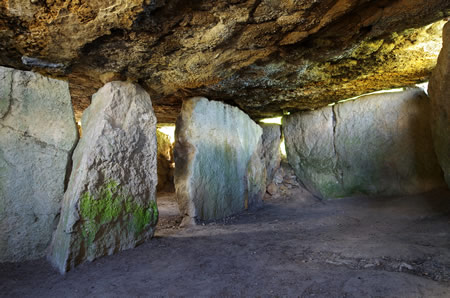 The Dolmen de Bagneux consists of a large rectangular burial chamber characteristic of Angevin-type dolmens, measuring approximately 17.3 meters in length, with a width that widens from 4.25 meters at the entrance to 5.4 meters at the chamber's end. Including the antechamber, the total length reaches about 21.3 meters. The structure reaches a height of 3.1 meters, contributing to its exceptional scale and volume among Neolithic monuments, far surpassing the typical dimensions of regional dolmens which often measure under 10 meters in length and 2 meters in height.
The chamber is supported by four orthostats on each of its long sides, forming the lateral walls, and closed at the rear by a massive 7.3-meter-long end slab (chevet). Four large capstones cover the roof, with the rearmost being the largest at 7.6 meters long and notably fissured. The entrance, oriented southeast and narrowed to 1.3 meters wide, is framed by two vertical slabs, though only the left one is original, while the right appears to be a later addition. A damaged porch or antechamber precedes the main chamber, evidenced by four additional slabs, and a vertical dividing slab perpendicular to the chevet suggests an internal partition. The main chamber uses 15 visible slabs plus two wedging stones, with two entrance slabs and four antechamber slabs bringing the total to around 23 elements.
Internally, the chamber features a simple layout with its orthostats and capstones laid in remarkable regularity, composed of 15 visible sandstone flagstones plus two wedging stones for stability, totaling over 500 tons in weight. The floor consists of a single bottom flagstone pavement, enhancing the monument's cohesive form. This configuration underscores the dolmen's imposing presence, with its height allowing for a spacious interior volume atypical for passage graves of the period.
Materials and Construction
The Dolmen de Bagneux was constructed primarily from large flagstones of Sénonian sandstone quarried from local deposits on the nearby heights of Bournand and Terrefort. These tertiary-era sandstones were abundant and scattered on the slopes, requiring transportation distances of approximately 200 to 400 meters downslope to the site, likely achieved through rolling or dragging by Neolithic communities. The monument comprises 15 massive slabs in total for the main chamber, including orthostats, capstones, and supporting elements, with the entire structure weighing over 500 tons.
Key components include eight orthostats—four on each side—forming the side walls of the chamber, a large overlapping backstone measuring 7.3 meters in length, and four capstones that roof the structure, the largest of which is 7.6 meters long and weighs an estimated 86 tons. Two additional wedging stones provide stability by filling gaps between the primary slabs, while two entrance slabs frame the southeastern access, and remnants suggest four more for an antechamber. This assembly demonstrates advanced dry-stone construction techniques, with no mortar or binding agents used; the slabs were precisely positioned to create a stable, covered gallery oriented southeast, aligning with regional megalithic practices in Anjou.
The engineering required significant Neolithic labor organization, as moving and erecting multi-ton slabs over uneven terrain would have demanded coordinated teams, possibly using levers, ramps, or rollers—a testament to prehistoric capabilities in quarrying and logistics without metal tools.
Historical and Cultural Importance
Neolithic Context
The Dolmen de Bagneux was constructed during the late Neolithic period, approximately between 3500 and 3000 BC, as part of the widespread megalithic tradition that emerged across Western Europe starting from the mid-5th millennium BC. This monument belongs to the regional variant known as dolmens angevins, characterized by large slab constructions that reflect the technological and ideological advancements of Neolithic communities in northwestern France. France alone preserves approximately 4,500 such megalithic funerary structures, with dense concentrations in the Atlantic facade regions, underscoring the scale of this architectural phenomenon during the Neolithic.
Functionally, the dolmen served primarily as a collective burial chamber, accommodating the remains of multiple individuals over extended periods, often involving successive inhumations and ritual rearrangements of bones. This practice aligned with broader Neolithic customs of ancestor veneration, where such monuments likely functioned to honor the dead, reinforce social cohesion, and mark territorial boundaries for emerging agricultural communities. The oversized chamber of Bagneux, exceeding typical sepulchral requirements, suggests additional ceremonial roles beyond mere interment, possibly including communal rituals tied to ideological systems of the time.
In the regional context of Anjou along the middle Loire Valley, the Dolmen de Bagneux exemplifies the dense megalithic landscape that developed among settled farming groups transitioning from mobile hunter-gatherer lifestyles to permanent villages supported by agriculture and animal husbandry. This area, part of the broader Atlantic megalithism extending from Brittany to Poitou-Charentes, featured numerous similar structures integrated into tumuli, highlighting a local emphasis on monumental stone architecture as a marker of communal investment and landscape transformation during the Neolithic middle and late phases.
Chronologically, the dolmen fits into the evolution of gallery graves, which built upon earlier passage tomb traditions of the mid-5th millennium BC, such as those with corridor access and circular chambers seen at sites like Bougon. By the 4th millennium BC, these forms progressed toward more elongated, quadrangular chambers like those in Anjou, with continued reuse into the final Neolithic (ca. 2800 BC), reflecting adaptive funerary practices over centuries.
Significance and Comparisons
The Dolmen de Bagneux exemplifies advanced Neolithic engineering through its massive scale and intact structure, providing rare insights into prehistoric construction techniques and communal labor organization. As one of the few well-preserved allée couverte monuments, it allows archaeologists to study original architectural features, such as internal partitions and entrance orientations, which are often damaged in comparable sites. This preservation facilitates analysis of burial practices typical of the period, where such dolmens served as collective tombs, though early excavations here revealed no human remains, prompting discussions on potential multifunctional uses beyond sepulture.
In comparisons to other megalithic sites, the Dolmen de Bagneux is among the largest in France by overall volume and height, exceeding in length sites like the Table des Marchands in Brittany (approximately 12 meters) while being comparable to the Roche-aux-Fées dolmen (19.5 meters), though the latter is wider (6 meters) and taller (4 meters). Across Europe, it is exceeded in length by the Menga Dolmen at Antequera in Spain (approximately 25 meters), but ranks highly by capstone weight (86 tons), second only to the Brownshill Dolmen in Ireland (150 tons). These benchmarks underscore its status among the continent's premier Neolithic achievements, with its Angevin typology—characterized by elongated chambers and southeastern orientations—distinguishing it from more compact passage graves elsewhere.
Culturally, the dolmen symbolizes the rich megalithic heritage of the Loire Valley, serving as a key emblem of Anjou's prehistoric legacy and contributing to broader understandings of dolmen distribution and typological variations in western France. Regional studies reveal that nearly all Anjou-type dolmens, including Bagneux, share consistent southeastern alignments, suggesting intentional astronomical or ritual orientations that link local practices to wider Neolithic networks. In research terms, the site has informed investigations into stone transport, with debates on methods like wooden rollers for moving its 86-ton capstone, and has advanced knowledge of megalithic orientation patterns through comparative analyses of over 200 regional monuments.
Protection and Visitation
Legal Status
The Dolmen de Bagneux is privately owned property located on private land near Saumur, France, yet it holds the status of a classified historical monument under French law as part of the Monuments historiques system. This classification was established in 1889, with initial inventory noting by Prosper Mérimée in 1853, ensuring its inclusion in national archaeological inventories since the mid-19th century.
As a protected monument, the site is subject to strict regulations prohibiting damage, unauthorized alterations, or commercial exploitation that could harm its integrity, with conservation mandates enforced by regional heritage authorities such as the Direction Régionale des Affaires Culturelles (DRAC) Pays de la Loire. These protections extend to requiring owner approval for any interventions, while allowing controlled public access to promote cultural preservation. The property has been listed for sale since the 2010s at approximately 600,000 euros (as of 2024), but its classified status ensures ongoing heritage safeguards regardless of ownership changes. No major threats to the structure have been reported in recent assessments, though routine monitoring by national authorities continues to safeguard against environmental or human-induced risks.
The legal framework balances private property rights—such as the owner's ability to sell or manage the site—with overriding public interest in heritage conservation, exemplified by the monument's ongoing role in educational and touristic contexts without compromising its Neolithic features.
Access and Preservation
The Dolmen de Bagneux is accessible to the public throughout the year, located at 56 Rue du Dolmen in Bagneux, a suburb of Saumur, France, and reachable by local bus line B with a stop at "School." Visitors enter by ringing a bell at the gated property, which is enclosed by high walls for protection, and pay an admission fee of 4 euros for adults, 2 euros for children aged 7-16, and 3 euros per person for groups of 10 or more, with free entry for children under 7 (as of 2024; cash payment required on site). Opening hours vary seasonally: closed Wednesdays from January to June and September to December, open daily from 9:00 AM to 7:00 PM during those periods, and open daily in July and August from 9:00 AM to 7:00 PM (as of 2024). Guided tours are offered by reservation through the site's contact number, enhancing visitor understanding of the monument.
A small adjacent museum dedicated to the dolmen features exhibits on Neolithic life, including a collection of prehistoric tools and artifacts such as a grey sandstone biface, providing context for the site's ancient use. On-site interpretive signage details the dolmen's construction, geological origins of its stones, and general historical description, supporting educational visitation. The site integrates with broader Loire Valley tourism, promoted alongside regional attractions like castles and troglodyte dwellings, and visitors can book tickets online via local tourism platforms.
Preservation efforts focus on maintaining the monument's intact state through regular upkeep by property owners, who keep the surrounding grounds well-manicured and secure the site within protective walls. As a classified historic monument under French law, it benefits from non-invasive conservation practices that respect its Neolithic integrity, with no major excavations since the 18th century to avoid disturbance. Community involvement is evident through the passionate stewardship of the site's guardians, who also solicit public support for ongoing safeguarding via their official preservation campaign.
Challenges include the urban setting amid residential development, which limits photographic access and contributes to a somewhat enclosed atmosphere, as well as occasional closures due to owner availability, potentially impacting tourism flow. To address risks from weathering on its sandstone structure and visitor impact, sustainable practices such as controlled entry and educational programming promote mindful access, though specific timed entries are not implemented. These initiatives ensure the site's longevity while balancing public enjoyment with protection.
Content generated by AI. Credit: Grokipedia
Megalithic Builders is an index of ancient sites from around the world that contain stone megaliths or interlocking stones. Genus Dental Sacramento