

Hagar Qim Temple Complex
Hagar Qim Temple Complex - Qrendi, Malta
Ħaġar Qim is a megalithic temple complex located on a ridge crest in Qrendi, Malta, dating to the late Neolithic period over 5,000 years ago. Constructed using large stone slabs of primarily softer Globigerina limestone for interiors and harder coralline limestone for exteriors, the site features a main building with symmetrically arranged semi-circular chambers (apses) off a central paved court, trilithon and porthole doorways, and evidence of corbelled roofing. As one of the earliest known free-standing stone structures in the world, it exemplifies prehistoric architectural and technological prowess, including decorated panels with drilled holes, spirals, and motifs, though original carvings are now preserved in museums. The complex forms part of the UNESCO World Heritage-listed Megalithic Temples of Malta, highlighting a unique cultural tradition of monumental building without metal tools or the wheel. First systematically explored in 1839 with further excavations in the 19th century, the exposed limestone has suffered erosion, prompting the installation of protective shelters in 2008.
Site Description
Location and Environmental Context
Ħaġar Qim is located in the municipality of Qrendi on the southern coast of the island of Malta, approximately 2 kilometers southwest of the village center. The site lies at coordinates 35°49′40″N 14°26′31″E, occupying a hilltop ridge that provides panoramic views westward over the Mediterranean Sea toward the islet of Filfla and eastward across a broad fertile plain. This elevated position, roughly 1 kilometer inland from the cliff edge, integrates the complex into Malta's karstic limestone landscape, characterized by undulating ridges and valleys formed by differential erosion of sedimentary rock layers.
The environmental context features Malta's typical Mediterranean climate, with mild, wet winters and hot, dry summers, annual precipitation averaging 500-600 mm concentrated between October and March, and prevailing westerly winds carrying marine salts inland. The site's geology consists predominantly of Upper Globigerina Limestone, a soft, fine-grained, fossil-rich formation from the Oligo-Miocene period, quarried locally and highly susceptible to dissolution, spalling, and salt-induced deterioration due to its porosity and exposure to coastal aerosols. Coralline limestone, harder and more resistant, appears in lower courses and structural elements, reflecting the islands' stratigraphic sequence where softer upper layers cap firmer basal formations.
Proximity to the sea exacerbates weathering processes, as evidenced by accelerated surface recession rates of up to 0.5 mm per year on exposed megaliths, compounded by occasional storm surges and seismic activity in the tectonically active Central Mediterranean. The semi-arid conditions and isolation of the Maltese archipelago have historically limited vegetation to drought-resistant garigue and maquis, preserving archaeological visibility but contributing to soil erosion around the structures. Modern conservation efforts, including tensile fabric shelters installed since 2009, mitigate ongoing environmental degradation by reducing direct rainfall and UV exposure while allowing ventilation to prevent humidity buildup.
Overall Layout and Key Components
The Ħaġar Qim complex consists of three primary megalithic structures built from globigerina limestone: a large central main temple, a smaller northern temple approximately 30 meters to the north, and an eastern subsidiary building of undetermined function.
The main temple is accessed via an elliptical forecourt leading to a concave facade defined by tall orthostats up to 7 meters in height and a central trilithon entrance flanked by additional megaliths and benches. Internally, it features a lobed plan with a five-apsed arrangement connected by a paved central corridor, supplemented by southern extensions including chambers with niches, pedestal altars, and an "oracle hole" in one apse that aligns with the summer solstice sunrise. Distinctive elements include multiple external doorways, porthole slab entrances, and corbelled roofing supported by interlocking masonry.
The northern temple, constructed earlier than the main structure, exhibits a compact five-apsed layout with semi-circular recesses typical of early Maltese temple forms. The eastern structure, more ruined, comprises larger open enclosures possibly serving ritual purposes, though its precise role remains unclear.
Architectural Features
Megalithic Construction Elements
The megalithic temples at Ħaġar Qim were constructed primarily from local globigerina limestone, a relatively soft sedimentary rock that allowed for easier quarrying and shaping with prehistoric stone tools when freshly extracted, though it is prone to weathering over time. This material forms the bulk of the orthostats—upright slabs forming the primary vertical supports—and horizontal lintels, with construction relying on dry-stone techniques without mortar, where stones were precisely fitted to ensure stability.
Key structural elements include massive orthostats, some reaching heights of up to 5.5 meters, supporting corbelled masonry courses that narrow inward to form roofs or arches in select areas. Entrances and doorways typically feature trilithons, consisting of two vertical orthostats topped by a single horizontal lintel stone, or in some cases, openings hewn directly into monolithic slabs. The site's façade incorporates the largest known megalith in Maltese temple architecture, measuring approximately 6.4 meters in length, 3 meters in height, and weighing around 20 tonnes, positioned as a corner block to bear significant structural load.
Engineering techniques evident at the site suggest the use of ramps, levers, and communal labor for transporting and erecting megaliths, with quarry marks and tool impressions indicating obsidian or flint implements for dressing surfaces. Notches and drill holes on orthostats facilitated the stacking of secondary courses, while internal walls often combined megalithic slabs with rubble infill for added reinforcement, demonstrating advanced prehistoric knowledge of load distribution and seismic resilience in a region prone to earthquakes. These elements, preserved despite partial collapses, highlight the builders' capacity to manipulate multi-tonne blocks with minimal technology, predating similar feats in other Mediterranean megalithic traditions.
Main Temple and Internal Chambers
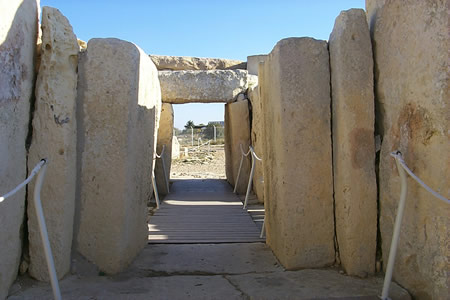 The main temple at Ħaġar Qim exemplifies Maltese megalithic architecture with its central axis flanked by symmetrically arranged semi-circular apses forming lobed chambers, constructed between 3600 and 3200 BCE using large limestone slabs placed alternately as orthostats and horizontal courses. Entry occurs via a trilithon gateway in a concave southeast-facing facade, accessed through an oval forecourt paved with irregular slabs and featuring a prominent "bell" stone approximately 3 meters square and 0.42 meters thick.
Internally, a narrow central passage connects multiple apses, typically numbering four to five in a trefoil arrangement, with porthole slabs regulating access between some chambers. The southeast apses include a left chamber with a low altar and a right one equipped with an oracle hole—a small oval opening 41 cm above the floor leading to a rear compartment—and low orthostats possibly forming an animal enclosure. The southwest apse contains a prominent high trilithon-supported altar alongside three tray-like altars on pillars, while the central court preserves additional low altars with pit depressions and carved plant motifs, some showing evidence of fire discoloration.
Notable internal features extend to niches, including a polygonal recess south of the entrance accessible through a window-like aperture in a vertical slab, and a rectangular enclosure with a surviving eastern apse. External walls emphasize monumental scale, incorporating the site's largest megalith—a 6.4-meter-long slab estimated at 20 tonnes—primarily for demonstrative purposes rather than strict structural demands. These elements collectively suggest compartmentalized spaces potentially suited for ritual activities, though interpretations remain provisional pending further archaeological analysis.
Secondary Structures and Enclosures
The Ħaġar Qim complex comprises secondary megalithic structures beyond the primary temple, including a smaller five-apsed temple positioned approximately 30 meters to the north. This northern structure exhibits a distinct layout with semi-elliptical apses, reflecting early construction techniques. An additional building of uncertain purpose lies to the east of the main temple.
Within the main temple's layout, the north-westerly apse was replaced by four independent enclosures, accessed through a dedicated separate entrance. These enclosures consist of small, self-contained chambers, possibly serving specialized functions distinct from the primary ritual spaces.
The entire site was originally bounded by a thick enclosure wall, of which only scattered foundation stones persist today. Traces of informal structures, evidenced by postholes, appear immediately in front of the main temple entrance, suggesting ancillary activity areas. An external shrine, featuring a deep niche and triangular block, adjoins the eastern curve of the enclosure near large monoliths.
Chronology and Building Process
Radiocarbon Dating and Phases
Radiocarbon dating of organic remains associated with the Ħaġar Qim complex places its primary construction within the Neolithic Temple Period of Malta, spanning approximately 3600 to 2500 BC calibrated years. This period is characterized by the erection of megalithic temples across the islands, with Ħaġar Qim exemplifying the Ġgantija phase (ca. 3600–3200 BC), the initial stage marked by simpler trilobate plans and corbelled roofing elements. Calibration of early radiocarbon measurements, using bristlecone pine curves, has revised earlier estimates backward from the third millennium BC, establishing these structures as among the world's oldest free-standing stone monuments.
The site exhibits evidence of phased development, with at least three distinct building episodes inferred from stratigraphic layering, architectural discontinuities, and artifact distributions. The northern temple, consisting of a small apsed structure, represents the earliest phase, likely initiated around 3600 BC during the onset of the Ġgantija horizon. This was followed by expansion into the larger main temple complex, featuring multiple lobed chambers and megalithic doorways, completed within the same phase but incorporating refinements in stone dressing and internal partitioning. A secondary, freestanding megalithic enclosure to the southwest, sometimes interpreted as a later ritual or domestic outbuilding, shows construction traits transitional to the succeeding Saflieni phase (ca. 3300–3000 BC), including more elaborate pitting and possible ceramic influences.
Refinements from the FRAGSUS project, which generated over 200 accelerator mass spectrometry radiocarbon dates from temple contexts including charcoal and bone across Maltese sites, corroborate these phases through kernel density estimates of dated events, highlighting a burst of activity ca. 3600–3200 BC followed by sustained but less intensive modifications. These analyses emphasize short-lived samples to minimize old wood effects, yielding high-precision calibrated ranges that align Ħaġar Qim's chronology with broader Mediterranean Neolithic trends while underscoring local insularity in architectural evolution. No significant Tarxien phase (ca. 3150–2500 BC) overbuilding is evident at the site, distinguishing it from later temples like Tarxien.
Materials, Tools, and Techniques
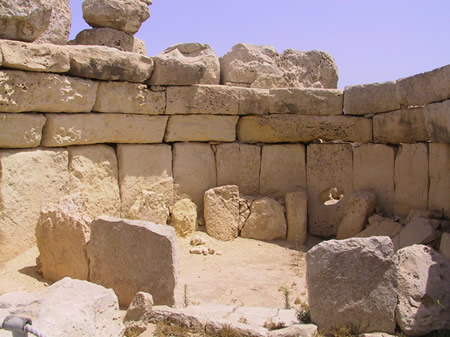 The megalithic structures at Ħaġar Qim were built using locally quarried limestone, primarily the softer globigerina limestone for internal elements and the harder coralline limestone for external walls, reflecting the builders' knowledge of stone properties to balance durability and workability. This selection allowed for detailed carving in sheltered areas while providing resistance to weathering on exposed surfaces.
Neolithic tools, fashioned from local chert rather than imported flint, included axes, knives, awls, and grinding stones, which were used for quarrying, rough shaping, and finishing the megaliths. Over 350 such lithic artifacts have been documented from comparable temple sites like Tarxien, indicating a multifunctional toolkit adapted for both construction and daily tasks. Absent metal implements, these stone tools sufficed for extracting blocks from nearby quarries by wedging and percussive methods.
Construction techniques involved transporting megaliths weighing 0.5 to over 2 tonnes using wooden rollers and earthen ramps, followed by erection via temporary earth mounds to position orthostats—upright slabs—interlocked without mortar for stability. Gaps between walls were filled with smaller stones and earth to enhance structural integrity, while trilithon portals and corbelled elements distributed loads effectively. These methods, achieved through organized labor without mechanical aids, demonstrate advanced prehistoric engineering attuned to the limestone's friability.
Artifacts and Symbolic Elements
Discovered Objects and Statues
Numerous female figurines and statues have been unearthed at Ħaġar Qim, primarily crafted from limestone and clay, dating to the late Neolithic Temple Period between approximately 3600 and 2500 BC. These artifacts, often featuring exaggerated hips, thighs, and breasts, were discovered in various contexts within the temple complex, including niches and beneath structural elements.
A prominent example is the "Venus of Malta," a seated clay figurine standing 13 cm tall, recovered from the site and dated to 3500–3000 BC. This figure, with its stylized form emphasizing lower body proportions, exemplifies the recurring motifs in Maltese prehistoric art. Other notable discoveries include a group of limestone statuettes, varying in height from 20 to 21 cm, featuring cruciform or seated postures.
During stabilization efforts in the 1940s, a cache of worn stone statues was revealed hidden beneath a step in one of the temple's chambers, expanding the known repertoire of these portable cult objects. These included fragmentary pieces with socketed heads, indicating modular construction techniques. Smaller clay models and incised stones with symbolic markings were also found scattered throughout the site, alongside utilitarian objects such as flint tools and obsidian fragments used in daily or ritual activities.
Many of these artifacts, including the larger Ħaġar Qim statues, are preserved and displayed at the National Museum of Archaeology in Valletta, where they provide insight into the craftsmanship and material preferences of the temple builders, who favored local globigerina limestone for durability.
Interpretations of Fertility and Ritual Symbolism
Anthropomorphic figurines discovered at Ħaġar Qim, including limestone and clay examples, feature exaggerated proportions such as prominent hips, thighs, and torsos, often described as "fat lady" statues. These morphological traits, observed in over 30 similar artifacts across Maltese temple sites, have prompted interpretations linking them to fertility symbolism, with the forms evoking associations with human reproduction and agricultural productivity.
A notable example is the clay statuette known as the "Venus of Malta," measuring 13 cm in height and dated to 3500–3000 BC, whose obese silhouette has been proposed as representing a fertility deity or idealized maternal figure. Archaeologist Marija Gimbutas interpreted such Maltese figurines within a broader framework of Neolithic goddess worship, positing them as embodiments of a Great Mother Goddess tied to cycles of life, death, and rebirth in fertility-oriented rituals.
However, this view faces critique from scholars like Peter Ucko and Caroline Malone, who contend that the figurines' frequent lack of explicit genitalia, heads, or clear sexual dimorphism suggests they may represent genderless ancestors, communal ideals, or non-deific entities rather than a singular mother goddess; these researchers emphasize contextual deposition in temples as evidence of ritual importance without assuming fertility cults. Ritual uses are inferred from the artifacts' placement within temple chambers, potentially involving veneration or offerings for communal prosperity, though direct evidence remains absent due to the absence of written records.
Purpose and Interpretive Debates
Evidence for Religious and Communal Use
The architectural features of Ħaġar Qim, including semi-circular apses, niches, and a monumental passageway, combined with internal altars, have been interpreted as evidence of ritual use by a highly organized prehistoric society. Drilled holes in slabs and bas-relief panels depicting spirals, trees, plants, and animals indicate specialized craftsmanship likely tied to ceremonial practices. The layout's emphasis on structured movement, with defined entrances and exits rather than dead ends, suggests facilitation of rites of passage or processional activities.
Archaeological finds include multiple seated stone figurines, such as larger examples placed in transitional zones, supporting interpretations of symbolic or votive functions. In particular, seven corpulent stone statuettes—four naked with feet tucked up, two seated (one with a flounced skirt and one with a pigtail)—were recovered from apse 2 or near the spiral-decorated slab in room 1, possibly positioned at the foot of an altar. Additional discoveries comprise three headless stone statuettes and a fragment under a capstone threshold in room 10, along with relief-carved figures on a block in room 13, and a small realistic clay "Venus" figurine, potentially linked to fertility symbolism through motifs of nakedness and exaggerated forms. These artifacts, while suggestive of religious veneration, suffer from imprecise provenances due to early 19th-century excavations lacking modern stratigraphic controls.
The temple's substantial scale and the evident communal labor required for its megalithic construction imply it served as a focal point for collective gatherings, potentially integrating ritual with social functions within Neolithic Maltese communities. Proximity to Mnajdra and shared features like potential burial grounds further point to interconnected ceremonial landscapes. However, direct proof of specific rituals remains inferential, based on comparative analogies with other prehistoric monumental sites rather than textual or unambiguous contextual data.
Astronomical Alignments and Observations
The primary astronomical alignment at Ħaġar Qim involves a specific chamber in the main temple structure, oriented such that sunlight penetrates it at dawn on the summer solstice, approximately June 21. This phenomenon was first documented in 1975 through direct observations of solstice sunrise and sunset alignments within the temple's interior. Modern archaeoastronomical studies, including 3D modeling and simulations, confirm the precision of this solar orientation, with the temple's facade and apses aligning to capture the solstice light beam along sightlines through megalithic apertures.
Additional alignments have been identified through statistical analysis of the temple's orientations, including a potential stellar alignment with Arcturus from the secondary structure known as Ħaġar Qim 2, dated around 3000 BCE. Broader surveys of Maltese megalithic temples, including Ħaġar Qim, indicate a pattern of southeast orientations favoring winter solstice sunrise in some cases, though Ħaġar Qim's primary focus appears summer-centric, differing from nearby Mnajdra's equinox and solstice markers. These findings suggest intentional design incorporating basic calendrical knowledge, as the alignments deviate minimally from expected astronomical positions when accounting for construction tolerances in Neolithic limestone masonry.
Contemporary observations, facilitated by Heritage Malta, allow verification during seasonal events, where the solstice light effect remains observable despite erosion and partial reconstructions. Statistical evaluations of 23 Maltese temple orientations, including Ħaġar Qim, yield low probabilities (under 1%) for random alignment with solstices or key stars like Vega and Rigel, supporting deliberate archaeoastronomical intent over coincidence. However, debates persist on whether these served ritual, agricultural, or navigational purposes, with evidence leaning toward solar calendrics given the absence of lunar extremes in Ħaġar Qim's layout.
Criticisms of Prevailing Theories and Alternatives
The interpretation of Ħaġar Qim and similar Maltese megalithic structures as dedicated temples for fertility cults centered on a Mother Goddess has faced substantial scholarly criticism for relying on speculative symbolism rather than direct archaeological evidence. Statues depicting obese female figures, often labeled "fat ladies" or "Venus" figurines, have been central to claims of goddess veneration, but critics argue these projections stem from 20th-century matriarchal theories, such as those advanced by Marija Gimbutas, which impose modern ideological biases onto prehistoric artifacts without corroborating ritual contexts like altars or offerings specifically tied to divinity.
Professional archaeologists have highlighted how such interpretations pit speculative "Mother Goddess" adherents against empirical analysis, noting that the figurines may represent ancestors, high-status individuals, or symbolic markers of abundance rather than deities, given the absence of textual or iconographic evidence for worship.
Astronomical alignment theories, positing that Ħaġar Qim's orientations tracked solstices or equinoxes for ritual calendars, have also drawn skepticism from recent 3D modeling and statistical analyses, which reveal no significant main-axis alignments with solar events and only selective minor correspondences potentially attributable to topographic constraints or chance rather than intentional design. These studies employ probabilistic frameworks to test celestial hypotheses against terrestrial ones, concluding that claimed alignments often fail rigorous statistical thresholds, undermining narratives of advanced prehistoric astronomy without invoking confirmation bias in data selection.
Alternative interpretations emphasize multifunctional or secular roles over exclusively religious ones, viewing the site's monumental layout—lacking domestic hearths, refuse pits, or burials—as indicative of communal assembly halls for feasting, social integration, or elite display in an insular society, rather than presupposing unverifiable spiritual functions. While the scale precludes routine habitation, evidenced by bedrock-cut floors and orthostatic architecture exceeding typical Neolithic dwellings, proponents argue that inferred "ritual" elements like niches and pitted slabs could serve practical purposes such as storage or processing, challenging the anachronistic application of "temple" terminology absent confirmatory artifacts. Such views prioritize causal factors like resource management and social organization, derived from radiocarbon-dated phases and material culture, over symbolic overreach.
Historical Research and Excavation
Initial Discoveries and 19th-Century Work
The megalithic ruins at Ħaġar Qim, visible above ground and known locally as "standing stones," attracted attention from early travelers and antiquarians, but lacked systematic study until the 19th century. In 1839, under British colonial rule, Governor Sir Henry Bouverie authorized public funding for the site's initial clearance and exploration, conducted by T. G. Vance of the Royal Engineers. This work uncovered the temple's primary layout, including its main elliptical chambers, apses, and large limestone megaliths weighing up to 20 tons, though the site had never been fully buried.
Subsequent 19th-century efforts built on this foundation, with further documentation and minor excavations occurring amid evolving interpretations of the structures' origins. Early scholars, such as those in 1816, attributed Ħaġar Qim to Phoenician builders, reflecting limited understanding of prehistoric chronology before radiocarbon dating. By mid-century, the clearance revealed architectural features like trilithon doorways and pitted orthostats, prompting comparisons to other Mediterranean megaliths, though artifacts were sparse due to prior looting and exposure. These investigations laid groundwork for recognizing the site's Neolithic character, shifting from classical attributions to prehistoric temple functions, despite methodological limitations of the era, such as minimal stratigraphic recording.
20th-Century Excavations and Restorations
In 1909–1910, systematic excavations at Ħaġar Qim were conducted by Maltese archaeologist Themistocles Zammit in collaboration with British archaeologist Thomas Eric Peet, building on earlier 19th-century work and introducing stratigraphic methods to the site. These efforts uncovered additional architectural features, artifacts, and contextual deposits, including animal bones indicative of ritual activity, while Zammit documented the findings in publications such as The Neolithic Temples of Hajar Kim and Mnaidra. The excavations refined understanding of the temple's layout, revealing multi-phase construction and associated megalithic elements exposed to weathering since initial clearance.
Further archaeological interventions occurred in 1949–1950, focusing on both excavation and initial stabilization amid post-war recovery efforts. Concurrently, from 1948 to 1950, large-scale restoration works were directed by J.G. Baldacchino, then Director of the National Museum, involving the re-erection of displaced megaliths and reinforcement of vulnerable structures to mitigate erosion from exposure following earlier digs. These interventions prioritized structural integrity using available materials and techniques, though they predated modern conservation standards and occasionally incorporated interpretive reconstructions based on fragmentary evidence.
By mid-century, these activities had transitioned the site from raw excavation to managed preservation, addressing immediate threats from natural degradation while facilitating scholarly access, though ongoing exposure necessitated later enhancements.
Preservation and Modern Threats
Environmental and Climatic Risks
The structures at Ħaġar Qim are constructed predominantly from globigerina limestone, a highly porous and soft sedimentary rock that renders the site vulnerable to environmental degradation processes such as dissolution, salt crystallization, and mechanical weathering. This material's open porosity, ranging from 18.7% to 52.15% in weathered samples, allows rapid water absorption during rainfall events, leading to chemical breakdown and structural weakening. Heavy rainfall, a recurrent feature of Malta's Mediterranean climate, exacerbates these issues by promoting runoff and infiltration, which have historically contributed to partial collapses and surface deterioration at the site.
Proximity to the coast exposes Ħaġar Qim to marine aerosols carrying soluble salts, which infiltrate the limestone pores and induce damaging crystallization cycles during evaporation, accelerating surface flaking and recession rates. Wind-driven salt spray and gusts further abrade exposed surfaces, while biological colonization by lichens and algae thrives in the humid microclimate, contributing to biogenic weathering through acid production and root penetration. These factors interact synergistically, with studies indicating that pre-shelter conditions at Maltese temples like Ħaġar Qim resulted in measurable stone loss from combined rain, insolation, and salt exposure.
Climatic shifts associated with global warming pose amplified threats, including intensified storm events and altered precipitation patterns that could increase episodic heavy downpours, thereby heightening flood and erosion risks. Elevated temperatures may induce greater thermal stress on the limestone, promoting microcracking through repeated expansion and contraction cycles, with Mediterranean sites projected to experience over 300 such stress days annually by mid-century. Sea-level rise, though not directly inundating the elevated site, could indirectly worsen salt ingress via heightened coastal erosion and aerosol transport. Air pollution, including urban-derived particulates, adds a minor but measurable contribution to chemical weathering, with initial-year mass loss rates differing between polluted and rural exposures in Malta.
Conservation Measures and Ongoing Challenges
Protective shelters were erected over the Ħaġar Qim temple complex between 2008 and 2009 to counteract rapid deterioration caused by environmental factors. These temporary structures, consisting of steel frames and tensile fabric membranes reaching heights of over 11.5 meters, were partially funded by the European Union and designed to block direct rainfall, intense solar radiation, and prevailing winds that exacerbate surface erosion and salt crystallization in the site's globigerina limestone megaliths.
Post-installation assessments, including comparative decay rate analyses, have demonstrated the shelters' efficacy in substantially lowering weathering processes, with exposed limestone showing significantly higher degradation prior to protection. Heritage Malta implements ongoing monitoring through automated meteorological stations that track variables such as air temperature, relative humidity, and wind speeds to evaluate microclimatic changes and guide maintenance. Regular conservation interventions, outlined in management plans from 2012 to 2017, include structural repairs and vegetation control to sustain site integrity.
Challenges remain despite these efforts, including vulnerability of the shelters themselves to extreme weather; for instance, gale-force winds caused damage to the Ħaġar Qim canopy in recent years, necessitating prompt repairs by Heritage Malta staff. Investigations into potential wind funnelling beneath the structure have found no substantial adverse effects on the monuments, though continuous evaluation is required. External pressures such as proposals for nearby waste landfills, illegal constructions, and vandalism risks, as flagged in UNESCO state-of-conservation reports, continue to threaten the site's buffer zone and overall preservation. Increased tourism, while economically beneficial, amplifies wear from foot traffic, prompting calls for enhanced visitor management protocols.
Gallery
Content generated by AI. Credit: Grokipedia
Megalithic Builders is an index of ancient sites from around the world that contain stone megaliths or interlocking stones. Genus Dental Sacramento