

Newgrange
Newgrange - Meath, Ireland
Newgrange is a monumental Neolithic passage tomb located in the Brú na Bóinne archaeological ensemble in County Meath, Ireland, constructed around 3200 BC by early farming communities and famous for its winter solstice alignment, which highlights the astronomical knowledge of its builders. The structure consists of a massive kidney-shaped mound approximately 85 meters in diameter and 12 meters high, covering about one acre and surrounded by 97 kerbstones, many adorned with intricate megalithic art including spirals, chevrons, and lozenges. A 19-meter-long corbelled passage leads to a cruciform chamber with a corbelled roof reaching nearly 6 meters in height, where human cremation remains and artifacts such as bone pins and pottery shards indicate its primary use as a burial site.
The monument's most notable feature is its precise astronomical alignment: during the winter solstice sunrise around December 21, a beam of light penetrates the 19-meter passage and illuminates the chamber floor for about 17 minutes, a phenomenon first documented in modern times by archaeologist M.J. O'Kelly in 1968 after the site's excavation and partial reconstruction in the 1960s. This alignment, along with the site's elaborate quartz-fronted facade and engraved entrance stone (Kerbstone 1), highlights the advanced engineering and symbolic sophistication of Neolithic builders. As part of the Brú na Bóinne complex—which includes over 40 passage tombs—Newgrange was designated a UNESCO World Heritage Site in 1993 under criteria (i), (iii), and (iv) for representing a masterpiece of human creative genius, providing unique testimony to a disappeared cultural tradition, and exemplifying an outstanding architectural ensemble illustrating significant stages in human history.
Newgrange's discovery and excavation began in the 17th century, but systematic work from 1962 to 1975 under O'Kelly revealed its original form, including the restoration of white quartz slabs to the entrance and the great circle of 12 standing stones around the mound. The site, predating Stonehenge and the Great Pyramids of Giza by several centuries, offers profound insights into Neolithic society, ritual practices, and cosmology, with ongoing research emphasizing its role beyond elite burials to potentially communal astronomical and ceremonial functions. Today, managed by the Office of Public Works, Newgrange attracts visitors via guided tours from the Brú na Bóinne Visitor Centre, with limited solstice access allocated by lottery to preserve the site; as of 2025, access to Newgrange is via guided tours from the Brú na Bóinne Visitor Centre, with Knowth temporarily closed until March 2026.
Location and Context
Site Overview
Newgrange is a prehistoric monument situated in the Boyne Valley, County Meath, Ireland, at coordinates 53°41′12″N 6°28′42″W, approximately 50 km north of Dublin and about 1 km north of the River Boyne. It forms a central part of the Brú na Bóinne Archaeological Park, a protected landscape encompassing several Neolithic sites.
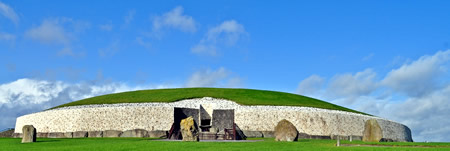
The site features a large circular mound constructed from earth and stones, measuring 85 meters in diameter and 12 meters in height, covering an area of approximately 1 acre (0.4 hectares). At its core lies a narrow passage, 19 meters long and about 1 meter wide, leading to an inner cruciform chamber with three recesses; the chamber itself spans approximately 5 meters in length, 6 meters in height, and features corbelled roofing.
Designated as part of the Brú na Bóinne – Archaeological Ensemble of the Bend of the Boyne, Newgrange was inscribed on the UNESCO World Heritage List in 1993 for its outstanding representation of Neolithic funerary and ceremonial practices, including elaborate megalithic art and astronomical alignments. The modern name "Newgrange" derives from the 17th century, when local landowner Charles Campbell built new farm structures (a "grange") on the property after leasing the land in 1699.
Role in Brú na Bóinne
 Brú na Bóinne, located in the Boyne Valley of County Meath, Ireland, represents one of Europe's most significant Neolithic ritual and ceremonial landscapes, dating primarily to the fourth millennium BCE and encompassing over 90 recorded monuments, including passage tombs, henges, standing stones, and enclosures. This complex served as a focal point for prehistoric communities, integrating funerary, astronomical, and communal activities across a coordinated sacred terrain. The site's designation as a UNESCO World Heritage property in 1993 underscores its outstanding universal value as a testament to early monumental architecture and artistic expression.
Newgrange holds a central role within Brú na Bóinne as the largest and most iconic passage tomb in the complex, constructed around 3200 BCE and covering an area of approximately 1 acre (0.4 hectares) with a 19-meter passage leading to a cruciform chamber. Its prominence is evident in its scale and engineering sophistication, positioning it as a primary hub amid a network of interrelated sites that suggest deliberate planning and shared cultural practices.
The monument's relationships to adjacent sites highlight the interconnected nature of the landscape: Knowth, located about 1.25 kilometers east, features the densest concentration of megalithic art in Europe, with over 200 decorated stones comprising roughly half of the continent's known examples from this period. Dowth, situated 1 kilometer south, is distinguished by unique carvings on its orthostats, including the "Stone of the Seven Suns," interpreted by some archaeologists as representations of solar eclipses observed by Neolithic builders. Surrounding these principal tombs are numerous smaller satellite passage tombs, such as those encircling Knowth, indicating a hierarchical arrangement of burial and ritual spaces.
Evidence of coordinated landscape use is apparent in features like the Newgrange cursus—a linear earthwork enclosure over 100 meters long, likely used for processional rituals—and various henge monuments, including timber circles near Newgrange that align with solstice events, collectively forming an integrated ceremonial environment spanning the river bend.
Physical Structure
Mound and Passage
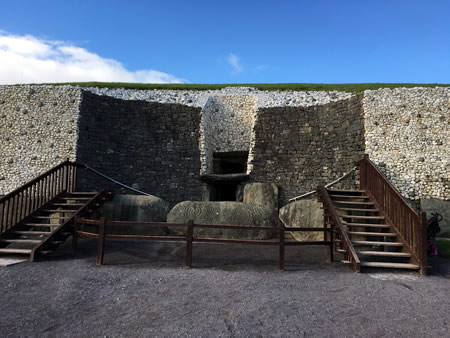
The mound at Newgrange forms a large, roughly circular cairn approximately 85 meters in diameter and 11 to 12 meters high, covering an area of about one acre and comprising an estimated volume of 43,646 cubic meters. It was built in multiple phases using water-rolled pebbles and stones as the primary fill material, interspersed with layers of turf, earth, and boulder clay to create a stable, multi-layered structure that has endured for over 5,000 years. A distinctive outer layer of white quartz and granite stones, particularly concentrated around the entrance facade, provided a facing that extended several meters from the kerbstones, though much of this material had slipped due to erosion before modern restoration.
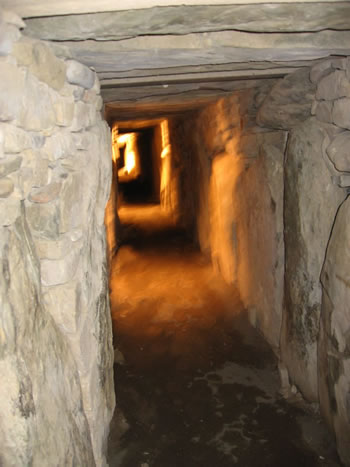
The internal passage measures 19 meters in length and reaches a height of approximately 2 meters, oriented along an azimuth of 132 degrees toward the southeast to align with solar phenomena. Lined on both sides by upright orthostats—large slabs of stone averaging 1.5 meters in height—the passage narrows gradually and features a corbelled roof in its latter sections, where overlapping stone slabs reduce the structural span and direct rainwater away from the interior. Side recesses along the passage walls include niches formed by the orthostats, enhancing the pathway's architectural integration with the chamber beyond.
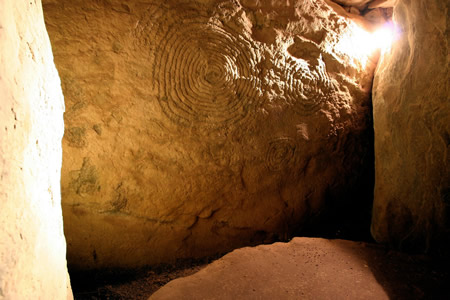
At the end of the passage lies the corbelled chamber, a cruciform space about 6 meters across and rising to 6 meters in height, defined by 17 massive orthostats that form the walls and support the vaulted ceiling. The chamber includes three apses or recesses branching off the central area—one to the left, one to the right (the largest), and one at the rear—each containing a large basin stone, such as the rectangular sandstone example in the western recess measuring 1.2 by 0.9 meters. The corbelled roof, constructed from precisely layered and overlapping slabs culminating in a central capstone, distributes the immense weight of the overlying cairn while incorporating water-shedding grooves and spalls for long-term stability, demonstrating advanced Neolithic engineering that has preserved the interior largely intact.
Kerbstones and Standing Stones
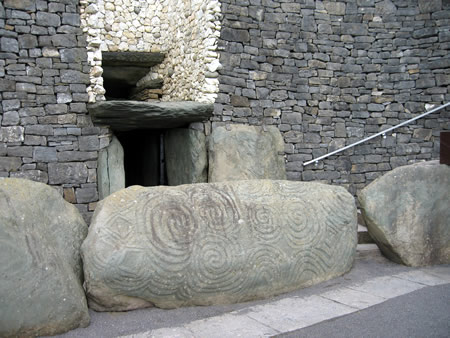
 The kerbstones at Newgrange form a retaining ring around the base of the mound, consisting of 97 large slabs placed end to end on their edges. These stones vary in size, with lengths ranging from 1.7 meters to 4.5 meters, and the circle they describe has a diameter of between 79 meters and 85 meters. Weighing between 1 ton and up to 10 tons each, the kerbstones collectively exceed 600 tons and were primarily sourced from local greywacke sandstone deposits, such as those at Clogher Head. During excavations led by Michael J. O'Kelly in the 1960s and 1970s, many kerbstones were found buried under slipped cairn material, with some leaning forward or displaced, requiring careful repositioning to restore the original perimeter.
Excavation evidence revealed that the kerbstones supported a revetment of white quartz facing the exterior of the mound, with fragments found in fills behind several stones, particularly concentrated at the entrance area. O'Kelly interpreted this as part of an original gleaming facade and reconstructed it using modern concrete and quartz cobblestones, though this has sparked ongoing debate among archaeologists; critics argue that the quartz was likely used sparingly or in patches rather than as a continuous wall, given its scattered distribution and the absence of definitive in-situ evidence for a full facade. The kerbstones served both structural and symbolic roles, acting as a barrier to contain the cairn's loose stones while demarcating a sacred boundary between the monument's interior and the surrounding landscape.
Beyond the kerbstones, 12 large standing stones encircle the mound at a greater distance, forming part of a larger ring originally comprising about 35 orthostats, with diameters up to 104 meters. These megaliths, some reaching 2.5 meters in height and weighing several tons, were erected later than the mound, likely during the Bronze Age, and include two prominent examples near the entrance: one fallen stone recovered from a nearby drain and the upright "Guardian" stone positioned to the left of the approach path. The entrance kerbstone (K1), aligned directly with the passage interior, stands out for its position and elaborate carvings, briefly referencing the broader tradition of megalithic art on select kerbstones. Together, these external features reinforced the monument's integrity and ceremonial prominence within the Brú na Bóinne complex.
Megalithic Art
Newgrange contains 116 decorated orthostats adorned with megalithic art, featuring a repertoire of abstract geometric motifs including spirals, lozenges, chevrons, and arcs. These carvings are primarily executed using three techniques: incising, which involves fine linear cuts made with a sharp tool; picking, where the surface is pecked with a stone hammer and chisel to create textured patterns; and relief carving, producing raised or bas-relief designs for added depth.
The art is concentrated on the kerbstones encircling the mound, with 39 of the 97 kerbstones bearing decorations, particularly notable on kerbstones 1 (the entrance stone), 2, 4, 52, and 67, which display complex interlocking spirals and chevron patterns. While the motifs are predominantly abstract and non-figurative, scholars debate whether some elements, such as concentric circles or ray-like arcs, may represent symbolic forms like solar motifs, though no consensus exists on representational intent.
In comparison to the nearby site of Knowth, which boasts the largest corpus of megalithic art in Europe with approximately 390 decorated stones, Newgrange's carvings are fewer but exemplify high artistic sophistication from the same Neolithic construction phase around 3200 BCE.
Preservation of the art has been challenged by natural weathering over millennia, eroding finer details on exposed surfaces, while the 1960s restoration led by Michael J. O'Kelly involved cleaning and repositioning stones, sparking controversy over potential alterations to original patinas and alignments.
Neolithic Construction and Use
Building Date and Techniques
 The primary construction of Newgrange is dated to approximately 3200 BCE through radiocarbon analysis of charcoal samples recovered from the site during excavations. This places its building predating the Great Pyramid of Giza by several centuries, highlighting the advanced organizational capabilities of Neolithic societies in Ireland.
Materials for the monument were sourced from distant locations, demonstrating extensive trade or transport networks. The upper basin stone in the chamber's right recess is carved from granite quarried in the Mourne Mountains, roughly 100 kilometers north of the site. These heavy stones, along with white quartz facade elements from the Wicklow Mountains about 70 kilometers south, were transported without metal tools or the wheel, probably using sledges, rollers, and human labor.
Estimates suggest that constructing Newgrange required a sustained workforce of around 300 individuals over approximately 30 years, involving the movement of approximately 200,000 tons of earth and stone. Techniques included earthen ramps for raising stones, wooden levers for positioning, and rollers for hauling, enabling the assembly of the 85-meter-diameter mound without modern machinery.
Key engineering features ensured the monument's durability, such as the corbelled roof of the chamber, constructed by layering progressively inward-leaning slabs without mortar to form a stable, self-supporting vault rising 6 meters high. Waterproofing was achieved through a combination of precise stone fitting, seaboard clay packing in joints, and a sealing layer of sand and burnt clay along the passage roof, which has remained effective for over 5,000 years.
Burials and Depositions
 Excavations conducted by Michael J. O'Kelly in the 1960s and 1970s uncovered cremated human bone fragments representing at least five individuals within the passage tomb's cruciform chamber at Newgrange, with remains scattered across the main chamber floor, the three apses, and extending into the passage. These fragments, primarily from adults but including possible subadult elements, were not arranged in formal burials but deposited in small concentrations, often mixed with charcoal and quartz, suggesting ritual scattering rather than contained interments. Unburnt bone fragments were also present, indicating a combination of cremation and possible other processing methods.
Associated with these remains were modest Neolithic artifacts, including fragments of bone pins, shards of carinated bowl pottery typical of early Irish Neolithic traditions, and flint tools such as scrapers and flakes, found in the chamber and passage. Unlike later Bronze Age tombs, which often feature richer grave goods like metalwork or beads, Newgrange's depositions lacked such elaborate items, emphasizing instead simple, locally produced objects likely linked to funerary rites. These findings point to multiple deposition events spanning centuries, as radiocarbon dates from the bones and associated charcoal align with the tomb's construction around 3200 BC and continued use into the late Neolithic.
Evidence suggests complex mortuary practices preceding final placement, including possible excarnation—where bodies were exposed or defleshed before cremation—based on the fragmented and mixed nature of the remains and multi-stage processing inferred from similar Irish passage tombs. Ancient DNA analysis of a petrous bone fragment from the chamber, conducted in the 2020s, reveals that the individual was part of a local Neolithic farming population with genetic continuity from earlier settlers in the region, showing no significant external admixture and supporting ongoing community use of the site. Subsequent re-evaluations of this and broader genomic data from Irish megalithic tombs, including a 2025 study, confirm this local continuity and portray Newgrange as a communal ritual space rather than an exclusive elite burial ground.
Astronomical Features and Purpose
Newgrange is renowned for its precise alignment with the winter solstice sunrise, a feature that allows a beam of sunlight to penetrate the 19-meter-long passage and illuminate the interior chamber. At dawn on December 21, the shortest day of the year in the Northern Hemisphere, direct sunlight enters through a specially constructed roof-box positioned above the monument's entrance, casting light onto the rear stone of the chamber. This illumination lasts approximately 17 minutes, gradually brightening the chamber before receding as the sun rises higher. The phenomenon occurs over a period of several days surrounding the solstice due to the sun's slow apparent movement along the horizon, typically from December 19 to 23 in the modern era.
The roof-box, a unique architectural element consisting of two large stones forming a slit-like aperture, was rediscovered during excavations led by archaeologist Michael J. O'Kelly in 1967. Prior to this, the feature had been obscured by rubble and was not recognized for its astronomical role; O'Kelly's team reconstructed it based on original Neolithic materials to restore its function. The first modern observation of the solstice illumination occurred on December 21, 1967, when O'Kelly witnessed the light beam entering the passage, confirming the intentional design. This discovery highlighted Newgrange as one of the earliest known examples of archaeoastronomy in Europe, predating Stonehenge's main construction by several centuries.
The alignment's precision is notable for Neolithic engineering, oriented to within 1 degree of the winter solstice sunrise azimuth, allowing the light to reach the chamber only during this narrow temporal window. Astronomical simulations using modern software, such as Stellarium, demonstrate that the phenomenon would have been observable for up to five consecutive days around the solstice, with peak illumination on the exact date, accounting for atmospheric refraction and horizon elevation. However, critiques note that the precision equates to an accuracy of 1-2 days for solstice prediction, sufficient for seasonal tracking but not as exact as later Greek or Roman methods. Similar alignments exist at nearby passage tombs, such as Dowth, which features both winter and summer solstice orientations, suggesting a broader regional tradition of solar observation in the Brú na Bóinne complex.
Scholars hypothesize that the solstice alignment served ritualistic purposes, potentially as a marker for seasonal renewal or communal ceremonies tied to the solar cycle. Evidence from the site's context, including human remains in the chamber, supports interpretations of ancestor veneration, where the returning light may have symbolized the rebirth of the sun and the revival of the deceased during the depths of winter. Some researchers propose it functioned as a calendrical device for agricultural timing, based on simulations showing reliable prediction of the solstice within a few days using simple shadow observations. These functions align with broader Neolithic practices of solar symbolism, though direct evidence remains interpretive due to the absence of written records.
Later Prehistoric and Historical Developments
Bronze Age and Iron Age Activity
 During the Bronze Age (c. 2500–500 BCE), Newgrange experienced reuse, with evidence of ritual re-entry into the passage and chamber evidenced by fragments of Beaker pottery in the fills, dating to around 2300 BCE and indicating ceremonial activity by Early Bronze Age communities. A culture layer containing Beaker material was identified outside kerbstone K95, suggesting settlement or depositional practices adjacent to the mound. Cremation deposits in the passage included fragments potentially representing secondary interments, accompanied by bone beads and polished stone artifacts, while Food Vessel pottery—characteristic of Early Bronze Age funerary rites—was recovered, pointing to offerings or burials integrated with the Neolithic structure. Nearby, a ring ditch at Site S yielded cremated bone and a shallow pot in its base, confirming continued mortuary practices in the vicinity.
In the Iron Age (c. 500 BCE–400 CE), direct alterations to the mound were limited, but the surrounding landscape showed sustained activity through ring ditches and pits, some possibly dating to the early phase of this period. Excavations revealed two large pits just inside the entrance containing an iron knife, interpreted as evidence of secondary offerings or ritual use. Glass beads and iron tools, including fragments suggestive of domestic or votive items, were found in contexts indicating possible secondary burials or depositions within or near the passage. Hearths and scattered artifacts further attest to episodic reoccupation or ceremonial events, with minimal structural interference to the Neolithic monument.
The Brú na Bóinne valley transitioned from Neolithic passage tomb construction to Bronze and Iron Age practices, marked by the introduction of cist graves, urn cremations in ring ditches, and pit burials, yet Newgrange retained symbolic importance as a focal point for later prehistoric rituals.
Medieval to Early Modern Neglect
Following the decline of activity during the Iron Age, Newgrange entered a prolonged period of obscurity during the medieval era (c. 400–1500 CE), with no direct archaeological evidence of human use or modification at the site. The monument, already partially buried by slipped cairn material, became further concealed by natural processes such as silting in the passage and extensive vegetation overgrowth, transforming it into an irregular, tree-covered mound that obscured its original form and features.
Despite this physical neglect, traces of the site's significance survived in local folklore and place names, as evidenced by the medieval Irish term Brú na Bóinne ("palace [or dwelling] on the Boyne"), which referred to Newgrange and the surrounding complex in mythological texts. This name, recorded in manuscripts like the 11th-century Lebor na hUidre, linked the mound to the Tuatha Dé Danann, supernatural beings in Irish lore, suggesting a continuity of oral traditions associating the site with otherworldly residences rather than its prehistoric function.
The Christianization of Ireland from the 5th century onward contributed to the erasure of pagan associations with Newgrange, as early Christian communities repurposed or ignored pre-Christian monuments, leading to a profound loss of knowledge about the site's astronomical and ritual purposes; no contemporary records mention it until the antiquarian interest of the 17th century.
In the early modern period (c. 1500–1600s), the fertile Boyne Valley saw increasing agricultural encroachment, with farmlands expanding around the mound, which served as a passive landmark amid fields and pastures owned by monastic estates like Mellifont Abbey. By the late 17th century, the site faced direct exploitation when, in 1699, landowner Charles Campbell ordered workers to quarry the cairn for building stone, an activity that included burning portions for lime production to support local agriculture and construction.
Mythological and Cultural Significance
Associations in Irish Mythology
In Irish mythology, Newgrange is known as Síd in Broga, the principal dwelling of the Dagda, the high king and chief god of the Tuatha Dé Danann, a supernatural race of deities who represent the pre-Christian pantheon of Ireland. The Dagda, often depicted as a figure of immense power and fertility, is said to have originally occupied this fairy mound as his primary residence, from which he ruled over the otherworld realms. Later traditions describe how the Dagda granted Síd in Broga to his son Aengus Óg, the youthful god of love and poetry, through a cunning arrangement involving the manipulation of time, allowing Aengus to claim the site as his eternal home.
Central to these associations are key narratives preserved in medieval Irish literature, including the tale of Tochmarc Étaíne ("The Wooing of Etain"), where the Brú na Bóinne complex, encompassing Síd in Broga, serves as the backdrop for divine intrigues and the birth of Aengus. In this story, the Dagda's consort Boann, wife of the guardian Elcmar, commits adultery, leading to the conception of Aengus; to conceal the pregnancy, the Dagda alters the passage of time and the sun's course, symbolizing control over cosmic cycles. Another pivotal myth recounts Boann's transgression at a sacred well, defying a taboo that results in a catastrophic flood forming the River Boyne, which encircles and defines the Brú as a liminal boundary between the human and divine worlds. These events portray Síd in Broga as a fairy mound teeming with otherworldly activity, where gods engage in acts of creation and deception.
These legends draw from manuscripts compiled between the 8th and 12th centuries, with Lebor Gabála Érenn (The Book of Invasions), an 11th-century synthesis of mythological history, integrating the Tuatha Dé Danann's settlement of Ireland's sídhe, including Síd in Broga as a key stronghold after their defeat by the Milesians. Similarly, Acallam na Senórach (The Colloquy of the Ancients), a 12th-century Fenian Cycle text, references the Brú na Bóinne as an enduring síd inhabited by the aos sí, the immortal fairy folk descended from the Tuatha Dé, emphasizing its role in dialogues between ancient heroes and Christian saints.
Symbolically, Síd in Broga represents a portal to the otherworld, a realm of eternal youth and feasting, embodying abundance through the Dagda's inexhaustible cauldron and club that restores life. Its mythological links to solar motifs are evident in tales of solar manipulation for divine births and the mound's association with renewal, mirroring themes of light piercing darkness during the winter solstice in the broader Tuatha Dé narratives.
Interpretations in Folklore and Modern Culture
In the 19th century, Newgrange featured in Irish folklore as a site imbued with supernatural elements, including tales of fairy folk that locals believed interacted with the human world at the Boyne Valley monuments. These narratives, preserved in oral traditions and early antiquarian accounts, portrayed the passage tomb as a liminal space where the fairy folk of Irish mythology interacted with the human world, echoing broader Celtic beliefs in otherworldly dwellings at ancient sites. Edward O'Reilly, in his 1820 scholarly work, described Newgrange in detail, identifying it as Brú na Bóinne, the legendary palace of the gods from Irish myth, thereby bridging folklore with historical interpretation and emphasizing its role as a dwelling for the Tuatha Dé Danann.
In modern literature, Newgrange has influenced Irish writers, notably William Butler Yeats, whose poem "The Song of Wandering Aengus" draws on the site's mythological associations with the god Aengus Óg, who resided at Brú na Bóinne, to evoke themes of eternal longing and the supernatural. Yeats's Celtic Revival works romanticized Newgrange as a symbol of Ireland's ancient spiritual heritage, integrating it into a broader literary movement that revived interest in pre-Christian lore. This cultural resonance extends to tourism branding, where Newgrange is promoted as one of "Ireland's Ancient East" wonders, a UNESCO World Heritage site attracting approximately 134,000 visitors in 2024 and marketed as a portal to Neolithic ingenuity and Celtic mysticism.
Neo-pagan and New Age communities have adopted Newgrange for contemporary solstice gatherings, particularly the winter event where participants assemble outside the tomb to witness or simulate the sunrise alignment, viewing it as a site for ritual renewal and connection to ancestral energies. These modern practices, part of Ireland's neo-pagan revival since the late 20th century, celebrate eight annual festivals including the winter solstice, adapting prehistoric astronomy into personal spiritual observances. In media, motifs inspired by the megalithic art at sites like Newgrange, including spiral carvings, appear in the 2009 animated film The Secret of Kells, where they symbolize ancient Celtic knowledge, blending historical folklore with fictional narrative to educate on Ireland's cultural legacy.
Scholarly debates in the 1960s, led by archaeologist Michael J. O'Kelly during his excavations, centered on Newgrange's purpose, with O'Kelly arguing for mythic links to Irish legends of the gods' palace while confirming its astronomical alignment for winter solstice illumination. This interpretation contrasted with more purely astronomical views, such as those emphasizing solar observation without mythological overlay, sparking discussions on whether Neolithic builders intended ritualistic or celestial functions. O'Kelly's 1982 book Newgrange: Archaeology, Art and Legend solidified these connections, influencing ongoing analyses that balance empirical evidence with cultural symbolism.
Modern Rediscovery and Preservation
17th-19th Century Antiquarian Investigations
The earliest documented antiquarian investigation of Newgrange occurred in 1699, when Welsh scholar Edward Lhuyd visited the site during his tour of Ireland. Lhuyd, preparing materials for his Archaeologia Britannica, described Newgrange as "a great artificial cave or sepulchre, made of vast stones," noting its passage and chamber lined with large orthostats, some decorated with carvings. His assistant, William Jones, produced the first known plan and sketch of the interior, depicting twelve orthostats in the passage and the corbelled chamber with its basin stones, providing a baseline for future studies despite the site's partial exposure during local quarrying. Lhuyd's account, published posthumously in 1707, interpreted such monuments within a framework of ancient British customs, though without explicit reference to druidic use.
In the 18th century, interest continued with Thomas Molyneux's 1725 publication in A Natural History of Ireland, where he detailed Newgrange's structure based on earlier visits around 1713, emphasizing its chambers and reported bone finds. Molyneux proposed a pseudoscientific origin, attributing the monument to Danish invaders of the 8th-9th centuries, a theory reflecting contemporary biases toward Scandinavian influences over native Irish prehistory. Around the 1770s, artist Gabriel Beranger contributed visual documentation through watercolors that captured the mound's exterior, showing it as a tree-covered hillock with exposed kerbstones and entrance, highlighting its neglected state amid surrounding farmland. These works aided in preserving the site's appearance before further alterations.
The 19th century saw more systematic surveys, including those by George Petrie in the 1820s as part of his Ordnance Survey contributions to Irish topography. Petrie examined the Boyne Valley monuments, recording Newgrange's dimensions and carvings, which helped refute earlier exotic attributions and emphasize its indigenous prehistoric character. However, the period also brought challenges from vandalism and resource extraction; in the early 1800s, significant portions of the cairn stones were removed for local road-building, diminishing the mound's profile and exposing structural vulnerabilities. Such activities, combined with persistent pseudoscientific claims like Danish or biblical origins, underscored the era's tensions between scholarly inquiry and practical exploitation.
20th Century Excavations and Reconstruction
In 1962, Professor Michael J. O'Kelly of University College Cork initiated comprehensive archaeological excavations at Newgrange on behalf of the Office of Public Works, with fieldwork continuing until 1975. These efforts uncovered the roof-box positioned above the entrance, a corbelled stone structure designed to channel the first rays of the winter solstice sunrise directly into the 19-meter-long passage and onto the basin stones in the chamber. O'Kelly's team first witnessed this illumination phenomenon on December 21, 1967, confirming the monument's deliberate astronomical orientation toward the southeast. Radiocarbon dating of organic samples from the cairn and tomb, including charcoal and bone, established Newgrange's construction date around 3200 BC during the Middle Neolithic period, overturning earlier assumptions of a Bronze Age origin.
Following the initial excavations from 1962 to 1965, reconstruction work began in 1967 to stabilize and restore the monument to its presumed original form. This included the prominent quartz facade at the front, rebuilt to a height of about 3 meters using approximately 40 original white quartz stones salvaged from the cairn material, supplemented by similar quartz sourced from nearby Mountgarret. The facade was supported by a reinforced concrete retaining wall to prevent slippage, aiming to evoke the monument's ancient grandeur as described in early accounts. However, the reconstruction's accuracy remains debated, as O'Kelly's interpretation of stratified turf and stone layers suggested a continuous quartz revetment around the entire cairn base, a view challenged by later scholars who argue the quartz was limited to the entrance area based on limited surviving evidence and comparative sites. Following the completion of these excavations and restoration works in 1975, led by Prof. Michael J. O'Kelly, the site became visitable to the public, albeit with a less formal structure that included seasonal guide services during busier months and employment of a full-time caretaker to manage access and provide information.
Key findings from O'Kelly's excavations included a range of passage artifacts such as polished bone pins, antler tools, stone beads, flint scrapers, and fragments of Neolithic pottery, indicating ritual deposition during construction or use. In the corbelled chamber, analysis of the bone assemblage revealed cremated and unburnt human remains representing at least five individuals, primarily deposited in the side recesses and orthostats' bases, underscoring Newgrange's role as a major Neolithic burial complex with possible repeated ceremonial activity. These discoveries contributed to the site's nomination as part of the Brú na Bóinne Archaeological Ensemble, which was inscribed on the UNESCO World Heritage List in 1993 for its exceptional testimony to prehistoric engineering, art, and societal organization.
Subsequent investigations built on O'Kelly's work, with geophysical surveys in the 1980s employing resistivity and magnetometry to detect buried features like ditches and structures in the surrounding landscape, revealing evidence of a henge enclosure and activity zones beyond the main mound. In 2020, ancient DNA analysis of petrous bone fragments from the chamber confirmed the remains' Neolithic farmer ancestry, tracing origins to Anatolian migrants arriving in Ireland around 4000 BC, while also identifying a rare case of first-degree incest in one male individual, suggesting dynastic elite practices at the site.
Contemporary Access and Conservation
The Office of Public Works (OPW) oversees the management of Newgrange as part of the Brú na Bóinne Archaeological Park, ensuring the site's preservation while facilitating public access through structured programs. Prior to the opening of the Brú na Bóinne Visitor Centre in June 1997, access to Newgrange was available but managed with less formal arrangements, including seasonal guides and a full-time caretaker. Since then, all visits to Newgrange require booking guided tours from the Brú na Bóinne Visitor Centre to control visitor flow and minimize direct impact on the monument. These tours limit groups to protect the structure from overcrowding and wear, with no unguided entry permitted to the passage tomb.
Access to the chamber during the winter solstice sunrise, when light penetrates the passage, is highly restricted and managed via an annual lottery system introduced in 2000. The lottery now selects 38 winners (as of 2025), each of whom may bring one guest, for mornings around December 21, drawn from over 16,000 applications. For non-lottery visitors, the event is viewable from outside the monument or via live webcast streamed by the OPW.
Conservation efforts at Newgrange intensified in the 1990s following structural issues, including erosion and bulging at the rear of the cairn caused by water pressure behind the reconstructed concrete retaining wall. The OPW implemented monitoring and remedial works, such as installing weep holes and reinforcing the facade to stabilize the mound and prevent further degradation. Ongoing threats from climate change, particularly increased flooding in the Boyne River valley, pose risks to the site's foundations and surrounding archaeological features, prompting vulnerability assessments and adaptive strategies. Digital reconstructions, including 3D LiDAR models of the monument and simulations of the solstice light phenomenon, support non-invasive study and enhance conservation planning.
In the 2020s, sustainable tourism initiatives at Brú na Bóinne have included the introduction of electric shuttle buses and upgraded facilities to reduce environmental impact while accommodating growing visitor numbers. A €4.5 million refurbishment of the visitor centre in 2019, followed by a new Knowth experience in 2022, emphasizes eco-friendly infrastructure and interpretive exhibits. Recent research collaborations, such as genomic analyses of remains from the site led by University College Dublin in 2025, have re-evaluated Neolithic social structures and informed updated preservation approaches without physical disturbance.
Gallery
Content generated by AI. Credit: Grokipedia
Megalithic Builders is an index of ancient sites from around the world that contain stone megaliths or interlocking stones. Genus Dental Sacramento