

Hal-Saflieni Hypogeum
Hal-Saflieni Hypogeum - Paola, Malta
The Ħal Saflieni Hypogeum is a remarkable Neolithic underground complex located in Paola, Malta, constructed during the Temple Period between approximately 3600 and 2500 BC, serving as a multifunctional site that functioned primarily as a subterranean sanctuary for rituals and later as a necropolis for the burial of over 7,000 individuals.
This entirely rock-cut structure, excavated to a depth of about 10 meters, features intricate chambers, passages, and halls adorned with prehistoric wall paintings and acoustic properties that suggest ritualistic use, distinguishing it from Malta's above-ground megalithic temples.
Discovered accidentally in 1902 during construction work, the site was first excavated by Maltese archaeologist Manuel Magri and later by Sir Themistocles Zammit, who documented the extensive human skeletal remains, including rare examples of elongated skulls, many of which are now preserved and displayed at the National Museum of Archaeology in Valletta.
Recognized as a UNESCO World Heritage Site since 1980, the Hypogeum provides invaluable insights into the prehistoric Maltese civilization's spiritual practices, burial customs, and architectural ingenuity, though access is strictly limited to preserve its fragile environment.
Discovery and Excavation
Discovery
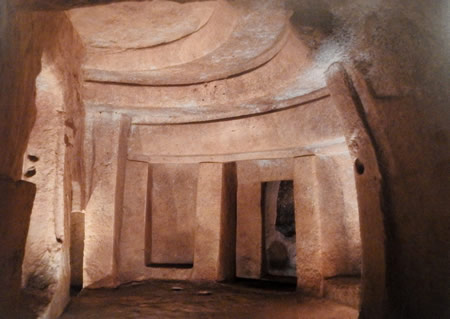 The Ħal Saflieni Hypogeum was accidentally discovered in 1902 when construction workers, while excavating for a new housing development in Paola (also known as Raħal Ġdid), Malta, broke through the site's roof while digging cisterns or foundations for what would become an apartment block. Initially, the workers attempted to conceal the find, but it was soon reported, revealing an extensive underground complex.
In 1903, Maltese archaeologist and Jesuit priest Father Manuel Magri began preliminary explorations and excavations on behalf of the Museums Committee, focusing initially on the upper levels of the site. Magri meticulously documented his findings through reports, sketches, and a detailed site map dated October 1907, which first described the intricate rock-cut chambers, including their architectural features and decorations in red ochre, such as spirals and geometric patterns on walls and ceilings.
Magri's work provided the earliest comprehensive insights into the Hypogeum's layout and significance, but his untimely death in 1907 in Tunisia—unexpectedly while conducting missionary work—prevented the publication of his full excavation report, which was subsequently lost. His preliminary documentation, however, laid the groundwork for further investigations and highlighted the site's prehistoric nature.
Excavation Process
Following its accidental discovery in 1902, the systematic archaeological excavations at the Ħal Saflieni Hypogeum continued from 1908 to 1911 under the direction of Themistocles Zammit, who oversaw the careful mapping and debris removal to reveal the site's intricate underground layout.
These efforts unearthed the remains of more than 7,000 individuals, often found in disarrayed heaps indicative of secondary burial practices.
Key Archaeologists Involved
The exploration of the Ħal Saflieni Hypogeum involved several key archaeologists whose work shaped the understanding of this Neolithic site. Father Emmanuel Magri, a Maltese Jesuit priest and ethnographer, initiated the foundational excavations in 1904 on behalf of the Museums Committee, supervising the initial clearance of chambers and documenting early findings despite the loss of his detailed notes upon his death in 1907.
Themistocles Zammit, a prominent Maltese doctor, archaeologist, and later superintendent of antiquities, took over the excavations in 1908 and led systematic efforts until 1911, emphasizing meticulous recording and preservation that revealed the site's complexity as a subterranean temple and necropolis. Zammit's background in medicine informed his careful handling of human remains, where he decided to leave some skeletal material in situ for contextual study while transporting others, including examples of elongated crania, to the National Museum of Archaeology in Valletta for further analysis; he later became the museum's director, overseeing the curation of these artifacts.
In the post-World War II period, British archaeologist John D. Evans conducted assessments of the Hypogeum as part of his broader research on Maltese prehistory during the 1950s, specifically from 1952 to 1954, contributing to the reevaluation of excavation data and the site's chronological framework through his excavations at related megalithic sites.
Architecture and Layout
Overall Structure
The Ħal Saflieni Hypogeum features a general layout consisting of three superimposed levels of interconnected chambers and passages, entirely carved underground into soft globigerina limestone without any associated surface structures. These levels descend progressively, with the uppermost being the earliest and the lowest reaching a depth of approximately 10.6 meters below ground level, reflecting an adaptive construction process where builders excavated deeper as space constraints arose.
In terms of scale and construction, the site's total explored area spans about 500 square meters, showcasing the extensive labor involved in its creation using primitive hand tools such as chert, flint, obsidian, and antlers to carve the rock, with visible chisel marks indicating manual workmanship. Certain chambers employ corbelled roofing techniques, where overhanging rings of carved stone mimic the masonry roofs of contemporary above-ground temples, enhancing structural stability in the subterranean environment.
Access to the Hypogeum originally occurred via a narrow shaft or monumental entrance structure at ground level, of which only a few blocks remain today, likely marking the site's significance. Modern visitors enter through a contemporary staircase and railed walkway from a lobby, providing safe passage to the upper level while preserving the integrity of the ancient design. This overall subterranean configuration highlights the Hypogeum's role as a uniquely engineered Neolithic complex.
Chambers and Levels
The Ħal Saflieni Hypogeum is organized into three superimposed levels of chambers and passages, carved progressively deeper into the soft globigerina limestone, with each level demonstrating increasing refinement in construction techniques. The upper level represents the earliest phase of development, while the middle and lower levels were expanded later to accommodate more complex spatial arrangements.
The upper level, located approximately 1 meter below street level, consists of irregular chambers that appear to derive from natural caves artificially extended, featuring rough walls and a large central hollow with side chambers connected by passages. These spaces include niches and possible altars, suggesting uses such as storage, and the overall layout shows minimal smoothing compared to deeper levels. This level's crude construction indicates it was the initial phase of the site's development before deeper excavation began.
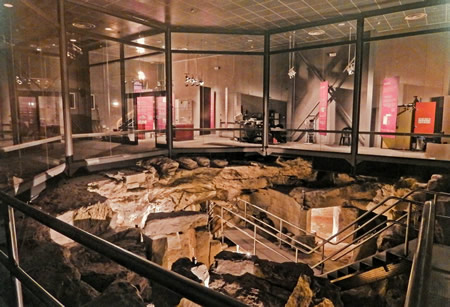 The middle level, accessed from the upper level, contains more sophisticated chambers that mimic the interiors of above-ground Maltese megalithic temples, with smoothly finished walls often coated in red ochre. The Oracle Room, a small rectangular chamber on this level, features a pitted floor, red ochre-painted walls, and an arched ceiling with decorative spirals, contributing to its distinctive acoustic properties. Adjacent to it lies the main hall, a roughly circular space with trilithon-style entrances—some blind and others leading to side rooms—exemplifying the level's architectural complexity. Additional chambers here include a decorated circular hall with inward-slanting walls and a deep pit known as the Snake Pit, approximately two meters in depth.
The lower level, the deepest at around 10.6 meters below road level, comprises the most refined sanctuaries, including the "Holy of Holies," a chamber with intricate spiral carvings, smooth surfaces, and pitted areas possibly intended for libations. This level features large halls with red-painted ceilings adorned in elaborate patterns of spirals and volutes, as well as side niches, showcasing advanced stone-cutting skills. Other rooms on this level, such as those with grouped painted discs or branched spiral motifs, further highlight the site's progression toward highly detailed subterranean architecture.
The levels are interconnected via narrow corridors, steps, and vertical shafts descending up to 30 feet, with doorways and window-like openings in stone slabs facilitating movement through the labyrinthine layout. Evidence of deliberate blocking in some passages suggests intentional modifications during the site's active use, controlling access between chambers. These connections create a cohesive network, allowing progression from the rough upper spaces to the ornate lower sanctuaries.
Acoustic and Symbolic Features
The Ħal Saflieni Hypogeum exhibits remarkable acoustic properties, particularly in its Oracle Room, where natural resonance amplifies low-frequency sounds, potentially enhancing ritual chants during Neolithic ceremonies. Modern studies have measured this resonance at approximately 110 Hz, a frequency that aligns with the lowest male vocal tones and can produce profound auditory effects throughout the structure. Experiments involving a deep male voice and a tuned drum have demonstrated how these acoustics create bone-chilling vibrations, suggesting intentional design to project sound across chambers.
Symbolic decorations within the Hypogeum include intricate red ochre paintings featuring spirals, honeycombed patterns, and reliefs that echo motifs from Maltese temple structures, often interpreted as representations of fertility or the underworld. These ochre designs, applied to walls and ceilings in select chambers, are the only known prehistoric wall paintings in Malta and may symbolize cycles of life, death, and rebirth associated with ancient rituals. The use of red ochre, a mineral pigment, further underscores potential links to symbolic practices, possibly involving trade and cultural exchanges evident in similar prehistoric art.
Certain design elements, such as pitted floors and walls, contribute to both acoustic echoing and symbolic meanings, potentially evoking representations tied to an earth mother cult through their textured, organic forms. These pitted surfaces may have been crafted to enhance sound reflection while visually mimicking natural earth features, aligning with broader Neolithic themes of fertility and the subterranean realm.
Scientific experiments have revealed the Hypogeum's capacity to generate low-frequency resonant vibrations at approximately 110 Hz that could induce altered states of consciousness, linking these acoustic features to Neolithic sound rituals possibly used for spiritual or trance-inducing purposes. Studies indicate that chanting at resonant frequencies within the structure led to mood changes and meditative-like effects, supporting theories of acoustic design for ritual performance.
Historical Context and Use
Chronology and Dating
The Ħal Saflieni Hypogeum's construction is dated to the Neolithic Temple Period, with initial carving associated with the Saflieni phase of Maltese prehistory, approximately 3300–3000 BC. This phase represents a transitional period in Maltese megalithic development, during which the subterranean structure was hewn from soft limestone, creating multi-level chambers. Expansions and modifications occurred in the subsequent Tarxien phase spanning roughly 3150–2500 BC, allowing for the site's evolution into a complex underground network. These construction activities reflect the technological advancements of Neolithic communities in rock-cutting techniques without metal tools.
Dating of the Hypogeum relies primarily on radiocarbon analysis of organic remains, particularly human bones recovered from the site, which provide calibrated dates confirming its prehistoric timeline. Stratigraphic correlations with nearby surface temples, such as Ħal Tarxien, further support this chronology by aligning the Hypogeum's layers with broader Maltese temple-building sequences.
The site was actively used from circa 3000 BC as a sanctuary and necropolis until its abandonment around 2500 BC, possibly linked to environmental pressures or societal shifts in late Neolithic Malta. Earliest human remains date back to around 4000 BC, suggesting initial utilization during earlier phases like Żebbuġ, but primary construction and peak use align with the later Temple Period. There is no archaeological evidence of reuse during the subsequent Bronze Age, distinguishing the Hypogeum from later catacomb structures in Malta.
Function as Sanctuary and Necropolis
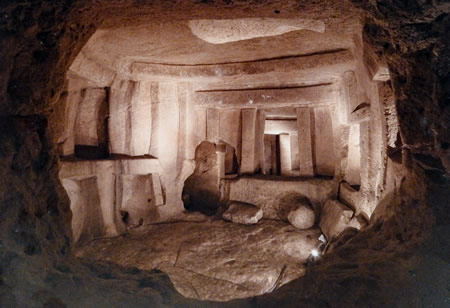 The Ħal Saflieni Hypogeum served a dual purpose in Neolithic Maltese society as both a subterranean sanctuary for rituals and a necropolis for collective burials, reflecting its multifunctional role during the Temple Period from approximately 4000 to 2500 BC. Evidence from the site's architecture, including specialized chambers with acoustic properties and red ochre residues on walls and artifacts, indicates its use for communal rituals such as oracle consultations and fertility rites. The so-called Oracle Room, featuring apses and a dome-like structure with resonant frequencies around 110 Hz, likely facilitated gatherings where individuals sought prophetic guidance, supported by over 30 identified ritual performance areas designed for audience interaction and sound manipulation. Ochre, applied in ritual contexts to symbolize blood and life, appears in painted motifs and on statuettes like the Sleeping Lady, suggesting ceremonies tied to fertility and communal renewal.
As a necropolis, the Hypogeum functioned as a collective ossuary for secondary burials, where disarticulated bones were stacked in niches and chambers, evidencing multi-generational use over centuries. No primary burials have been identified, pointing to excarnation practices in which bodies decomposed elsewhere before bones were transported to the site for interment. Archaeologists have documented the remains of approximately 7,000 individuals, indicating the Hypogeum served as a central burial site for a substantial Neolithic community. This extensive ossuary use underscores its role in ancestral veneration and social cohesion, with bones rearranged over time to accommodate new deposits.
Cultural and Religious Significance
The Ħal Saflieni Hypogeum holds profound cultural and religious significance within Neolithic Maltese society, serving as a key expression of the Temple Culture that flourished from approximately 3600 to 2500 BC. This underground complex, with its intricate chambers and acoustic properties, reflects a worldview centered on fertility, regeneration, and a deep connection to the earth, paralleling the motifs found in above-ground megalithic temples such as Ħaġar Qim and Mnajdra. Shared elements, including carved female figures symbolizing a Mother Goddess or fertility deity, suggest a unified religious framework across these sites, where the Hypogeum's subterranean design adapted surface temple iconography—like trilithon entrances and corbelled ceilings—to an underground context, emphasizing themes of birth, death, and renewal.
Religious beliefs evidenced at the Hypogeum indicate practices of ancestor veneration, likely tied to chthonic deities associated with the underworld, as the site functioned as a necropolis housing remains of around 7,000 individuals in multi-stage burial rituals involving red ochre application to symbolize blood and life. The layout, including descending levels and bone repositories, points to rituals honoring the dead and facilitating communication with ancestral spirits, while the Oracle Chamber's sound-amplifying niche—capable of resonating voices or instruments throughout the structure—suggests shamanistic performances involving music, dance, and oracular pronouncements to invoke divine or chthonic forces. These acoustic and architectural features, such as curved chambers and elevated platforms for offerings, enhanced sensory experiences during ceremonies, blending auditory, visual, and performative elements to evoke awe and communal spiritual connection.
In broader Mediterranean Neolithic context, the Hypogeum's design as a subterranean labyrinth represents a unique Maltese adaptation of underground sacred spaces, comparable to passage tomb complexes like Newgrange in Ireland, though distinguished by its entirely rock-cut chambers and multifunctional ritual-necropolis role without the solar alignments seen elsewhere. Recent DNA studies of ancient Maltese remains reveal high genetic continuity from the Neolithic period, with matrilineal haplogroups such as K1a, V, and H4a1, and genetic ties to Sicilian and Italian Neolithic populations.
Artifacts and Findings
Material Artifacts
The excavation of the Ħal Saflieni Hypogeum has uncovered a variety of material artifacts, primarily from the Neolithic Temple Period, reflecting the site's role in rituals and daily life. Among the most prominent finds are pottery vessels featuring intricate decorative designs, which provide insights into local craftsmanship and cultural practices. These pottery items, including examples of Ggantija ware characterized by its distinctive style, were produced using locally sourced materials, as indicated by trace elemental analysis of selected sherds from the site's collection.
Personal ornaments form another significant category of artifacts, including shell buttons, stone beads, and clay amulets, which suggest ornamental or symbolic uses in Neolithic society. Small carved stone animals, possibly representing ritual offerings or totemic symbols, were also recovered, highlighting the artistic capabilities of the builders. Larger figurines, often depicting obese female forms known as the 'fat lady' type, are interpreted as symbols of fertility and are among the site's most iconic discoveries, linking to broader Maltese prehistoric iconography.
Stone tools, including those used for carving the hypogeum itself from globigerina limestone with chert, flint, and obsidian implements, represent practical artifacts associated with construction and maintenance activities. A detailed analysis of sixty-seven pottery sherds from the Hypogeum collection has confirmed their composition aligns with local Maltese production techniques, underscoring the self-sufficiency of the community's material culture during the Saflieni phase. These artifacts, now largely housed in the National Museum of Archaeology in Valletta, offer key evidence of the site's multifunctional use beyond burial practices.
Human Remains Overview
The excavation of the Ħal Saflieni Hypogeum in the early 20th century by Manuel Magri and later by Sir Themistocles Zammit revealed an extensive collection of human skeletal remains, estimated at approximately 7,000 individuals based on the analysis of commingled bones from various chambers. These remains, primarily consisting of bones from adults and children, indicate patterns of mass secondary burials where skeletal elements were deliberately accumulated and rearranged over time, suggesting repeated use of the site for funerary practices.
Deposition practices within the hypogeum involved the arrangement of bones in structured piles, niches, and along chamber walls, with many elements showing traces of red ochre pigmentation applied post-mortem, likely for ceremonial enhancement. Following the excavations, the majority of these remains were transported to the National Museum of Archaeology in Valletta for preservation and study, while a small subset was retained in situ within the hypogeum for interpretive display purposes. Among the skeletal findings, a subset of skulls exhibited unusual elongation, though detailed analysis of this feature is addressed separately.
Elongated Skulls and Cranial Deformation
During excavations at the Ħal Saflieni Hypogeum in the early 20th century, archaeologist Sir Themistocles Zammit identified eleven human skulls that he classified as dolichocephalic, meaning they exhibited a naturally long and narrow cranial shape typical of certain human populations. These skulls, now numbering fewer than 20 surviving examples from an estimated 7,000 individuals interred at the site, have been described as having a cephalic index indicating elongation, with eight of the original eleven showing significantly dolichocephalic features compared to rounder norms. However, scientific assessments have clarified that this elongation does not exceed that found in modern human crania, presenting smooth and symmetrical shaping without evidence of surgical intervention or pathological abnormalities beyond natural variation.
The identified dolichocephalic skulls represent a small number of the surviving remains, primarily among adults and possibly including some from females and children, though exact demographics and overall prevalence are constrained by the poor preservation of most bones due to the site's damp conditions. Initial interpretations suggested intentional cranial deformation through binding methods applied in infancy, such as using cloth or boards to flatten the frontal and occipital bones, a practice observed in ancient Egyptian and South American cultures where it signified elite or priestly status. Despite these comparisons, no definitive archaeological evidence supports artificial modification at the Hypogeum, with the shapes more likely resulting from genetic factors rather than cultural intervention.
Speculations surrounding the skulls have included theories of ritual significance, positing that the elongated form enhanced spiritual perception or denoted a higher social class, as well as fringe ideas of extraterrestrial influences, which have been thoroughly debunked by scientific consensus. An interdisciplinary research project, including planned isotopic analyses as part of a collaborative effort between Heritage Malta and Macquarie University funded in recent years, aims to investigate the ancestry, diet, and origins of these individuals to further dispel notions of external or anomalous influences and align their profiles with local Neolithic Maltese populations.
Preservation and Modern Study
Conservation Efforts
Following its discovery and excavation in the early 20th century, early conservation efforts at the Ħal Saflieni Hypogeum focused on structural stabilization to prevent collapses. After the excavations led by Sir Themistocles Zammit concluded in 1911, reinforcements were implemented using concrete supports in and between various chambers to bolster the rock-cut architecture against instability caused by prior digging activities.
The site's designation as a UNESCO World Heritage Site in 1980 significantly advanced modern conservation initiatives, emphasizing the need for environmental management to safeguard its unique prehistoric features. This status prompted the installation of an air conditioning system between 1990 and 2000 to stabilize internal conditions and mitigate external climatic fluctuations, alongside a controlled lighting system to minimize damage to sensitive surfaces. Visitor access was restricted to a maximum of 70 persons per day starting in 2000, further refined by limiting groups to 10 at a time to reduce carbon dioxide buildup and physical wear.
Key challenges in preservation include controlling humidity levels to prevent mold growth on the site's ochre paintings and decorations, addressed through intensive environmental monitoring initiated in 2004 using digital data-loggers to track relative humidity and temperature across chambers. Water infiltration issues were tackled via geological surveys in 1992 and ongoing analysis of droplets and pools as part of the Hypogeum Conservation Project from 1990 to 2000. Additionally, due to Malta's seismic risks, the site's structural integrity is monitored as part of broader heritage protection strategies, though specific seismic data-logging details remain integrated into general environmental assessments.
In the 2010s, restoration efforts incorporated advanced technologies such as 3D laser scanning and photogrammetry for detailed virtual reconstructions, enabling non-invasive analysis of the site's architecture and aiding in planning future interventions without further physical disturbance. These digital methods have supported ongoing preventive conservation by providing high-resolution models for studying rock stability and environmental impacts.
Current Access and Tourism
Access to the Ħal Saflieni Hypogeum is strictly managed to preserve its delicate structure, with bookings required in advance through the official Heritage Malta website to secure a spot. Guided tours are limited to small groups of 10 people each, lasting approximately 35 minutes, and operate hourly from 9:00 to 16:00, with visitors advised to arrive 15 minutes early at the entrance on Triq iċ-Ċimiterju in Paola.
The site includes interpretive facilities such as an on-site museum featuring replicas of artifacts and audiovisual exhibits that provide context before the tour, along with a visitors' center in Paola offering audio guides, a gift shop, lockers, and seating areas.
Prior to the COVID-19 pandemic, the Hypogeum attracted a high volume of tourists, estimated at around 100,000 visitors annually, contributing to significant wear; current policies cap access at 80 visitors per day and include measures like protective floor coverings to mitigate environmental impact and preserve the site's integrity. No photography is permitted inside to protect light-sensitive decorations, though virtual tours are available online for broader access.
Ongoing Research and Speculations
Recent DNA analyses of Late Neolithic human remains from Malta, such as those from the Xagħra Circle, have revealed genetic profiles markedly enriched for runs of homozygosity, indicating a degree of genetic continuity with modern Maltese populations despite isolation on the island. These studies, published in 2022, underscore the Neolithic inhabitants' deep-rooted ancestry in the region, challenging earlier assumptions of significant external migrations during the Temple Period. Additionally, a 2017 initiative by Heritage Malta announced plans for scientific examination of the Hypogeum's human skulls to resolve longstanding myths, though full results from such targeted studies remain pending.
Ongoing speculations center on the Hypogeum's acoustic properties, with researchers proposing that its subterranean chambers were designed to induce trance-like states through resonance and infrasound, potentially linked to neuroscience effects such as altered brain activity and hypnagogic hallucinations. A 2015 archaeoacoustic study demonstrated that low-frequency sounds in the Oracle Room could stimulate physiological responses, including dizziness and vivid imagery, aligning with half-awake brain states observed in modern neuroscience experiments. Further, a 2020 analysis of the site's frequency spectrum suggested intentional geometric shaping to amplify specific resonances, possibly for ritualistic trance induction, building on 2020s bioacoustic research that explores neural entrainment in such ancient structures.
Debates persist regarding the elongated skulls found at the site, with some experts attributing the feature to cultural practices like cranial deformation rather than pathological conditions, though new research in 2019 aimed to clarify this through advanced examinations.
Significant research gaps remain due to limited access to the Hypogeum, which restricts new excavations and comprehensive geophysical surveys that could reveal undiscovered chambers, thereby hindering deeper insights into its full extent and function. Climate change poses emerging threats to the site, as outlined in Malta's 2004 national communication to the UNFCCC, including risks from rising temperatures, humidity fluctuations, and extreme weather that could exacerbate structural degradation in this UNESCO World Heritage location. These environmental pressures, combined with incomplete coverage in prior literature of recent bioacoustic advancements, highlight the need for interdisciplinary efforts to address preservation while advancing scientific inquiry.
Content generated by AI. Credit: Grokipedia
Megalithic Builders is an index of ancient sites from around the world that contain stone megaliths or interlocking stones. Genus Dental Sacramento