

Skorba Temple Complex
Skorba Temple Complex - Zebbiegh, Malta
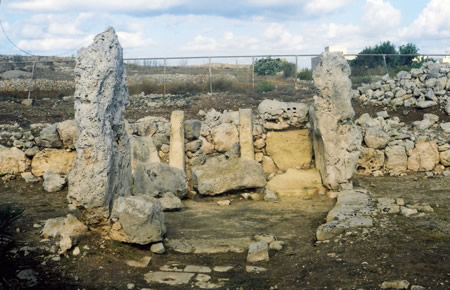
The Skorba Temples are a prehistoric archaeological site located on the outskirts of Mġarr in northern Malta, consisting of two megalithic temple structures dating to the Neolithic Ġgantija phase around 3600 BC, along with earlier domestic huts from the Red Skorba phase circa 4400–4100 BC. These temples feature characteristic Maltese megalithic architecture, including upright orthostat slabs, corbelled roofs, and symmetrically arranged semi-circular apses, representing some of the world's earliest free-standing stone buildings. Designated as a UNESCO World Heritage Site in 1992 as part of the Megalithic Temples of Malta, Skorba provides crucial evidence of an organized prehistoric society with ritual and domestic functions, spanning multiple cultural phases from the pre-Temple Period to the Tarxien phase around 2500 BC.
The site was first recognized in 1914 by archaeologist Sir Themistocles Zammit and local resident Carmelo Rizzo, who identified a menhir-like structure amid agricultural fields overlooking a valley. Systematic excavations began in May 1960 under British archaeologist David H. Trump, with fieldwork continuing through 1963 on behalf of the National Museum of Malta, uncovering the temple complex alongside evidence of Neolithic settlement patterns. Key findings include female clay figurines symbolizing fertility cults, a distinctive Red Skorba ware ladle, and decorated stone panels with bas-relief motifs such as spirals, plants, and animals, many of which are housed at the National Museum of Archaeology in Valletta. These artifacts and structures illuminate the evolution of Maltese prehistory across phases like Għar Dalam, Grey Skorba, and the temple-building eras, highlighting technological advancements in stone masonry and societal organization.
Skorba's significance lies in its role as a bridge between domestic life and monumental ritual architecture, offering insights into the Neolithic transition in the central Mediterranean without the influence of external civilizations. The site's preservation of multiple construction phases demonstrates the continuity and innovation in temple-building traditions, from simple huts to complex ceremonial spaces, underscoring Malta's unique contribution to global prehistory. Ongoing research, including surveys and ceramic analysis from projects like the Maltese Temples Landscape Project in 2010, continues to refine understandings of its environmental context and cultural connections.
Location and Context
Geographical Setting
The Skorba Temples are situated in the hamlet of Żebbiegħ, on the outskirts of Mġarr in northern Malta, at coordinates 35°55′14.84″N 14°22′39.58″E. This rural location places the site within the Northern Region of Malta, part of the central Mediterranean archipelago characterized by its limestone geology and island geography.
The site occupies a low hill rising to approximately 113 meters above sea level, offering panoramic views over surrounding valleys to the north and south that historically supported arable land suitable for early agriculture. It lies about 1 kilometer from the nearby Ta' Ħaġrat Temples and close to the village of Mġarr, with its harbor and adjacent airfield contributing to the modern semi-rural setting. During the Neolithic period, the local environment featured a relatively dry climate transitioning to increased moisture around 6700–4900 cal BP, fostering open landscapes that evolved into dense Pistacia scrubland, which likely influenced settlement by providing accessible resources and defensible elevated positions. The soils in the area consist of young, immature raw types with low humic content overlying limestone bedrock, including moist and acidic variants in lower zones that supported limited vegetation and early human adaptation through landscape modification.
Today, the site is managed by Heritage Malta as a public heritage attraction, with dedicated pathways for visitor access and interpretive signage explaining the prehistoric context; it was open Tuesdays through Sundays from 10:00 to 16:30 as of 2023 (for current hours, consult the official website).
Relation to Maltese Megalithic Culture
 The Megalithic Temples of Malta, including Skorba, were inscribed on the UNESCO World Heritage List in 1980, with the designation initially covering the Ġgantija temples and expanded in 1992 to encompass six core sites: Ġgantija, Ħaġar Qim, Mnajdra, Skorba, Ta' Ħaġrat, and Tarxien; a minor boundary modification occurred in 2015. These structures represent some of the earliest free-standing monumental architecture in the world, dating primarily to the Neolithic period between approximately 3600 and 2500 BCE, and reflect a shared tradition of ritual and ceremonial building across the Maltese islands.
Skorba holds a distinctive position within this tradition by offering key evidence of the evolutionary progression from early Neolithic settlements to more elaborate temple complexes, spanning phases from the Għar Dalam (c. 5200–4800 BCE) through the temple-building eras. Unlike more monumental sites, Skorba's remains include underlying village structures that illustrate the transition from domestic habitation to specialized ritual spaces, providing insights into the societal shifts that enabled temple construction. This bridging role underscores Skorba's importance in understanding the broader development of Maltese prehistoric culture, where simple agrarian communities evolved into ones capable of organizing large-scale architectural projects without written records or external influences.
In comparison to other temples, Skorba is smaller in scale and less symmetrically planned than Ġgantija, yet it shares characteristic apse arrangements, such as its four-apse eastern structure from the Tarxien phase (c. 3150–2500 BCE), which mirror the lobed, multi-room layouts seen across the sites. Its close proximity to Ta' Ħaġrat, located just a few kilometers away in the same northern Maltese region, suggests the formation of clustered ritual centers, possibly serving interconnected communities in a landscape of scattered prehistoric activity.
The Skorba temples are emblematic of a Neolithic Maltese society that lacked metal tools, relying instead on stone implements and imported obsidian from sources like Lipari and Pantelleria for cutting and shaping materials. Artifacts such as 'fat lady' figurines recovered from Skorba and related sites have been interpreted in various ways, including possible fertility symbolism or roles in ritual practices, emphasizing themes of reproduction and abundance in a resource-limited island environment.
Chronology and Phases
Pre-Temple Settlement
The earliest evidence of human occupation at Skorba dates to the Għar Dalam phase, approximately 4850–4500 BC, marking the initial Neolithic settlement in Malta. Recent research from the FRAGSUS project, including 2016 excavations, has refined this chronology through AMS radiocarbon dating, confirming occupation from 4706 to 4519 cal BC. This period is characterized by a small farming village, with archaeological remains including domestic structures such as an oval hut measuring about 6 m by 4.2 m, constructed with mud-brick walls up to 0.7 m thick and featuring a pebbly clay floor. Evidence of early agriculture includes charred remains of barley, wheat, and lentils, while animal husbandry is attested by bones of sheep, goats, cattle, pigs, and dogs, indicating a mixed economy reliant on domesticated species. Pottery from this phase consists of simple, undecorated coarse wares, often gritty and in forms like tronco-conical bowls, alongside rarer fine grey polished vessels with minimal incised decoration.
The subsequent Grey Skorba phase, spanning roughly 4500–4400 BC, represents a continuation and slight development of the village settlement. Key finds include a straight wall structure approximately 11 m long and 60–80 cm thick, built with irregular stones set in red clay, suggesting domestic enclosures or boundaries. Pottery is predominantly plain and undecorated, featuring dark grey wares tempered with gypsum grits, including common forms like S-profiled bowls and carinated vessels. This phase shows limited structural elaboration, with possible mud-brick elements, and maintains evidence of agricultural continuity through associated plant and animal remains, though specific new domestic features are sparse.
By the Red Skorba phase (c. 4400–4100 BC), the settlement expanded, incorporating more defined domestic areas with hearths, storage pits, and larger communal spaces. Pottery evolved to include red-slipped and ochre-painted varieties, often highly burnished with infrequent decorations such as C-shaped motifs, alongside carinated bowls and pedestalled forms. Animal bones, particularly goat skulls, and tools like sickle blades underscore ongoing husbandry and crop processing, with the village growing into a more organized community. This phase also reveals early signs of ceremonial activity through structured deposits, signaling a gradual transition toward ritual practices that would later influence temple development.
Temple Building Periods
The temple building at Skorba began during the Ġgantija phase around 3600–3200 BC, marking a significant shift from earlier domestic structures to monumental megalithic architecture. This initial construction involved the erection of a three-apsed temple, known as the West Temple, using local coralline limestone blocks in a trilithon style with orthostats and massive uprights up to 3.4 meters high. The design featured a concave façade and paved entrance, representing the earliest known example of the Maltese temple layout and indicating organized communal labor by local Neolithic communities of farmers and artisans.
During the subsequent Saflieni phase, circa 3300–3000 BC, the site underwent minor modifications, including potential experiments with roofing techniques and subtle adjustments to the existing structures, though no major new constructions are evident at Skorba. This transitional period bridged the simpler Ġgantija forms and more elaborate designs, with evidence from thin stratigraphic deposits suggesting limited activity focused on maintenance rather than expansion. Chronological placement relies on pottery typology and stratigraphic sequencing, corroborated by radiocarbon dating of associated organic materials like charcoal from nearby sites.
The Tarxien phase, from approximately 3150–2500 BC, saw the most substantial developments at Skorba, including the addition of a fourth apse to create the East Temple, overall enlargement of the complex, and decorative elements such as carved spirals and animal motifs on stone slabs. These enhancements reflect a peak in architectural sophistication and ritual elaboration, constructed by the same agrarian population using refined megalithic techniques. The site's abandonment around 2500 BC aligns with the broader decline of the Maltese Temple Period, possibly linked to environmental stresses. Dating for this phase combines radiocarbon analysis of wood and bone remains—yielding calibrated dates around 3000–2500 BC—with detailed stratigraphic profiles from excavations. Over its roughly 1,000-year span, Skorba's temples evolved from a precursor village site into a key ritual center.
Architectural Description
Overall Layout
The Skorba Temples complex is oriented along an east-west axis on a hilltop in Mġarr, Malta, with the primary entrance facing southeast to align with the site's ritual and communal functions. The overall plan integrates megalithic temple structures with earlier settlement remnants, creating a cohesive prehistoric landscape that emphasizes hierarchical spatial progression from exterior gathering areas to secluded inner sanctuaries.
At the core are two principal temples: the western structure, initially built as a three-apsed (trefoil) temple during the Ġgantija phase around 3600–3200 BCE, which was later modified in the Tarxien phase (c. 3150–2500 BCE) by adding a fourth apse and other extensions; and the eastern temple, a four-apsed design with opposed pairs of chambers connected by a central corridor and niche. These temples are surrounded by traces of pre-temple village huts from the Red Skorba phase, whose foundations and walls blend into the temple layout, suggesting continuous occupation and adaptation of the space.
The site's façade, particularly for the western temple, originally featured a concave design approximately 22 meters wide, though significant portions were damaged by post-prehistoric agricultural activity. Preceding this was an elliptical forecourt bounded by a megalithic retaining wall, serving as an open area for ritual gatherings and processions before entering the temples.
Internal organization revolves around defined pathways that guide movement: a narrow, paved entrance passage—1.60 meters wide and 3.70 meters long in the western temple—leads from the forecourt to a central court, from which symmetrical apses radiate, promoting a deliberate ritual journey deeper into the structures. This layout, common to Maltese megalithic temples, underscores Skorba's role in prehistoric ceremonial practices.
Specific Structural Elements
The Skorba Temples were built using locally quarried limestones, with the durable upper coralline limestone employed for the massive exterior megaliths and the more workable globigerina limestone used for interiors, doorways, and decorative elements. These megaliths, often serving as orthostats, reached heights of up to 3.9 meters and weighed several tons, demonstrating the builders' proficiency in handling substantial stone blocks. Construction adhered to dry-stone techniques, interlocking irregular boulders without mortar to achieve structural integrity through precise fitting and inward-leaning alignments that distributed weight effectively.
Prominent structural features included torba floors, a waterproofing layer composed of lime-ash mixed with globigerina chippings, which covered interior spaces to protect against moisture. Drilled libation holes, typically two per slab and measuring about 15 cm in diameter, were incorporated into horizontal entrance slabs to facilitate ritual liquid offerings. Orthostats lined the inner walls in a characteristic apsed layout, while altars—fashioned from perforated globigerina blocks and sometimes backed with rubble and red clay—served as focal points for ceremonies. These elements highlight the temples' functional design for communal and sacred activities.
During the Tarxien phase, decorative enhancements appeared, including relief carvings of spirals on septal slabs, adding symbolic depth to the architecture. Evidence of roofing consists of timber beams overlaid with thatch and clay, inferred from carbonized wood remnants and layers of orange crumbled clay in the debris, suggesting lightweight coverings supported by internal corbelling or horizontal beams. Builders likely employed levers with stone notches to maneuver megaliths into position and may have used earthen ramps or rollers for transporting blocks weighing up to 1.5 tons over short distances. The structures' ruined state partly results from deliberate post-abandonment destruction, such as wedge-splitting of orthostats, though natural decay has also played a role.
Archaeological Findings
Pottery and Artifacts
The pottery sequence at Skorba reflects the site's evolution from early Neolithic settlements to temple-building phases, with distinct typologies marking cultural transitions. The earliest Għajdun phase pottery consists of simple coarse wares without slip, including globular jars, tronco-conic bowls, and pedestalled forms, alongside finer polished grey wares for domestic use. Succeeding this, Grey Skorba ware comprises plain, coarse grey vessels with white grit inclusions and polished surfaces, primarily used for storage and domestic purposes; common forms include tronco-conic and S-curved bowls, necked jars, and ovoid shapes, with rare incised decorations such as chevrons or pendent arcs. This ware indicates utilitarian functions in a pre-temple village context, with sherds often found in domestic layers alongside hunting implements.
Following the Grey Skorba phase, Red Skorba pottery features red-slipped surfaces on similar simple forms like carinated and pedestalled bowls, globular jars, and biconical vases, occasionally adorned with incised motifs; these vessels served both everyday domestic needs and emerging ritual practices, as evidenced by their presence in small shrine structures. In the later Ġgantija phase, pottery shifted toward more refined bowls and jars with lugs or pellets, including everted tapered-rim bowls, inverted rolled-rim jars, and open dishes often coated in red ochre, reflecting integration into temple rituals such as libations. The Tarxien phase produced finer wares like carinated bowls and fluted jars, decorated with geometric volute patterns and textured surfaces, used in ceremonial contexts within the temples. Overall, excavations cataloged thousands of sherds across these phases, underscoring Skorba's role as a key site for Maltese ceramic typology.
Beyond ceramics, non-pottery artifacts at Skorba include lithic tools such as obsidian blades and cores sourced from Lipari in the Aeolian Islands, indicating early Mediterranean trade networks as early as the Grey Skorba phase; these translucent grey tools, alongside opaque green varieties from Pantelleria, were used for cutting and scraping. Flint arrowheads and sickle blades, primarily from Sicilian sources, complemented the obsidian assemblage for hunting and agriculture. Animal bones, mainly from domesticated species like sheep, goats, cows, and pigs, were abundant in ritual deposits, such as goat skulls and cow toe bones in Red Skorba shrines, suggesting offerings in ceremonial activities. Terracotta and stone figurines, including stylized female forms with exaggerated features possibly symbolizing fertility, were recovered from early phases, with at least nine examples noted in Red Skorba contexts. These portable finds highlight Skorba's connections to broader Sicilian and central Mediterranean exchanges.
Human Remains and Offerings
Excavations at Skorba uncovered a limited assemblage of human skeletal remains, primarily from the Għajdun phase settlement areas rather than the temple structures themselves. In the southeastern part of a Għajdun hut (GliĊ), three fragments of human jaw bones were found in floor debris, belonging to two children aged approximately 4.5 and 7 years, with no signs of caries or pathology noted in osteological analysis. Additionally, in a nearby refuse deposit (EF trench), six fragments of an adult skull were recovered, possibly from an early adult male, though racial indicators were inconclusive based on curvature measurements. These remains represent at most a few individuals and show no evidence of ochre application, excarnation, or secondary burial practices specific to the site.
Offerings at Skorba primarily consist of faunal remains and botanical materials associated with ritual contexts in the temples and shrines. In the Red Skorba shrine's North Room, a half-dozen goat skulls with facial bones removed were discovered on the floor, alongside 20 cow toe bones that had been ground smooth and some marked with grooved crosses, interpreted as votive deposits. Domestic animal bones, including sheep/goat, cattle, pig, and dog, were abundant throughout the shrine layers, suggesting possible sacrificial activities. In the Tarxien phase of the West Temple, an altar featuring a V-perforation may have served to tether animals for sacrifice. Botanical offerings included carbonized grains such as barley (40 c.c.), wheat (3.5 c.c., mainly emmer with some club wheat), and lentils (5 seeds) from a Għajdun phase domestic rubbish deposit, indicating agricultural produce incorporated into rituals.
These findings point to ceremonial practices centered on animal offerings and fertility-related symbolism, with the absence of weapons among artifacts supporting interpretations of a non-violent society. The concentration of faunal elements in shrine niches and altars, combined with libation holes in temple floors for chthonic offerings, suggests rituals possibly linked to agricultural abundance or communal feasting, though direct evidence for ancestor worship remains limited to broader Maltese Neolithic patterns. Future osteological and DNA analyses of the skeletal fragments could provide further insights into population health and relatedness.
Excavation History
Early Investigations
In 1914, Themistocles Zammit, then director of the National Museum of Malta, and local resident Carmelo Rizzo conducted an initial clearance at Skorba, removing topsoil and identifying megalithic blocks, including an upright entrance slab, though this work did not extend to full excavation or detailed recording. This effort highlighted the site's potential as a temple complex but was limited by the era's exploratory approach, leaving much of the structure obscured.
During the interwar period, interest remained sporadic, with limited probing by local archaeologists and enthusiasts. In 1937, Captain Charles G. Zammit, son of Themistocles Zammit, undertook preliminary work, noting megalithic blocks incorporated into surrounding field walls and a scatter of prehistoric potsherds; he opened a small trench that revealed a decorated limestone slab, leading to the site's classification as a suspected temple and its acquisition by the government for protection. However, these investigations lacked comprehensive publication, and findings were not widely disseminated beyond local reports.
Prior to formal protection, Skorba faced significant challenges from looting and agricultural activities, which disturbed deposits and damaged structures. Farmers split orthostats with wedges to expand cultivable land, buried animal carcasses in the soil, and ploughed over the site, erasing traces of facades and creating pits that destroyed parts of early shrines; such interference continued into the mid-20th century, complicating later systematic digs. These early efforts laid the groundwork for the major excavations of the 1960s, which built upon the identified megaliths and artifacts.
Mid-20th Century Digs
The mid-20th century excavations at Skorba were conducted between March 1961 and September 1963, directed by archaeologist David H. Trump on behalf of the National Museum of Malta. These systematic digs revealed two adjacent temples—a trefoil West Temple from the Ġgantija phase and a four-apse East Temple from the Tarxien phase—along with village remains featuring up to 2.50 meters of stratified deposits across multiple Neolithic phases. The work uncovered, including a significant 11-meter-long village wall from the Għar Dalam phase, providing the first complete temple plans at the location.
Trump's team employed a grid-based trench system, with areas labeled such as PC, UC, and OD, to facilitate precise stratigraphic recording of layers throughout the site. Methodologies included detailed documentation of depositional sequences and sieving of soil to recover small finds like shells, bones, and grains, ensuring comprehensive artifact collection. The excavation team comprised Maltese workers, including museum staff and local laborers, supplemented by volunteers from the University of London, such as those associated with J.D. Evans.
Key stratigraphic phases identified included Għar Dalam (GhD), Grey Skorba (GSk), Red Skorba (RSk), Zebbug (Zb), Mġarr (Mg), Ġgantija (Gg), Saflieni (Saf), Tarxien (Tx), and Tarxien Cemetery (TC), establishing a clear chronological sequence for Maltese prehistory. Radiocarbon dating of charcoal samples, including from a Mġarr hut, provided dates such as 3190 ± 150 BC for the Zebbug phase and 2430 ± 150 BC for Tarxien, pioneering the use of this technique in Malta.
The findings were published in Trump's 1966 report, Skorba: Excavations Carried Out on Behalf of the National Museum of Malta, 1961–1963, issued by the Society of Antiquaries of London and printed by Oxford University Press. This work filled critical gaps in understanding Maltese Neolithic development by naming the Red Skorba and Grey Skorba phases and clarifying cultural continuity from pre-temple to temple periods. Trump's excavations also underscored the site's national importance, contributing to enhanced preservation efforts and the framework for Malta's cultural heritage protections.
Significance and Preservation
Cultural and Historical Importance
The Skorba Temples provide crucial insights into the societal organization of prehistoric Malta during the Neolithic period (ca. 3600–2500 BCE), revealing evidence of large-scale coordinated labor required to quarry, transport, and erect megalithic structures using local globigerina limestone blocks weighing up to 1.5 tons each. This monumental construction, achieved without metal tools or written records, suggests a ritual economy centered on communal efforts and possibly a specialized priestly class, as indicated by the presence of shrines with votive figurines, altars, and animal offerings like goat skulls in the temples' inner chambers.
On a broader scale, Skorba represents one of the world's earliest examples of free-standing monumental architecture, predating Stonehenge by several centuries and dating to the Ggantija phase (c. 3600–3200 BC), which underscores Malta's pioneering role in Neolithic megalithic traditions. Archaeological evidence from the site, including imported obsidian from Sicilian sources like Lipari and Pantelleria, points to maritime trade networks linking Maltese society to Sicilian and North African cultures, facilitating the exchange of materials such as flint, ochre, and polished stone axes over distances traversable in 1–3 days by small boats. These connections highlight Skorba's position within a Mediterranean cultural web, where temple-building evolved from earlier village structures to complex ritual complexes. A 2025 study suggests that the temples' orientations may have served as aids for celestial navigation by ancient seafarers, linking ritual practices to maritime activities.
Symbolically, the temples at Skorba embody the zenith of Neolithic temple architecture in Malta, with motifs and layouts emphasizing fertility—evident in steatopygous female figurines—and communal identity through shared ritual spaces that mediated between the living, ancestors, and the landscape. Their inclusion in the UNESCO World Heritage listing as part of the Megalithic Temples of Malta recognizes this enduring cultural legacy.
Despite these revelations, significant research gaps persist, including limited genetic studies on Maltese prehistoric populations; recent analyses of Late Neolithic genomes from nearby sites indicate high inbreeding and isolation, but Skorba-specific data remains scarce. Additionally, the role of climate in the temples' abandonment around 2500 BCE is underexplored, though the 4.2 ka aridification event may have exacerbated environmental stresses like drought and soil exhaustion in Malta's semi-arid setting.
Modern Management and Protection
The Skorba Temples form part of the Megalithic Temples of Malta, inscribed on the UNESCO World Heritage List in 1980 and extended in 1992 to include Skorba, under criterion (iv) as an outstanding example of early monumental architecture illustrating a significant stage in human history. In 2015, UNESCO clarified and adjusted the buffer zones for the serial property, including Skorba, to enhance protection against encroaching development and environmental risks.
Heritage Malta, established in 2002 under the Cultural Heritage Act, oversees the management, conservation, and public access to Skorba Temples as part of its national mandate for cultural heritage sites. This responsibility encompasses site stabilization through ongoing conservation measures outlined in the Megalithic Temples Management Plan (2012–2017), with an updated plan in preparation as of 2024, annual monitoring of structural integrity, and exploratory plans for improved visitor facilities to balance preservation with educational outreach.
Key threats to Skorba include natural erosion from wind and rainfall, which compromises the exposed megalithic structures, and uncontrolled tourism access that can accelerate wear on the site. These are addressed through perimeter fencing to limit visitor proximity, periodic repairs to barriers, and conservation efforts that prioritize non-invasive techniques to maintain the site's authenticity.
Future preservation strategies for Skorba involve advancing digital 3D modeling to support virtual reconstruction and research, enhancing physical accessibility for diverse visitors, and deeper integration into Malta's national education curricula to foster awareness of prehistoric heritage.
Content generated by AI. Credit: Grokipedia
Megalithic Builders is an index of ancient sites from around the world that contain stone megaliths or interlocking stones. Genus Dental Sacramento