

Coricancha
Coricancha - Cusco, Peru
Coricancha, also spelled Qorikancha and meaning "golden enclosure" in Quechua, was the preeminent temple complex of the Inca Empire dedicated to Inti, the sun god central to Inca cosmology and state religion. Located at the heart of Cusco, the imperial capital, it served as the empire's spiritual nexus where mummified ancestors and sacred huacas were venerated, underscoring the Inca ruler's divine lineage from Inti. Constructed primarily from precisely cut ashlar stone blocks fitted without mortar, its walls were once sheathed in gold plates and adorned with silver and precious artifacts, reflecting the empire's metallurgical prowess and the sun's radiance.
The temple's expansion is attributed to the Inca ruler Pachacuti in the mid-15th century, though earlier phases may trace to predecessors like Viracocha around 1200 CE, integrating pre-Inca foundations into a monumental complex that aligned with astronomical events for ritual calendars. Encompassing shrines to the moon, stars, thunder, and rainbows, Coricancha exemplified Inca architectural innovation, with trapezoidal niches and doorways designed for seismic resilience in the Andean environment. Following the Spanish conquest in 1533, conquistadors stripped its gold—estimated to weigh hundreds of tons—to fund ransoms and expeditions, after which Dominican friars erected the Convent of Santo Domingo atop its foundations, preserving yet overlaying the Inca structure.
Today, the site functions as an archaeological museum and one of Peru's most visited archaeological sites, inventoried and promoted as a major tourism resource by Mincetur (Ministerio de Comercio Exterior y Turismo), revealing original Inca stonework beneath colonial layers and hosting artifacts that illuminate the empire's religious and astronomical practices, though interpretations rely heavily on post-conquest chronicles prone to exaggeration for propagandistic ends. Its enduring remnants highlight the Inca's engineering feats, which withstood earthquakes better than overlying Spanish additions, affirming the superiority of indigenous construction techniques in the region's geology.
Overview and Location
Physical Description and Site Layout
The Coricancha occupies a central position in Cusco, Peru, at an elevation of 3,399 meters above sea level, with its ancient foundations integrated into the base of the Convent of Santo Domingo, a colonial structure erected atop the Inca remains.
The visible Inca architecture features robust walls constructed from andesite and limestone blocks meticulously shaped and fitted in ashlar style without mortar, exhibiting polygonal and rectangular forms, subtle inward battering of 3 to 5 degrees for enhanced stability, and characteristic trapezoidal niches, windows, and doorways—often single-jamb in design—that taper upward.
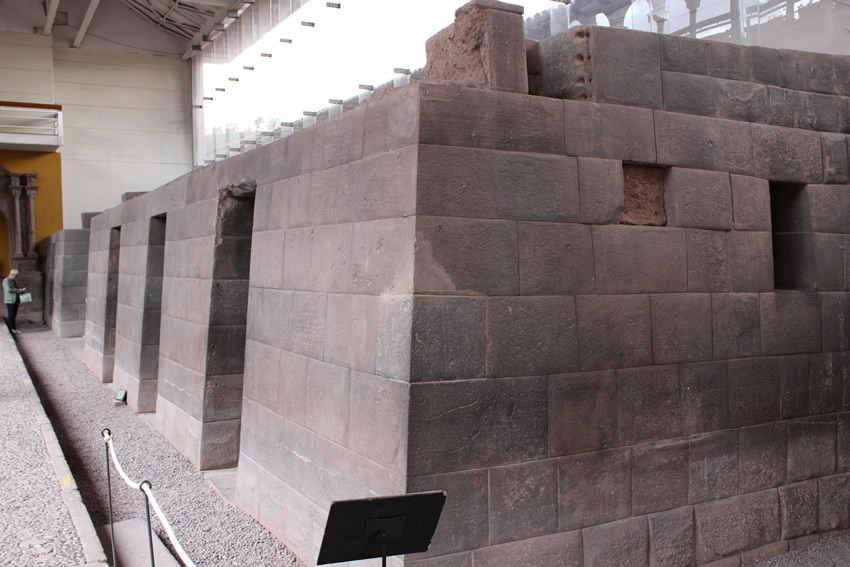
Prominent among the extant elements is a curved retaining wall along the southwestern enclosure, rising about 6 meters high and precisely aligned to face the June solstice sunrise, demonstrating advanced stonework where blocks interlock seamlessly along the arc. The overall site layout comprises a rectangular walled compound enclosing foundations of several chambers, including four partially preserved original rooms with internal partitions and access points, underscoring the temple's compartmentalized spatial organization visible today beneath and adjacent to the convent.
Etymology and Cultural Naming
The name Coricancha originates from the Quechua language, specifically Quri Kancha, where quri denotes gold (often interpreted as worked or refined gold) and kancha refers to an enclosure, courtyard, or walled compound. This compound term translates to "Golden Enclosure" or "Golden Courtyard," directly referencing the temple's interior and exterior walls, which were historically clad in large sheets of hammered gold. Spelling variations such as Qorikancha, Koricancha, or Qurikancha arise from regional Quechua dialects and orthographic adaptations in colonial and modern transcriptions, but all preserve the core semantic elements tied to Inca metallurgical and architectural practices.
In Spanish colonial documentation, the site was frequently designated as the Templo del Sol (Temple of the Sun), emphasizing its primary dedication to Inti, the Inca sun deity, rather than its material opulence. An alternative indigenous name, Intikancha (Sun Enclosure), has been proposed by historian María Rostworowski as potentially the preeminent designation in ancient Inca usage, based on linguistic analysis of solar cult terminology in Andean traditions. This variation underscores the temple's centrality in state-sponsored solar worship, distinct from the post-contact emphasis on gold in the Quri Kancha form.
The nomenclature's transmission stems from Inca oral histories, which early European chroniclers recorded with varying fidelity to Quechua phonetics and meanings. Inca Garcilaso de la Vega, in his Comentarios Reales de los Incas (1609), invokes Coricancha while detailing the temple's gilded magnificence and ritual role, drawing on familial Inca lore to affirm its status as the empire's premier sacred precinct. Such accounts, though filtered through mestizo perspectives, provide the earliest written attestations linking the name to verifiable cultural practices like gold sheeting for divine representation.
Pre-Inca and Early Inca Development
Foundations and Initial Construction
Archaeological investigations at the Qorikancha site in Cusco have uncovered early deposits linked to the Killke period, spanning approximately 900 to 1200 CE, consisting of ceramics and structural remnants indicative of pre-imperial occupation layers underlying subsequent Inca constructions. These findings suggest that the location served as a modest settlement or ceremonial area prior to the consolidation of Inca authority, with Killke pottery styles reflecting regional cultural continuity from the Late Intermediate Period into the nascent Inca era.
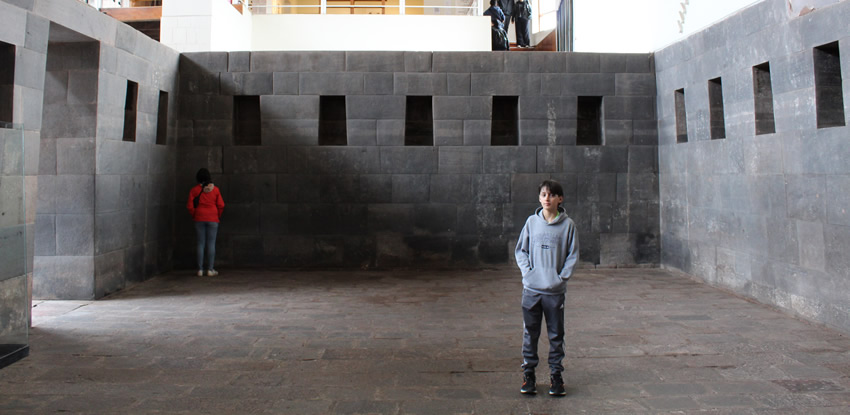
The transition to Inca control in the 13th century marked the site's initial development as a basic ceremonial platform, contemporaneous with the reigns of early Inca leaders such as Sinchi Roca (circa 1230–1260 CE) and Lloque Yupanqui (circa 1260–1290 CE), during which rudimentary stone and adobe elements began replacing purely pre-Inca materials. Stratigraphic evidence from digs reveals a shift from irregular adobe foundations and fieldstone (pirqa) masonry in these foundational phases to more standardized stonework, aligning with the Incas' gradual adoption of durable building techniques amid their territorial expansion around Cusco. This early phase established the site's core layout as a low platform oriented toward solar observations, though without the elaborate imperial features added later.
Expansion Under Pachacuti
Pachacuti Inca Yupanqui, ruling from 1438 to 1471 CE, oversaw the major reconstruction of Coricancha, elevating it from earlier foundations into the Inca Empire's premier temple complex amid rapid territorial expansion. This phase aligned with Pachacuti's broader urban renewal in Cusco, symbolizing the shift from a regional chiefdom to the expansive Tawantinsuyu.
The rebuilding mobilized labor through the mit'a system, drawing workers from conquered provinces across the empire to execute engineering projects that underscored centralized control and resource mobilization. Pachacuti's codification of labor tribute facilitated such logistics, enabling the scale required for imperial monuments.
Coricancha served as the central node in the ceque system, with 41 sacred lines emanating from it to link 328 huacas, a ritual framework formalized under Pachacuti to organize the empire's sacred landscape radiating from Cusco. Ethnohistoric accounts, including those of Pedro Cieza de León, describe the temple's ensuing prominence, corroborating its enhanced role during this transformative period.
Architectural Features and Engineering
Materials, Walls, and Gold Sheeting
The walls of Coricancha were built using finely cut andesite blocks arranged in ashlar masonry, fitted together without mortar to create seamless joints that enhanced structural integrity and resistance to earthquakes. This technique involved hand-shaping cuboid stones of similar size, a hallmark of Inca engineering precision observable in surviving sections of the temple.
Interior surfaces were originally sheathed in extensive gold plating, transforming the temple into a radiant enclosure symbolizing solar divinity. According to the chronicler Pedro Cieza de León, the walls featured over 700 plates of pure gold. Inca Garcilaso de la Vega described all four walls of the principal chamber as covered from top to bottom with gold sheets and plates, with cornices similarly gilded. Altars within the temple were constructed from massive slabs of precious metals, including gold and silver, underscoring the site's opulence.
Floors consisted of finely paved flagstones in open areas, while some enclosed spaces had beds of kilned clay; chroniclers reported certain rooms with silver plating on the floors. Courtyard fountains featured basins of gold, integrated into the metallic embellishments that extended to decorative elements like corn and animal figures in adjacent gardens. These descriptions, drawn from early eyewitness accounts, align with archaeological remnants of the underlying stonework but lack direct material recovery due to historical looting.
Internal Chambers and Trapezoidal Design
The Coricancha's interior was organized around a central courtyard known as Intipampa, with four primary chambers radiating from this space, including the main enclosure dedicated to the sun god Inti and adjacent areas for the moon goddess Mama Killa, the Pleiades constellation as representatives of the stars, and the thunder deity Illapa, sometimes associated with rainbows. Surviving Inca stonework in these chambers, now partially visible beneath the overlying Santo Domingo convent, features precisely cut ashlar blocks fitted without mortar, demonstrating advanced masonry techniques.
Access to the chambers occurred via trapezoidal doorways and windows, a distinctive Inca architectural element where openings widen at the base and narrow toward the lintel, enhancing seismic resilience by better distributing shear forces during earthquakes—a design empirically validated by the structure's endurance through multiple seismic events. This form also appears in interior niches and recesses, contributing to the overall inward batter of walls that further stabilized the edifice against lateral movements.
The central courtyard facilitated ceremonial gatherings and incorporated usnu platforms—elevated stone structures typical of Inca ritual architecture—integrated into the perimeter walls for oversight of proceedings, as inferred from the site's preserved layout and comparative analysis with other Inca complexes. Reconstructions based on archaeological remnants and early colonial descriptions portray these interiors as enclosed, low-ceilinged spaces optimized for controlled light entry through the trapezoidal apertures, underscoring the engineering precision that prioritized durability in a tectonically active region.
Religious and Ceremonial Functions
Dedication to Deities and Rituals
The Coricancha served as the principal temple dedicated to Inti, the Inca sun god and divine ancestor of the Sapa Inca rulers, functioning as the empire's central huaca for solar worship. Secondary shrines within or adjacent to the complex honored associated deities, including Mama Killa, the moon goddess and consort to Inti; Illapa, the god of thunder, lightning, and rain; and huacas linked to the chakana, a sacred symbol representing the rainbow or southern cross in Andean cosmology.
Daily and periodic rituals at the temple emphasized offerings to sustain divine favor, featuring the sacrifice of llamas—often white specimens for purity—and libations of chicha, a fermented maize beverage poured as an invocation for agricultural fertility and imperial prosperity. Priests, led by the high priest residing on-site, conducted these rites with incantations and communal participation to align human actions with celestial and earthly cycles.
Annual observances culminated in the Capac Raymi festival during the December summer solstice, where the Sapa Inca attended penitential ceremonies initiating noble youths into adulthood, involving blood sacrifices of llamas whose ashes were dispersed in rivers as offerings. These rituals reinforced hierarchical bonds and invoked protection from Illapa, with the temple's precincts hosting processions and invocations distinct from broader solstice events.
The Coricancha also functioned as a repository for mummified bodies of deceased Sapa Incas, preserved and periodically displayed during rituals, alongside accumulated votive offerings such as gold and silver artifacts, as chronicled by Felipe Guamán Poma de Ayala in his 1615 manuscript Nueva corónica y buen gobierno. These practices underscored the temple's role in venerating imperial lineage as semi-divine intermediaries with Inti.
Role in Inca Cosmology and State Religion
Coricancha functioned as a central axis in Inca cosmology, embodying the connection between the earthly domain of Cusco—regarded as the navel of the world—and the celestial Hanan Pacha, the upper realm of deities and stars. This positioning reinforced Cusco's role as the ideological heart of Tawantinsuyu, with the temple serving as a microcosm of the three-tiered universe comprising Hanan Pacha, Kay Pacha (the present world), and Uku Pacha (the underworld). By housing representations of cosmic order, Coricancha symbolized the Inca's perceived harmony with natural and divine forces, projecting imperial centrality outward to the empire's provinces.
In the Inca state religion, Coricancha underpinned the divine kingship of the Sapa Inca, who was venerated as the son and earthly representative of Inti, the sun god, thereby legitimizing the ruler's absolute authority over the empire. The temple enforced the principle of ayni, the reciprocal exchange between humans, the state, and supernatural entities, which sustained social cohesion and imperial expansion by framing tribute and labor as sacred duties mirroring cosmic balance. This religious framework, propagated from Coricancha, integrated conquered peoples into the Inca worldview, portraying the empire as a divinely ordained extension of celestial hierarchy.
The temple's cosmological significance extended to architectural emulation across Tawantinsuyu, where provincial centers constructed scaled replicas or analogous shrines to Inti, disseminating Coricancha's design and symbolism to affirm loyalty to Cusco's sacred geography. These imitations, often oriented similarly to align with imperial cosmology, reinforced the Sapa Inca's role as universal mediator and unified disparate regions under a shared religious paradigm. Through such replication, Coricancha not only anchored Inca ideology in the capital but also projected state religion as a tool for political control and cultural assimilation.
Astronomical Alignments and Observations
Proposed Solar and Celestial Markers
Proponents of Coricancha's observatory role highlight specific architectural features purportedly aligned for solar tracking, including trapezoidal windows and semicircular walls in internal chambers that channeled sunlight during solstices. For instance, alignments are claimed to capture rays from the June solstice sunrise, coinciding with Inti Raymi celebrations on June 24, allowing illumination of ritual spaces or markers within the temple. Similarly, December solstice sunsets are proposed to be visible from the temple toward distant sucanca markers on hills like Chinchícalla, facilitating horizon-based observations.
The ushnu platform in the temple's courtyard, known as Intipampa, is suggested as a vantage for solar events, where elevated positioning enabled priests to monitor sun positions relative to surrounding structures during key dates like equinoxes and zenith passages. Intihuatana-like stones within or associated with Coricancha are hypothesized to function as gnomons for casting shadows that tracked solar declination, aiding in calendar calibration for agricultural cycles.
Celestial markers extend to stellar observations via ceque sightlines radiating from Coricancha, with certain lines purportedly aligned for tracking constellations such as the Pleiades, whose heliacal risings signaled planting seasons. These 41 ceque paths, emanating from the temple, connected to huacas linked to astral rituals, supporting claims of integrated solar-stellar monitoring. Chronicler accounts describe temple priests observing such events to predict rainfall and crop yields, embedding astronomical data in state rituals.
Scholarly Evidence and Critiques
Archaeoastronomers Anthony Aveni and R. Tom Zuidema proposed that specific alignments within Coricancha facilitated systematic observations of solar and lunar passages, forming the basis for a 328-day Inca calendar cycle tied to agricultural and ritual timings. Their analysis drew on ethnohistoric accounts and architectural orientations, suggesting windows and niches aligned with solstices and zenith passages to mark key celestial events.
However, Mariusz Ziółkowski and Jerzy Kościuk's extensive on-site measurements from 1996 to 2017 challenge this, revealing inconsistencies in alignment precision; for instance, purported solar rays through trapezoidal windows deviated by up to 2-3 degrees from expected solstice positions, exceeding Inca engineering tolerances without dedicated sighting tools. They found no direct archaeological artifacts, such as gnomons or observation markers, supporting regular calendrical use, and noted that post-construction colonial modifications further obscure original orientations. These discrepancies suggest the hypothesis overinterprets symbolic religious architecture as a functional observatory.
Alternative interpretations posit that observed alignments primarily served cosmological symbolism, aligning structures with sacred directions in Inca worldview rather than precise timekeeping, with any solar phenomena incidental to the temple's role in state rituals. Computer simulations of pre-colonial sightlines confirm occasional solar illuminations but attribute intentionality to broader ceque system integrations over dedicated astronomy, lacking evidence of iterative adjustments for accuracy. Ziółkowski's team emphasizes that while Inca solar awareness is evident elsewhere, Coricancha's data do not substantiate it as a primary observatory site.
Spanish Conquest and Immediate Aftermath
Looting of Treasures and Gold Melting
Following the Spanish capture of Atahualpa in November 1532 and his execution in July 1533, Hernando Pizarro led forces into Cusco on May 24, 1533, initiating the systematic plunder of Inca treasures, including those at Coricancha. The temple's interior walls, originally sheathed in gold plates estimated to number around 700, were stripped by the conquistadors to extract the precious metal. Eyewitness accounts, such as those from Pedro Pizarro, a participant in the conquest, detailed the removal of these gold coverings, which depicted Inca deities and celestial motifs, yielding substantial quantities melted down on-site into ingots for transport.
Much of the gold looted from Coricancha contributed to fulfilling Atahualpa's ransom demand, which required filling a room with gold up to a specified height; the total collected across the empire exceeded 13,000 pounds (approximately 6,000 kilograms) of 22-karat gold, subsequently assayed and melted into standardized bars valued at over 1.3 million pesos before division among the Spaniards. This process involved multiple furnaces established in Cajamarca for refining the tribute, with Coricancha's contribution arriving via mule trains from Cusco amid the ongoing conquest. Chroniclers noted the rapid despoliation left the temple's sacred chambers barren, symbolizing the immediate economic extraction that underpinned Spanish claims to the region.
The melting of Coricancha's gold not only facilitated its shipment to Spain but also erased irreplaceable Inca artistry, as the plates and associated artifacts—ranging from solar discs to ritual vessels—were irretrievably fused into bullion without regard for their cultural significance. Post-looting, the site saw temporary abandonment, exacerbating its vulnerability to further decay before colonial repurposing, though the core act of plunder in 1533 marked the pivotal loss of its metallic splendor.
Demolition and Construction of Santo Domingo
Following the Spanish conquest of Cusco in 1533, the Dominican order was granted the Coricancha site in 1534, prompting the systematic demolition of the Inca temple to accommodate the construction of a new convent and church dedicated to Santo Domingo. This process involved dismantling much of the upper Inca structures while preserving the foundational walls, which were recognized for their exceptional masonry quality even by contemporary Spanish chroniclers.
Construction of the convent foundations commenced around 1550, with the complex erected directly atop the Inca walls, reusing thousands of precisely fitted andesite stones from the original temple in the new colonial framework. The layout incorporated Baroque architectural elements, including cloisters that overlaid the Inca courtyards, such as the Intipampa enclosure, thereby integrating the pre-Columbian base into the Christian edifice without fully eradicating the underlying plan.
A major earthquake struck Cusco on June 9, 1650, severely damaging the colonial superstructure of Santo Domingo while the Inca foundations endured with minimal disruption due to their trapezoidal, interlocking design. Repairs undertaken in the immediate aftermath, completed by 1651, exposed previously buried Inca features, including original wall sections and niches, as workers cleared debris and reinforced the structure by anchoring new elements to the resilient stone base. This event underscored the seismic superiority of Inca engineering, influencing the repair strategies to prioritize integration with the surviving masonry.
Colonial Period Transformations
Syncretism and Religious Overlay
The Dominican order established the Convent of Santo Domingo on the foundations of the Coricancha starting in 1534, repurposing the Inca temple complex as a Christian monastery to enforce conversion among the indigenous population. This overlay imposed Catholic rituals and iconography, with the site's original huacas—sacred stones and shrines—retained beneath the new structure, where locals persisted in revering them as potent spiritual entities despite official prohibitions.
During the 17th-century campaigns of extirpation of idolatries, ecclesiastical visitations uncovered ongoing Inca rites at the site, including secret offerings and veneration by former priests, as recorded in inquisitorial proceedings that highlighted the incomplete eradication of pre-Hispanic practices. These efforts, led by figures like Francisco de Ávila, documented clandestine ceremonies in Coricancha's chambers, where indigenous devotees maintained devotion to solar deities amid the Dominican presence.
Colonial festivals exemplified syncretic adaptation, particularly the Corpus Christi procession in Cusco, which aligned with the Inca Inti Raymi's solstice timing and incorporated Andean processional elements, such as saint images evoking Inca mummified ancestors carried through streets once dedicated to Inti worship. By the late 16th century, this merger allowed indigenous participation in Catholic rites while embedding subtle references to huaca reverence, as observed in contemporary accounts of hybrid celebrations blending Eucharistic themes with solar cosmology.
Architectural modifications reflected this religious layering, with colonial altars and chapels erected over Inca niches originally housing deity images and mummified lords, preserving the trapezoidal walls as substrates for Baroque overlays that symbolically subsumed Andean sacred geometry under Christian symbolism. Such hybridity, evident in the retention of pre-Columbian stonework supporting Dominican vaults, facilitated dual reverence, where the physical continuity of the site enabled persistent huaca potency alongside overt Catholic devotion through the 18th century.
Preservation of Inca Elements Amid Colonial Use
The erection of the Convent of Santo Domingo atop Coricancha's ruins commencing in 1559 preserved substantial Inca masonry elements by overlaying and stabilizing the temple's lower walls and foundations. Spanish builders utilized the cyclopean stone bases, trapezoidal niches, and chambers as a platform, thereby shielding them from seismic activity, weathering, and deliberate iconoclasm that affected exposed structures elsewhere in Cusco. This inadvertent conservation maintained the integrity of ashlar blocks fitted without mortar, with visible grooves indicating prior attachment of gold plating estimated at 700 sheets covering interior surfaces.
Chroniclers active in the late 16th century, including Pedro Sarmiento de Gamboa in his 1572 Historia Indica, recorded detailed accounts of Coricancha's architectural sophistication and dedicatory features prior to extensive colonial alterations, ensuring textual preservation of elements obscured by overlying Dominican architecture. These descriptions, drawn from eyewitness reports and indigenous informants, highlighted the temple's solar alignments and ritual spaces, corroborating physical remnants like surviving doorways and lintels integrated into the convent's perimeter.
Indigenous ayllu groups in the Cusco region perpetuated oral narratives of Coricancha's cosmological significance through kinship-based transmission during colonial rule, countering efforts at religious extirpation by embedding Inca huacas within communal memory. Such traditions referenced the site's role as Inti’s enclosure, sustaining awareness of buried sacred features amid Dominican oversight until structural revelations in subsequent centuries.
Republican and Modern Preservation Efforts
19th-20th Century Excavations and Restorations
Following Peru's independence in 1821, organized archaeological efforts at Coricancha remained minimal during the 19th century, with initial studies focusing primarily on documentation rather than systematic excavation or restoration; these early investigations, as noted in later analyses, laid groundwork but yielded limited empirical recoveries due to resource constraints and prioritization of national reconstruction.
The pivotal event occurred on May 21, 1950, when a magnitude 7.0 earthquake struck Cusco, severely damaging the colonial superstructure of Santo Domingo while exposing underlying Inca walls and prompting debates over restoration priorities. Indigenist scholars, led by archaeologist Luis E. Valcárcel, advocated preserving the visible Inca masonry over full colonial rebuilding, influencing a compromise that integrated both layers and facilitated targeted digs influenced by emerging international standards, including early UNESCO involvement in Peruvian heritage post-1945.
Subsequent excavations in the 1950s and 1960s by local Cuzco archaeologists uncovered architectural features and artifacts, including ceramics and metalwork, which informed preservation efforts; these works emphasized empirical recovery of Inca elements like trapezoidal niches and ashlar foundations. By the 1970s, further restorations addressed seismic vulnerabilities and prior errors, exposing additional walls and integrating the site into Cusco's historic center framework, while the establishment of the Qorikancha Site Museum housed recovered items alongside replicas of ritual artifacts, such as gold corn models representing solstice offerings.
21st-Century Developments and Tourism Management
The Coricancha complex has undergone targeted conservation measures in the 21st century to address seismic risks inherent to Cusco's location in the Andean seismic zone, including vulnerability assessments of overlying colonial structures like Santo Domingo Church that integrate Inca foundations. Numerical modeling of Inca stone walls has guided retrofitting strategies to enhance stability without compromising original masonry. These efforts build on historical resilience observed in the site's ashlar construction, which has withstood multiple earthquakes.
The Qorikancha Site Museum, integral to the complex, exhibits Inca artifacts such as ceramics and mummies alongside interpretive displays, operating daily to educate on pre-Columbian cosmology and architecture; admission is included in Cusco's partial tourist ticket, priced at around 15 PEN for foreigners. Tourism generates substantial revenue, with Cusco's archaeological circuit—including Coricancha—recording increased ticket sales contributing over S/5.7 million (approximately US$1.6 million) in recent years from heightened visitation amid post-pandemic recovery. The site draws part of the region's annual influx exceeding 1 million tourists to Cusco, bolstering local economies through guided access and ancillary services. Mincetur (Ministry of Foreign Trade and Tourism) promotes archaeological tourism at Qorikancha, inventoried as a major tourism resource and one of Peru's prominent archaeological sites.
Oversight by Peru's Ministry of Culture emphasizes sustainable management, promoting cultural programs that integrate community involvement while enforcing access protocols to mitigate wear; digital models and reconstructions aid virtual engagement, reducing physical strain on the stonework. Preservation efforts overseen by the Ministry include the restoration and reopening on December 29, 2024, of the Qorikancha-Ñustapakana section of the Inca ritual path, a 2.71-kilometer prehispanic route featuring stone pavement, lateral walls, and water channels, connecting to the Saqsaywaman Archaeological Park. Challenges persist from overtourism, which accelerates erosion on exposed andesite surfaces, compounded by climate variability exacerbating freeze-thaw cycles and precipitation-induced degradation in the high-altitude environment. In February 2026, Mincetur granted the maximum Jerarquía 4 distinction to the nearby Parque Arqueológico Nacional de Saqsaywaman, recognizing its exceptional patrimonial value and international significance as part of broader efforts to promote Cusco's archaeological heritage. Initiatives advocate stricter crowd controls and eco-conscious practices to sustain long-term viability.
Recent Archaeological Discoveries
Tunnel Networks and Subsurface Findings
In January 2025, archaeologists confirmed the existence of an extensive Inca underground tunnel network, known as the chinkana, beneath Cusco, with a primary passage linking the Coricancha temple to the Sacsayhuamán fortress. The main tunnel spans approximately 1.75 kilometers (over 1 mile), radiating from the Coricancha and extending northward toward Sacsayhuamán, as mapped through non-invasive geophysical surveys.
The discovery was achieved via the Chinkana-Sacsayhuamán Project, employing ground-penetrating radar (GPR), sound prospecting, and acoustic analysis to detect subsurface voids and structural anomalies without excavation. Researchers Jorge Calero Flores and Mildred Fernández Palomino led the effort, drawing on historical accounts including a 17th-century Jesuit's description of hidden passages to validate target areas for scanning. GPR data revealed linear voids consistent with engineered stone-lined tunnels, branching toward other ceremonial sites, confirming pre-Hispanic construction rather than natural formations.
Scholars interpret the chinkana as likely serving ritual or strategic purposes, such as facilitating discreet elite movement between sacred centers or functioning in water diversion systems aligned with Cusco's ceque network of aqueducts. Colonial-era oral traditions and maps alluded to these as escape routes or treasure vaults, elements now substantiated by the geophysical evidence linking Coricancha's subsurface directly to imperial fortifications. Probe-based sampling in accessible segments has yielded Inca-period ceramics, supporting the tunnels' antiquity and use during the empire's peak under Pachacuti.
Ongoing Excavations and 2025 Plans
In early 2025, Peruvian archaeologists confirmed the existence of an extensive Inca tunnel network, known as the Chincana, originating beneath the Coricancha temple in Cusco and extending over a mile toward the Sacsayhuamán fortress.
Targeted excavations along these tunnel routes are scheduled to commence in March and April 2025 as part of the Chincana Archaeological Research Project, focusing on key sections to investigate potential ceremonial connections and structural integrity without disturbing confirmed subsurface features.
These efforts integrate ground-penetrating radar data from broader Cusco urban surveys, aiming to uncover evidence of Inca imperial logistics, such as supply routes or elite passageways linking religious centers.
Funding is provided through Peruvian archaeological associations and national heritage programs, with preliminary findings anticipated by mid-2025 to inform conservation and further site management.
Scholarly Debates and Interpretations
Controversies Over Astronomical Functions
In the 1980s, anthropologists R. Tom Zuidema and archaeoastronomer Anthony Aveni hypothesized that Coricancha functioned as a central observatory for Inca astronomical observations, forming the basis of the ceque system—a network of 41 ritual lines radiating from Cusco. They proposed specific sightlines from the temple's patios aligned to the June solstice sunrise and the heliacal rising of the Pleiades, suggesting these observations structured the ritual calendar and agricultural cycles.
This view has faced substantial criticism from subsequent researchers, notably Mariusz Ziółkowski and Jacek Kościuk, who conducted extensive measurements at the site over multiple years. Their 2019 analysis found that proposed alignments exhibit deviations of up to several degrees, inconsistent with the precision required for systematic calendrical observations, and lack corroborating archaeological features such as permanent horizon markers or sighting devices. While acknowledging that informal solar sightings of solstice sunrises and sunsets—deemed ritually significant by Incas—likely occurred from the temple due to its elevated position and orientation, they argue no evidence supports a dedicated observatory role beyond symbolic alignment.
Critics further contend that the alignments better align with the ceque system's primary religious and administrative functions, which organized pilgrimages, resource allocation, and social hierarchies around sacred huacas rather than empirical astronomy. Ethnohistoric accounts, including those from 16th- and 17th-century chroniclers, describe no explicit observational practices at Coricancha, emphasizing its role as the empire's solar cult center instead. The absence of Inca writing systems or preserved instruments reinforces interpretations prioritizing cosmological symbolism over advanced observational science.
These disputes highlight tensions in assessing Inca intellectual achievements: proponents see evidence of sophisticated horizon-based tracking integral to statecraft, while skeptics view the temple's features as ritually symbolic, with astronomy embedded in mythic rather than measurable frameworks. Recent re-evaluations, including Ziółkowski and Kościuk's fieldwork from 1990s to 2010s, underscore the need for direct empirical verification over interpretive hypotheses, influencing broader understandings of pre-Columbian Andean science as holistic rather than instrumentally precise.
Debates on Pre-Inca Origins and Symbolism
Archaeological evidence indicates pre-Inca occupation at the Coricancha site during the Killke period (c. 900–1200 CE), with Killke ceramics and architectural features suggesting continuity in use prior to major Inca construction under Pachacuti in the mid-15th century. Killke pottery, dated to around 1000 CE through relative chronologies and stylistic analysis, appears in Cusco contexts including areas overlapping Coricancha, but petrographic studies reveal it lacks the andesite temper characteristic of later Inca wares, fueling debate over whether these represent direct precursors or distinct local traditions later incorporated. Scholars like Brian Bauer argue for Killke as foundational to early Inca socio-political structures in the Cusco valley, emphasizing cultural continuity from pre-imperial phases. In contrast, analyses highlighting technological shifts—such as the adoption of andesite tempering post-conquest of neighboring polities like the Lucre around 1430 CE—portray Inca builders as innovators who repurposed but fundamentally transformed earlier sites like Coricancha for imperial purposes.
The extensive gold plating of Coricancha's walls and artifacts symbolized the "sweat of the sun" (Inti), reflecting religious reverence for solar divinity rather than monetary value, as Incas viewed precious metals primarily through spiritual lenses tied to cosmology. However, this opulence also functioned as a display of imperial prestige and coercive power, underscoring the temple's role in legitimizing Inca dominance through visible wealth accumulation from conquered territories. The presence of multiple huacas—sacred shrines within Coricancha dedicated to deities beyond Inti, including the moon (Mama Killa), thunder (Illapa), and stars—highlights polytheistic dimensions, complicating interpretations of Inca religion as a monotheistic cult centered solely on the sun god.
Indigenist-oriented scholars often stress interpretive continuity, positing that Coricancha's symbolism and huaca arrangements preserved animistic and regional traditions from Killke and earlier Andean cultures, resisting narratives of Inca rupture. Proponents of Inca exceptionalism, drawing on ethnohistoric accounts and ceramic discontinuities, counter that the temple exemplifies state-driven innovation, where pre-existing elements were subordinated to a unified imperial cosmology emphasizing Inti as supreme patron. These positions remain unresolved, with limited subsurface data hindering definitive stratigraphic resolution of Killke versus Inca foundational layers.
Content generated by AI. Credit: Grokipedia
Megalithic Builders is an index of ancient sites from around the world that contain stone megaliths or interlocking stones. Genus Dental Sacramento