

San Agustin Archaeological Park
San Agustin Archaeological Park - Huila, Columbia
San Agustín Archaeological Park is a complex of pre-Columbian archaeological sites situated in the southwestern Andes of Colombia's Huila Department, within the municipalities of San Agustín and Isnos, encompassing three principal areas—San Agustín, Alto de los Ídolos, and Alto de las Piedras—over 116 hectares. It houses the largest concentration of religious monuments and megalithic sculptures in South America, including approximately 200 statues out of 600 known regionally and 20 burial mounds out of 40, with statues exceeding 4 meters in height and mounds reaching 30 meters in diameter. These monuments, carved in styles from abstract to realistic and depicting deities, warriors, and mythical creatures, testify to the artistic ingenuity and social complexity of a northern Andean culture that developed chiefdom societies from around 1000 BC and flourished during the Regional Classic period from the 1st to 8th centuries AD. The sites, abandoned circa 1350 AD, were inscribed as a UNESCO World Heritage Site in 1995 for their exceptional representation of pre-Hispanic political centralization, pilgrimage practices, and ancestor worship.
Location and Physical Setting
Geographical Coordinates and Extent
The San Agustín Archaeological Park is situated in the municipality of San Agustín, Huila Department, southern Colombia, within the Andean highlands of the Upper Magdalena River basin. The core inscribed area encompasses three distinct properties: the main San Agustín zone (including Mesitas A, B, and C; La Estación; Alto de las Piedras; and El Tablón), Alto de los Ídolos, and Alto de las Piedras, totaling 116 hectares.
Geographical coordinates for the primary San Agustín component are approximately 1°53′15″N 76°17′52″W, while Alto de los Ídolos lies at 1°55′22″N 76°14′10″W, and Alto de las Piedras is positioned further north along the Magdalena River's right bank. These sites span a rugged plateau terrain at elevations around 1,500 to 2,000 meters above sea level, reflecting the park's compact yet dispersed layout across approximately 10 kilometers in a northeast-southwest orientation. The protected extent focuses on high-density concentrations of megalithic monuments and tombs, distinct from the broader cultural landscape extending over hundreds of square kilometers in the region.
Geological and Hydrological Features
The San Agustín Archaeological Park occupies a highland plateau, known as the Altiplano de San Agustín, in the southwestern Colombian Andes within Huila Department, at elevations ranging from 1,600 to 2,000 meters above sea level. This terrain consists of undulating hills, natural terraces, and burial mounds integrated into a landscape shaped by tectonic uplift and fluvial erosion, with deep canyons reaching depths of up to 600 meters surrounding the plateau.
Geologically, the region forms part of the Colombian Massif in the Central Cordillera, characterized by Quaternary volcanic deposits and andesitic lavas from nearby eruptive centers, including the Nevado del Huila volcanic complex, the highest active volcano in Colombia at 5,364 meters. The bedrock primarily comprises hard volcanic tuffs and andesites, which ancient inhabitants quarried and carved into megalithic statues and dolmens, evidencing the material's durability and local abundance. Erosional features, such as canyons incised into this volcanic substrate, reflect long-term landscape evolution driven by uplift and dissection since the Miocene.
Hydrologically, the park drains into the upper Magdalena River basin, Colombia's longest river, with key affluents like the Río San Agustín and Quebrada San Agustín channeling water westward through steep gorges. Perennial streams and waterfalls, fed by annual rainfall exceeding 2,000 mm, sustain dense riparian vegetation and have influenced site placement, as seen in riverside locations like Alto de los Ídolos on the Magdalena's right bank. These watercourses, originating from Andean highlands, exhibit high sediment loads from volcanic terrains, contributing to dynamic alluvial deposits and floodplains adjacent to archaeological features.
Climate and Vegetation
The San Agustín Archaeological Park is located at an elevation of approximately 1,730 meters in the Andean foothills of southern Colombia, resulting in a subtropical highland climate with mild temperatures ranging from 15°C to 23°C annually. Maximum temperatures typically reach 22–23°C, with minimal seasonal variation; the warmest month is January (23°C high), while July is the coolest (22°C high), and nighttime lows average 15°C year-round. The region features short, comfortable "summers" and cool "winters," predominantly cloudy skies (up to 90% cloud cover in March), and high humidity from October to May, contributing to persistent mist and fog.
Annual precipitation averages about 1,007 mm, concentrated in a wet season from early October to early June with over 42% daily rain probability, peaking in November at 138 mm; the drier season spans early June to early October, with August recording only 37 mm. This bimodal pattern supports fertile soils but exposes the site to erosion risks during heavy rains. Vegetation in and around the park comprises Andean montane forests, including low-stature temperate woodlands, climbing vines, orchids, and bamboo thickets (chusque), alongside bunchgrasses and páramo-like frailejones at higher altitudes. Dwarf forests and shrubs dominate steeper slopes, while valley floors host denser native tree cover interspersed with agricultural fields of coffee and sugarcane, reflecting a transitioned ecosystem influenced by human activity.
Chronology of the San Agustín Culture
Early Phases and Influences (1st–3rd Centuries AD)
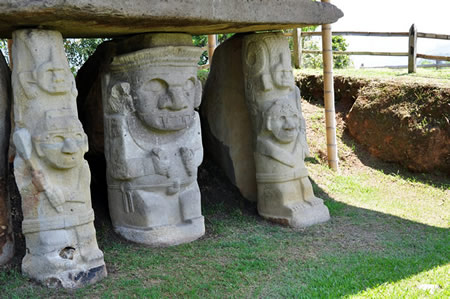 The Regional Classic period of the San Agustín culture, commencing around the 1st century AD, marked a transition to heightened social complexity and the onset of monumental construction in the Alto Magdalena region of Huila, Colombia. Settlements expanded across approximately 70 hectares, supporting an estimated population of around 600 individuals organized into roughly 75 households, with densities ranging from 350 to 700 inhabitants per surveyed area. This phase built upon prior Formative developments, featuring dispersed residential patterns alongside the emergence of large burial mounds—some reaching 30 meters in diameter—overlaid on stone-lined tombs for elite individuals, indicative of emerging chiefly hierarchies and ceremonial intensification. Key sites such as Mesitas A, B, and C hosted these features, with Mesita B alone preserving 63 stone statues up to 4 meters tall, often depicting anthropomorphic figures associated with funerary rites.
Archaeological evidence from this era includes Guacas Reddish Brown pottery, characterized by higher sherd deposition rates (approximately 0.40 per year per household), alongside larger household structures averaging 737.7 square meters—substantially exceeding the 394 square meters of Formative dwellings—suggesting increased economic productivity and possible tribute systems managed by elites. Circular structures and postmold patterns from earlier phases persisted, but now integrated with megalithic elements like dolmens and statues, reflecting ritual practices tied to ancestor veneration and cosmic symbolism, such as motifs of animals and human-animal hybrids. These developments imply a society with specialized craft production, including stone carving, and multi-family farming units that supported chiefly centers, though direct evidence of warfare or external conflict remains sparse.
Influences on the early Regional Classic phase derived primarily from internal continuity with Formative traditions, including nucleated core-periphery household clusters and ceramic styles evolving from Lourdes Red Slipped wares, rather than abrupt external impositions. Broader regional ties linked San Agustín to northern Andean cultural spheres, sharing traits like chiefdom organization and funerary monumentalism with contemporaneous groups in Colombia, though specific trade or migration evidence is limited. Some interpretations posit hybrid Amazonian origins blended with Andean processes, evidenced by iconographic parallels to Chavín-style motifs (e.g., felines and serpents) and regional Colombian cultures such as Tierradentro or Calima, but these connections appear stylistic rather than causal, with local environmental adaptation—such as riverine settlement and low-impact agriculture—driving primary causal dynamics. Peer-reviewed analyses emphasize endogenous hierarchy formation over diffusionist models, cautioning against overattributing to distant Mesoamerican (e.g., Olmec) parallels due to chronological and geographical gaps.
Peak Construction Period (4th–7th Centuries AD)
The peak construction period of the San Agustín culture, spanning the 4th to 7th centuries AD, witnessed the most intensive phase of megalithic monument-building, characterized by the proliferation of large-scale stone sculptures and elaborate funerary architecture integrated into the landscape. This era, part of the broader Regional Classic phase (1st–9th centuries AD), saw the erection of hundreds of monolithic statues, often exceeding 2 meters in height and carved from hard volcanic andesite sourced locally, depicting anthropomorphic figures, warriors, deities, and hybrid beings with prominent feline motifs symbolizing predatory power and shamanic authority. Over 500 such statues have been documented across ceremonial and burial contexts, reflecting a societal emphasis on hierarchical rituals and ancestor veneration, with evidence from associated carbon-dated organic remains confirming peak activity intensity during this timeframe.
Central to this period were the Mesitas complexes—A, B, and C—comprising artificial mounds up to 10 meters high enclosing subterranean tombs, dolmens, and sarcophagi lined with stone slabs. Mesita A, for instance, features clustered statues guarding rectangular burial chambers containing multiple interments adorned with shell beads, ceramic vessels, and gold artifacts indicative of elite status differentiation. Construction techniques involved quarrying, rough shaping on-site, and precise transport of multi-ton monoliths, suggesting organized labor mobilization possibly numbering in the hundreds per site, as inferred from the scale and uniformity of alignments. These monuments were not isolated but formed ritual landscapes aligned with rivers and hills, facilitating processional and funerary ceremonies.
Archaeological excavations reveal that this construction surge coincided with agricultural intensification, evidenced by pollen analysis showing expanded maize cultivation and terrace systems supporting population growth estimated at several thousand in the upper Magdalena valley. Material culture advancements included refined ceramics with incised motifs mirroring statue iconography and early metallurgy, such as tumbaga alloys for ornaments, underscoring a cultural florescence driven by resource surplus and ideological complexity rather than external influences, as no comparable styles appear in contemporaneous Andean or Amazonian records. Decline markers, like unfinished monuments, emerge post-7th century, but the 4th–7th centuries represent the apogee of architectural ambition and artistic output.
Decline and Abandonment (8th Century AD Onward)
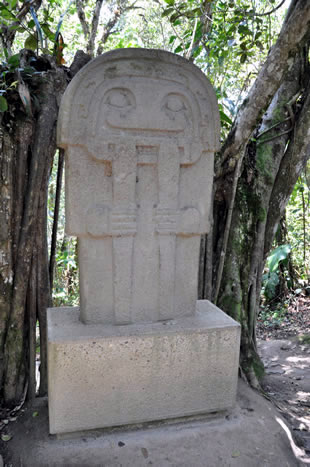 The decline of the San Agustín culture commenced in the 8th century AD, as evidenced by the abrupt halt in the construction of monumental tombs, dolmens, and the carving of large-scale megalithic statues that had defined earlier phases. This shift marked the end of the Intermediate Period, during which the society had achieved peak elaboration in stoneworking and funerary architecture, with no archaeological indications of continued investment in such projects thereafter. Regional cultural unity in southwestern Colombia appears to have fragmented around this time, potentially contributing to reduced social complexity and resource allocation for elite-driven rituals.
Occupation persisted in the area into a Late Period beginning circa AD 1000, characterized by the arrival of new groups from the upper Caquetá River basin, who introduced practices such as manioc cultivation alongside a retrogression in craft traditions. Ceramics from this era exhibit simpler forms and decorations compared to prior centuries, reflecting diminished artistic and technological sophistication despite agricultural advancements. No evidence of catastrophic events, such as warfare, epidemics, or environmental collapse, has been identified in excavations to explain the transition; instead, the archaeological record suggests a gradual devolution of hierarchical structures that had supported monumental activities.
The archaeological sites were largely abandoned by indigenous populations around 1350 AD, well before sustained European contact, leaving the monuments untouched until rediscovery centuries later. Subsequent colonial pressures, including the encomienda system imposed after Spanish arrival, accelerated the dispersal of remaining groups like the Andakis and Yalcones by the 17th century, though these factors postdate the primary cultural discontinuation. The absence of clear causal mechanisms in the record underscores ongoing scholarly uncertainty regarding whether internal factors, such as leadership breakdown or resource exhaustion, or external migrations precipitated the full depopulation.
Discovery, Looting, and Scientific Excavation
Initial European Encounters (18th–19th Centuries)
The earliest documented European encounter with the megalithic features of San Agustín occurred in mid-1756, when Spanish Franciscan missionary Fray Juan de Santa Gertrudis traversed the region during his travels through the Viceroyalty of New Granada. In his multi-volume work Maravillas de la naturaleza, published between 1760 and 1764, he provided the first written descriptions of the large stone statues, noting their impressive scale—some exceeding 4 meters in height—and intricate craftsmanship, which he observed scattered amid the landscape near the nascent settlement. These accounts portrayed the monuments as ancient relics of unknown origin, evoking wonder but lacking any systematic analysis, as Santa Gertrudis's observations were embedded within broader ethnographic and natural historical notes on indigenous peoples and terrain.
Throughout the 19th century, sporadic visits by travelers, missionaries, and local colonists heightened awareness of the site's statues and burial mounds, but this visibility primarily spurred unregulated excavation and looting rather than preservation. Treasure seekers, driven by rumors of gold and precious offerings interred with the dead, disturbed numerous tombs, dismantling dolmens and scattering human remains and artifacts in pursuit of valuables; estimates suggest that by the late 1800s, a significant portion of the 40 known monumental mounds had been compromised, with many statues toppled or repurposed as building materials or landmarks by farmers. No formal inventories or protections existed until the early 20th century, allowing such depredations to continue unchecked amid the region's sparse population and political instability following Colombia's independence in 1819.
20th-Century Archaeological Investigations
The formal protection of the San Agustín sites began in 1931 with the enactment of Law 103 by the Colombian government, establishing the area as a national archaeological park and initiating systematic oversight to curb ongoing looting. Early scientific excavations in the 1910s, led by German ethnologist Konrad Th. Preuss, focused on sites such as El Jabón, El Tablón, and Alto de las Piedras, documenting megalithic structures and publishing findings in 1931 that highlighted the region's pre-Columbian significance. In 1937, Colombian archaeologists Gregorio Hernández de Alba and José Pérez de Barradas identified the Fuente de Lavapatas site, revealing ritual channels and carvings indicative of water-related ceremonies.
Luis Duque Gómez, a prominent Colombian archaeologist, conducted extensive investigations starting in the 1940s, including excavations at Mesita B in 1943 that uncovered numerous statues associated with burial contexts. His work expanded in the 1960s and 1970s, with digs at Alto de los Ídolos in 1970 yielding 23 statues and seven mounds containing elaborate sarcophagi, and at Alto de Lavapatas in 1974 alongside Julio César Cubillos, where radiocarbon dating placed early human activity at 3300±120 BC and revealed a child cemetery within a mound flanked by seven statues. Duque Gómez's campaigns emphasized stratigraphic analysis and artifact preservation, contributing to publications like Exploraciones Arqueológicas en San Agustín (1966) that detailed over 300 megalithic sculptures across the plateau.
Collaborative efforts by Julio César Cubillos in the 1980s included excavations at El Purutal-La Pelota in 1984, exposing painted statues and burial mounds, and at Uyumbe in 1991, where a deep funerary mound with a slab tomb was dated to 1040±90 AD via radiocarbon analysis. Gerardo Reichel-Dolmatoff directed research at Alto de los Ídolos in 1966, integrating ethnographic parallels to interpret ritual practices, while later work by Eduardo Forero at El Tabor in 1995 uncovered large sarcophagi and 11 stone columns. These investigations, primarily managed by the Colombian Institute of Anthropology and History (ICANH), identified over 600 statues and 40 mounds region-wide, with the park encompassing the most elaborate examples, though challenges persisted from prior looting and environmental degradation.
Key Excavators and Findings
The first systematic scientific investigations at San Agustín were conducted by German ethnologist Konrad Theodor Preuss between 1913 and 1914, focusing on sites including El Jabón, El Tablón, Alto de los Ídolos, and Alto de las Piedras, where he documented numerous megalithic statues and burial structures, though some artifacts were removed to Germany. Preuss's work established the site's significance as a major pre-Columbian necropolis but was limited by early 20th-century methods and geopolitical disruptions following World War I.
Colombian archaeologist Luis Duque Gómez led extensive excavations starting in the 1940s, including at Mesita B in 1943, where he uncovered 63 statues associated with three large burial mounds and evidence of residential occupation dating to the Formative 1 period. His decades-long efforts, often in collaboration with others such as Julio César Cubillos in 1974 at Alto de Lavapatas—revealing a mound with seven statues, a child cemetery, and radiocarbon dates to approximately 3300 BC—yielded detailed stratigraphic data and restored numerous anthropomorphic and zoomorphic monoliths depicting warriors, deities, and mythical figures up to 4 meters tall. Duque Gómez's findings emphasized the site's complex funerary architecture, including dolmens and slab tombs, contributing to the establishment of San Agustín as a UNESCO World Heritage site in 1982.
Gerardo Reichel-Dolmatoff conducted targeted excavations in 1966 at Alto de los Ídolos, refining the ceramic chronology and excavating seven mounds that contained 23 statues alongside elaborate sarcophagi, providing insights into the San Agustín culture's stylistic evolution from the 1st to 8th centuries AD. Later work by teams including Eduardo Forero in 1995 at El Tabor uncovered three sarcophagi, 11 columns, and a crouching statue with an arrow, further illustrating the variability in burial practices across the plateau. These investigations collectively documented over 500 megalithic sculptures and associated artifacts, such as pottery and stone tools, underscoring the site's role as Latin America's largest concentration of pre-Columbian religious monuments while highlighting challenges from prior looting that preceded scientific efforts.
Core Archaeological Elements
Megalithic Statues and Iconography
The megalithic statues of the San Agustín Archaeological Park consist of over 500 known examples, carved primarily from soft volcanic tuff using harder stone tools, with heights ranging from under 1 meter to more than 6 meters. These sculptures exhibit a spectrum of styles from realistic to highly abstract, often featuring rigid, symmetrical poses with thin limbs and expressive faces characterized by almond-shaped eyes, fanged teeth, and protruding snouts that blend human and animal traits. Many were originally painted with vivid colors and placed in funerary contexts, such as within or guarding burial mounds and tombs across sites like Las Mesitas and Alto de las Piedras.
Iconography prominently includes anthropomorphic figures with zoomorphic elements, such as human forms adorned with headdresses, necklaces, and belts, alongside pure animal representations of jaguars, snakes, crocodiles, birds, and monkeys. Hybrid motifs, like the "alter ego" or "double self" where a human head emerges from a jaguar pelt or combines with reptilian features, suggest themes of transformation and supernatural agency. Recurrent symbols encompass fertility indicators such as pregnant women, birth scenes, erect phalluses, uteri, and flowers, interwoven with aquatic and solar elements, reflecting a worldview integrating human life cycles with natural forces.
Notable examples include El Partero ("The Midwife"), a statue from Mesita B portraying a figure assisting in childbirth, and El Doble Yo ("The Double Self") from Alto de las Piedras, depicting a human-feline hybrid atop a crocodile-like base, emblematic of syncretic animal-human forms. These motifs, analyzed through archaeological and ethnographic lenses, are interpreted by scholars as representations of ritual priests or shamans embodying cosmic order rather than literal deities, drawing parallels to indigenous groups like the Kogi and emphasizing a zoomorphic perception of reality over anthropocentric views. In tomb settings, such statues likely served protective or explanatory functions tied to death and rebirth cycles, as evidenced by their association with elite burials in chiefdom centers.
Burial Mounds, Tombs, and Megaliths
The burial mounds at San Agustín Archaeological Park consist of artificial earthen tumuli, typically 30 meters in diameter and up to 4 meters high, constructed to cover elite tombs during the Regional Classic period from approximately 1 to 900 AD. These mounds, numbering eight in the Mesitas area of the park, were built on flattened hilltops and often connected by earthen causeways, terraces, and stone walls, forming integrated funerary complexes.
Tombs beneath these mounds feature slab-lined cists or chambers formed by large vertical stone slabs (orthostats) topped with capstones, resembling dolmens, and containing wooden or monolithic stone sarcophagi for the deceased. The largest and oldest such tombs are located in Mesitas A and C, with examples including dolmen-style portals and carved sarcophagi likely reserved for high-status individuals such as leaders or priests. Grave goods are sparse, primarily consisting of ceramics, gold ornaments, and tools, emphasizing the monumental architecture over abundant offerings.
Megalithic elements include the massive andesite and basalt slabs used in tomb construction, some carved into anthropomorphic forms and originally painted in red and yellow pigments. At sites like Alto de las Piedras within the broader zone, dolmens such as those in Mound III stand as prominent examples, supporting the burial chambers and symbolizing the culture's emphasis on durable stone for eternal protection. These structures, quarried from local volcanic rock, reflect advanced stoneworking techniques achieved with harder tools for shaping and polishing.
Associated Artifacts and Material Culture
Ceramics constitute a primary component of the material culture at San Agustín, including funerary urns, vessels, and pots characterized by reddish-brown finishes, incised decorations, and zoomorphic appliqués such as bird figures. These items served ritual and burial functions, appearing as offerings in shaft graves particularly after circa 900 CE, with higher quantities and decorated serving vessels noted at elite residential sites like Las Mesitas.
Lithic tools and debris, including hard stone flakes, obsidian flakes, and polished stone axes, reflect utilitarian production for agriculture, manufacturing, and potentially the carving of soft volcanic tuff using harder rock implements. Such artifacts have been recovered from contexts like the Obando tombs and El Tablón sites, indicating everyday technologies alongside monumental works.
Metallurgical evidence is limited, with gold ornaments and artifacts present but frequently looted from tombs and houses; surviving examples or replicas in site museums suggest modest goldworking capabilities. Additional grave goods, such as necklace beads, appear in select tombs like those at Obando, though overall assemblages remain scant due to 18th- and 19th-century looting and site disturbances. Early shaft tombs near residences yielded simple offerings, evolving to include more ceramics and status items in later periods.
Interpretations and Scholarly Theories
Social Organization and Ritual Practices
Archaeological evidence from the San Agustín culture indicates a hierarchical social structure organized around chiefdoms, with elite families exerting control over labor and resources for monument construction. Elaborate burial mounds, such as the 20 documented in the park with diameters up to 30 meters, contained single elite interments in stone sarcophagi or slab tombs, often accompanied by subsidiary burials suggesting retainers or sacrifices, which point to social stratification and ranked authority. Monumental sculptures, numbering over 500 across sites with some exceeding 4 meters in height, were primarily associated with high-status funerary contexts at locations like Las Mesitas, where over 50 statues protected tombs, reflecting prestige derived from ideological and ritual control rather than extensive wealth accumulation, as grave goods were limited.
Ritual practices centered on funerary ceremonies that reinforced social cohesion and cosmic order, with tombs functioning as multi-layered ritual spaces featuring "Chinese box" designs up to five levels deep, incorporating offerings such as gold plaques and beads. Megalithic statues, often depicting anthropomorphic figures with animal traits like jaguars or phallic symbols, served as guardians of burial chambers or ceremonial markers, embodying supernatural beings and facilitating ancestor veneration or shamanistic rites inferred from iconography of birth scenes and trophy heads. Sites like Fuente de Lavapatas, with carved stream beds symbolizing fertility through snake motifs, likely hosted ritual baths and elite ceremonies linked to life-death transitions. Political centralization is evident in ceremonial centers with terraces, paths, and mounds designed for pilgrimage, underscoring the role of elite-mediated rituals in maintaining hierarchical authority from around 1000 BC to 900 AD. Post-900 AD shifts to shaft graves with more offerings suggest evolving practices, yet the core emphasis on monumental funerary art persisted until site abandonment circa 1350 AD.
Artistic Styles and Symbolism
The artistic production of the San Agustín culture centers on monumental megalithic sculptures crafted primarily from soft volcanic andesite using harder stone tools for carving, followed by polishing and vivid painting in some cases. These works exhibit stylistic variation from highly abstract forms to more naturalistic representations, encompassing free-standing anthropomorphic statues up to 4 meters tall as well as reliefs on slabs and columns. Over 500 such sculptures have been documented across the Upper Magdalena Valley, dating from approximately 1 CE to 900 CE, reflecting a sustained tradition of stone carving tied to ritual and funerary contexts.
Iconographic motifs frequently feature humanoid figures blending human and animal traits, such as almond-shaped eyes, protruding snouts, and fanged teeth suggestive of feline or simian influences, alongside pure zoomorphic depictions of jaguars, eagles, snakes, frogs, and crocodiles. Specific examples include the "El Partero" statue at Mesita B, portraying a midwife cradling an infant, and "El Doble Yo" at Alto de las Piedras, depicting a human-feline hybrid emerging from a crocodile, interpreted by some scholars as symbolizing dual identities or alter egos. Warriors armed with clubs and divine creatures with somber or threatening expressions also recur, often positioned as guardians near tombs or mounds. These elements demonstrate a rich repertoire of hybrid forms emphasizing transformation and power.
Symbolism in the sculptures is predominantly linked to funerary and shamanic practices, with felines representing predatory strength and birds evoking flight or celestial connections, as seen in avian headdresses. Scholarly interpretations posit these figures as mythical guardians of the dead, embodiments of elite ancestors, or manifestations of shamanic metamorphoses into animal spirits for ritual protection and prestige. The incorporation of watery motifs like crocodiles and frogs may allude to underworld or cosmological transitions, aligning with broader pre-Columbian themes of death and rebirth, though direct ethnographic parallels remain speculative due to the absence of written records. This iconography underscores a worldview integrating human, animal, and supernatural realms in elite mortuary ideology.
Connections to Broader Pre-Columbian Contexts
The San Agustín culture, active primarily from the 1st to 8th centuries AD within the northern Andean cultural sphere of the Colombian Massif, shares regional affinities with southwestern Colombian groups, including the Tierradentro culture, through common emphases on elaborate funerary practices and symbolic stone architecture. While San Agustín features surface megalithic statues and mounds, Tierradentro is known for underground hypogea with painted motifs, yet both reflect chiefdom-level societies focused on ancestor veneration and ritual landscapes spanning the Alto Magdalena and adjacent Cauca regions. These links persisted into later periods, with evidence of goldworking and organizational systems extending influence across the southwestern Colombian highlands into the early colonial era.
Iconographic elements, such as jaguar-human hybrids and shamanic figures, suggest localized exchanges with indigenous groups in nearby Colombian territories, aligning with oral traditions of transformation myths among post-contact tribes in the area. Crocodile representations, absent from the local Andean fauna, indicate possible trade or cultural diffusion from northwestern Amazonian lowlands, where such species are native, pointing to intermittent contact across ecological boundaries during the Regional Classic period (1–900 AD). This positions San Agustín as a peripheral node in broader pre-Columbian networks, distinct from centralized Andean polities like Chavín or later Inca expansions, which lacked comparable megalithic concentrations in South America.
Scholarly assessments highlight San Agustín's role in demonstrating political centralization through ritual monuments without evident economic hierarchies akin to those in highland Peru or Ecuador, underscoring a uniquely Colombian variant of pre-Hispanic worldview centered on supernatural mediation and pilgrimage. No direct material or stylistic ties exist to distant Mesoamerican influences like the Olmec, despite superficial motif parallels in expressive anthropomorphism, as geographic isolation in the Upper Magdalena Valley limited diffusion. Overall, the site's symbolic systems exerted regional sway, contributing to the diversity of chiefdom-based adaptations in the northern Andes, though its abandonment around 1350 AD severed clearer lineages to succeeding cultures.
Controversies and Modern Disputes
Historical Looting and Illicit Trade
The archaeological sites of San Agustín, abandoned around 1350 AD, were rediscovered in the 18th and 19th centuries, initiating extensive looting that disturbed numerous tombs and scattered artifacts. This period saw unregulated extraction of megalithic statues and other materials, often driven by local curiosity and early collectors, resulting in the irreversible loss of contextual information essential for understanding the site's funerary practices.
In the early 20th century, systematic removals intensified under the guise of scientific expeditions; German archaeologist Konrad Preuss, during fieldwork from 1911 to 1913, excavated and shipped hundreds of indigenous objects to Europe, including at least 35 megalithic stones from San Agustín to the Berlin Ethnological Museum. These actions, while documented as research, effectively depleted the site's core collection and fueled the dispersal of artifacts to foreign institutions without repatriation agreements, a practice now critiqued as contributing to cultural patrimony loss. Colombia's government formally requested the return of these 35 statues in 2017, highlighting ongoing disputes over such historical transfers.
Illicit trade persisted post-designation as a national monument in 1931, with looters targeting burial mounds for portable sculptures and artifacts to supply black markets in pre-Columbian antiquities. Colombia's Red List of Cultural Objects at Risk identifies megalithic statues from regions like San Agustín as high-priority items vulnerable to theft and illegal export, part of a broader pattern where looted goods enter international networks via undocumented digs. Archaeological testimonies note that such activities have long damaged San Agustín's integrity, with recovered black-market pieces occasionally repatriated to Colombian museums, though many remain untraced.
Repatriation Demands and Museum Holdings
Numerous megalithic statues and artifacts from the San Agustín culture have been acquired by foreign museums, primarily through early 20th-century excavations and exports that lacked modern repatriation protocols. The Ethnologisches Museum in Berlin holds the largest such collection outside Colombia, comprising approximately 35 statues and related items removed during expeditions led by German archaeologist Konrad Theodor Preuss between 1913 and 1914. These acquisitions occurred amid limited oversight, with hundreds of objects shipped to Europe, reflecting colonial-era practices of artifact removal without host nation consent.
Colombian authorities have pursued repatriation since the early 2010s, with formal demands intensifying in subsequent years. In 2012, local advocates requested the return of the Berlin-held statues, though the Colombian Ministry of Culture initially withheld commitment. By 2017, the government announced intentions to seek repatriation from Germany, bolstered by a Cundinamarca High Court ruling favoring the return of the 35 Preuss-excavated statues via an Acción Popular lawsuit. In 2023, Colombia escalated efforts with an official demand for the Berlin artifacts, citing cultural heritage laws and UNESCO conventions prohibiting illicit export.
As of 2024, negotiations remain unresolved, with Germany expressing potential willingness to repatriate but no artifacts returned to date. These demands align with broader Colombian repatriation campaigns, recovering over 700 pre-Columbian items from Spain in 2014, though San Agustín-specific claims face challenges from statutes of limitations and museum assertions of legal acquisition under historical treaties. Colombian officials argue that retaining such items abroad fragments cultural context and hinders local research, prioritizing in-situ preservation at the UNESCO-listed park.
Fringe Theories and Pseudoarchaeology
Some proponents of pseudoarchaeology, notably featured in the History Channel series Ancient Aliens, have interpreted the megalithic statues and tombs of San Agustín as evidence of extraterrestrial visitation or technological assistance to ancient inhabitants, citing the sculptures' scale—up to 4 meters tall and weighing several tons—and intricate details as beyond the presumed capabilities of pre-Columbian societies without external intervention. These claims often invoke motifs like hybrid human-animal figures as depictions of alien-human hybrids or advanced knowledge transmission, drawing parallels to global megalithic sites purportedly linked to extraterrestrials.
Independent content creators, such as YouTuber Praveen Mohan, have alternatively proposed that the site's iconography, including fanged figures and symbolic carvings, indicates an ancient Hindu temple complex established by trans-Pacific migrants from India around 2000 BCE, suggesting cultural diffusion or a lost seafaring civilization that influenced South American megalithism. Such theories rely on visual similarities to Indian deities like Shiva or Kali, ignoring archaeological dating via radiocarbon analysis that places San Agustín's primary occupation between 1000 BCE and 800 CE, with no artifacts evidencing Asian material culture or scripts. Mainstream excavations reveal stone tools and techniques consistent with local volcanic rock quarrying and polishing, undermining assertions of anomalous precision or imported expertise.
These fringe narratives, disseminated primarily through non-peer-reviewed media and enthusiast platforms, persist despite lacking genetic, linguistic, or metallurgical evidence for non-local origins, contrasting with empirical data from stratigraphic digs confirming indigenous continuity in the Upper Magdalena Valley. Scholars attribute the site's sophistication to organized labor and ritual specialization within a hierarchical society, not diffused or extraterrestrial inputs, emphasizing that pseudoarchaeological appeals often exploit the visual unfamiliarity of San Agustín's anthropomorphic style to imply mystery over verifiable chronology.
Preservation, Management, and Impact
UNESCO Designation and Legal Protections
The San Agustín Archaeological Park was inscribed on the UNESCO World Heritage List in 1995 during the 19th session of the World Heritage Committee, recognizing it under criterion (iii) for bearing "vivid witness to the artistic creativity and imagination of a prehispanic culture in the Northern Andes." This designation highlights the site's outstanding universal value as South America's largest complex of pre-Columbian megalithic funerary monuments and statuary, encompassing elaborate burials and sculptures that reflect a unique trajectory of political centralization and cosmological worldview from the 1st to 8th centuries AD. The inscription underscores the concentration of monumental art in the region, distinguishing it from other Andean cultures through its scale and stylistic distinctiveness.
In Colombia, the park's legal protections originated with Law No. 103 of 1931, which established state aid for the conservation of archaeological monuments in San Agustín and surrounding areas in the Huila department, designating them as public cultural property under national guardianship. This was reinforced in 1993 by Decree 774, declaring the site a National Monument and National Archaeological Park, thereby imposing inalienable status and prohibiting private ownership or exploitation. Further safeguards stem from the 1991 Colombian Constitution, which classifies archaeological heritage as part of the nation's inalienable patrimony, and the General Law of Culture (No. 397 of 1997, as amended by Law 1185 of 2009), which mandates strict regulations on excavation, export, and alteration, with penalties for violations including fines and imprisonment.
Management and enforcement are overseen by the Colombian Institute of Anthropology and History (ICANH), which implements a comprehensive plan addressing threats like erosion and looting through research, monitoring, and community engagement. These protections have facilitated ongoing conservation while enabling controlled public access, though challenges persist due to the site's remote location and historical disturbances.
Conservation Challenges and Efforts
The San Agustín Archaeological Park encounters ongoing conservation challenges due to its location in a humid, forested region of the Magdalena River basin, where heavy rainfall, vegetation overgrowth, and soil erosion threaten the integrity of megalithic sculptures and burial mounds composed of andesite and local stone. Exposure of many statues to the elements since their excavation in the early 20th century has led to weathering, lichen growth, and deterioration, exacerbated by the absence of comprehensive indoor storage or advanced protective coverings for the over 600 known monuments. Human pressures include unauthorized land use by local communities for agriculture and settlement, which encroaches on the site's periphery and contributes to habitat fragmentation in the surrounding ecosystem.
A primary structural issue is the lack of a designated buffer zone and fully implemented management plan, which has historically impeded regulatory control over adjacent development and resource extraction, as noted in UNESCO assessments from 2011 onward. Recent incidents underscore persistent vulnerabilities: in March 2023, documented damage to archaeological features within the park prompted public alerts from Colombia's Instituto Colombiano de Antropología e Historia (ICANH), attributing it to illicit interventions. Similarly, an unauthorized excavation adjacent to the park in April 2025 was reported to compromise broader heritage integrity, highlighting gaps in enforcement despite legal protections.
Conservation efforts have intensified through collaborative initiatives led by ICANH and international partners. In December 2024, ICANH socialized a strategic conservation plan for the San Agustín Park and related sites, emphasizing territorial integration, divulgation, and preventive measures against environmental degradation. Technical projects incorporate modern documentation techniques, such as 3D scanning and geospatial analysis, to monitor statue conditions and guide restoration, as piloted in efforts to preserve key features like the Lavapatas Fountain. UNESCO's ongoing oversight, including state-of-conservation reports, has prompted capacity-building workshops and funding for site stabilization, though implementation remains constrained by resource limitations and community engagement needs. These measures aim to balance preservation with sustainable tourism, which generates economic benefits but risks accelerating wear on paths and monuments.
Tourism Development and Economic Role
The San Agustín Archaeological Park has experienced significant tourism growth since the early 2000s, driven by improved security following Colombia's 2016 peace accord with FARC, enhanced road infrastructure, and new accommodations in the region. Visitor numbers, which hovered around 30,000 annually two decades ago, reached 66,238 in 2023 and climbed to 71,230 in 2024, reflecting a 7.5% increase, with 62,944 domestic tourists and 8,286 international visitors. Initiatives such as free entry on the last Friday of each month in 2024 and promotional campaigns like "Huila Grande Destino de Todos" have further boosted accessibility and appeal.
Economically, the park serves as the cornerstone of San Agustín's local economy, a municipality heavily reliant on tourism revenue amid limited alternative industries like agriculture. It sustains employment in hospitality, guiding services, and artisan crafts, while stimulating ancillary activities such as coffee and panela production routes that attract cultural tourists. Ongoing developments, including site enhancements like better lighting, observatories, and community shops planned for 2025, aim to amplify these benefits by fostering sustainable growth and diversifying visitor experiences. This dependence underscores tourism's role in poverty alleviation and infrastructure funding, though it necessitates balanced management to mitigate seasonal fluctuations and over-reliance on park admissions.
Gallery
Content generated by AI. Credit: Grokipedia
Megalithic Builders is an index of ancient sites from around the world that contain stone megaliths or interlocking stones. Genus Dental Sacramento