

The Acropolis of Athens is the most striking and complete ancient Greek monumental complex still extant, situated on a limestone hill of moderate elevation rising approximately 150 meters above the basin of Athens, Greece.
Originally fortified as a citadel during the Bronze Age, it evolved into a sacred precinct dedicated primarily to Athena, the city's patron goddess, with Mycenaean walls enclosing early shrines from the 13th century BC.
Following devastation by Persian forces in 480 BC, statesman Pericles spearheaded a comprehensive rebuilding program in the mid-5th century BC, funded partly by Delian League tribute, yielding masterpieces such as the Parthenon, Erechtheion, and Propylaea that epitomize Doric and Ionic architectural refinement and the era's sculptural prowess.
These structures, adorned with friezes and pediments depicting mythological and historical scenes, symbolize the zenith of Athenian imperial power, democratic governance, and cultural florescence amid the Peloponnesian era.
Designated a UNESCO World Heritage Site in 1987, the Acropolis endures as a testament to engineering ingenuity—evident in optical refinements countering visual distortions—while facing persistent threats from atmospheric pollution, seismic activity, and tourism, prompting methodical conservation since the 19th century.
Geography and Geology
Location and Topography
The Acropolis of Athens occupies a prominent position within the urban center of Athens, Greece, situated at geographic coordinates 37.970833° N, 23.726110° E.
This site rises as a distinct limestone hill in the Attica Basin, approximately 156 meters above sea level, providing a natural defensive elevation amid the surrounding plain.
Topographically, the Acropolis forms an elongated, irregularly shaped plateau measuring about 170 meters in width by 350 meters in length, characterized by a relatively flat summit that spans roughly 30,400 square meters.
The hill's profile includes sheer, rocky cliffs on its northern, eastern, and southern flanks, contributing to its steep overall incline and inherent defensibility, while the western side presents a more gradual slope historically utilized for primary access via ramps and steps.
This configuration results from tectonic uplift along a Late Cretaceous limestone ridge traversing the Attica plateau, with the rock's durability and erosion-resistant capstone preserving the elevated form despite regional seismic activity.
Rock Composition and Seismic Instability
 The Acropolis hill consists primarily of Upper Cretaceous limestone, dated to approximately 100 million years ago, which forms a tectonic nappe thrust over the underlying Athens Schist Formation, aged around 72 million years.
This limestone is a sedimentary rock dominated by calcium carbonate (CaCO₃), exhibiting grey hues on the hill's summit and exhibiting cataclastic features from faulting about 50 million years ago.
The contact between the permeable limestone and impermeable schist has fostered karstification on the slopes, creating caves, fissures, and a perched aquifer that promotes differential erosion and localized weakening.
This geological structure contributes to inherent instability, as the overthrust sheet exposes planes of weakness susceptible to fracturing under stress, while karst features enable water percolation that can exacerbate cracking during tectonic movements.
Greece's position along active plate boundaries, including the Hellenic subduction zone, subjects the region to frequent seismic activity, with Athens experiencing peak ground accelerations up to 0.16g in historical events.
The brittle nature of limestone leads to brittle failure modes, such as joint propagation and rockfalls, particularly on steep slopes where seismic amplification occurs due to topographic effects.
Historical earthquakes have repeatedly damaged the site, with the earliest documented impact in 427 BC causing minor structural shifts to monuments like the Parthenon.
A 426 BC event displaced Parthenon columns slightly without collapse, attributable to the building's flexible design rather than rock stability.
More severe effects followed in the 7th century AD and during the 1981 Alkyonides Gulf sequence (magnitudes up to 6.7), which inflicted cracks and detachments on the Propylaea and Erechtheion, prompting ongoing monitoring with seismic arrays installed since the early 2000s.
Contemporary assessments indicate moderate seismic hazard, with probabilistic models estimating 10% chance of exceeding 0.2g acceleration in 50 years, necessitating geotechnical interventions like drainage and anchoring to mitigate rockslide risks.
Historical Development
Prehistoric and Mycenaean Origins
The naturally fortified hill of the Acropolis exhibits the earliest traces of human habitation from the Middle Neolithic period, approximately 5000–4000 BC, based on archaeological evidence of settlement activities including pottery and structural remains.
Subsequent Neolithic occupation, extending into the Final Neolithic phase around 4000–3000 BC, is attested by artifacts recovered from caves and overhangs on the rock outcrop, indicating use as a refuge or seasonal site amid broader Attic prehistoric patterns. These findings remain fragmentary, as later monumental constructions have obscured or destroyed much of the prehistoric stratigraphy, with no evidence of permanent villages but rather episodic exploitation of the hill's defensibility and water sources like shallow wells.
Transitioning into the Bronze Age, Early and Middle Bronze phases (c. 3000–1600 BC) show minimal direct evidence on the Acropolis itself, though regional Attic sites suggest continuity in material culture; the hill likely served as a strategic vantage rather than a primary settlement.
By the Late Bronze Age Mycenaean period (c. 1600–1100 BC), the Acropolis emerged as the core of a local Mycenaean polity, functioning as a citadel with a ruler's residence.
The defining Mycenaean feature is the Cyclopean fortification wall, constructed circa 1250–1200 BC during Late Helladic IIIB, utilizing massive limestone blocks to enclose the summit and protect against regional threats amid the palace-centered Mycenaean system's decline.
This wall, incorporating isodomic masonry in parts, delimited a defensible enclosure of about 3 hectares, with gateways and possible palace foundations, reflecting centralized authority and engineering prowess comparable to Mycenaean strongholds at Tiryns and Mycenae.
Archaeological traces include Mycenaean pottery sherds and chamber tombs on the slopes, underscoring the site's role in a hierarchical society reliant on agro-pastoral economies and fortified elites, prior to the post-1200 BC collapse.
Archaic Period and Persian Destruction
 During the Archaic period (c. 800–480 BCE), the Acropolis of Athens evolved from a fortified Mycenaean citadel into a major religious sanctuary dedicated primarily to Athena, with the construction of monumental temples reflecting growing civic piety and architectural ambition. The earliest significant structure was the Hekatompedon, a Doric peripteral temple approximately 100 feet (30 meters) in length, built of limestone around 570–560 BCE and dedicated to Athena.
This temple featured pedimental sculptures, including motifs of lions devouring a bull or calf on the east and a lioness attacking a calf, symbolizing predatory power and possibly ritual sacrifice.
Archaeological evidence, including architectural fragments and inscriptions, indicates it occupied the central terrace near the later Parthenon site, serving as a precursor to subsequent Athena temples.
In the late 6th century BCE, under tyrants like Peisistratos, further development included the Old Temple of Athena Polias, constructed c. 525–500 BCE as a smaller limestone temple with six columns, positioned between the Erechtheion's future site and the Parthenon area.
Dedicated to Athena as protector of the city (Polias), it housed the goddess's ancient wooden cult statue (xoanon) and functioned as the primary sanctuary for state rituals.
Votive offerings, such as sculptures and bronzes recovered from Persian debris, attest to its role in accumulating wealth and artistic patronage, with the Acropolis becoming a repository for Archaic korai (maiden statues) and other dedications funded by Athenian prosperity from trade and silver mines.
The period's temple-building peaked after the Athenian victory at Marathon in 490 BCE, prompting initiation of the Pre-Parthenon, an ambitious limestone project intended to surpass the Hekatompedon in scale, with foundations laid directly atop earlier structures.
However, this momentum was shattered by the Second Persian Invasion. In September 480 BCE, forces under Xerxes I, seeking revenge for Marathon and aiming to subjugate Greece, overran Attica after the Greek defeat at Thermopylae; Athens was evacuated, and Persian troops systematically burned and looted the city, including the Acropolis.
Temples like the Hekatompedon and Old Temple of Athena were set ablaze, their roofs collapsed, and sculptures shattered, as evidenced by charred ivory, melted bronze, and fragmented pediments found in post-destruction layers.
The destruction was thorough but not total erasure; Persians looted treasures, including cult statues, while leaving some structures partially intact amid the flames, per archaeological strata showing deliberate firing of wooden elements and roofs.
This sack, confirmed by Herodotus's accounts corroborated by material evidence, halted construction and buried the Acropolis under debris, symbolizing Persian imperial dominance but ultimately galvanizing Greek resistance; the site lay in ruins until the 460s BCE, when Persian defeat at Plataea (479 BCE) enabled rebuilding under Cimon and Pericles.
The event's causality—tied to Athens' defiance and Persian logistics straining supply lines—underscored the Acropolis's strategic and symbolic vulnerability atop its rocky plateau.
Classical Periclean Era
The Classical Periclean Era marked a transformative phase in the Acropolis's history, initiated by the statesman Pericles (c. 495–429 BCE) in the mid-5th century BCE following the Persian Wars' devastation in 480–479 BCE.
Leveraging surplus funds from the Delian League treasury, which Athens had centralized after transforming the alliance into an imperial structure, Pericles oversaw an ambitious construction program to symbolize Athenian imperial power, democratic ideals, and devotion to Athena.
This effort employed thousands of workers, including citizens, metics, and slaves, and utilized Pentelic marble quarried nearby, elevating the Acropolis as a pinnacle of High Classical Greek architecture.
Central to the program was the Parthenon, a Doric peripteral temple dedicated to Athena Parthenos, begun in 447 BCE and structurally completed by 432 BCE under architects Ictinus and Callicrates, with Phidias as artistic supervisor responsible for the chryselephantine cult statue and sculptural decorations.
The temple's design incorporated optical refinements like entasis and a slight upward curve in the stylobate to counteract visual distortions, housing a massive gold-and-ivory statue of Athena standing 12 meters tall.
Construction costs exceeded 469 talents of silver, reflecting the scale of investment in cultural propaganda amid rising tensions leading to the Peloponnesian War.
The Propylaea, serving as the monumental gateway, commenced in 437 BCE under architect Mnesicles and remained unfinished by 432 BCE due to the war's outbreak, featuring a symmetrical layout with Doric outer colonnades and Ionic inner ones, plus planned pinakothekes for art displays.
Adjacent, the small Ionic Temple of Athena Nike, designed by Callicrates, was decreed in 427 BCE and completed around 421 BCE on a bastion overlooking the entrance, commemorating victories and adorned with a frieze depicting mythological and historical scenes.
Post-Pericles, amid the Peloponnesian War's Peace of Nikias (421–415 BCE), the Erechtheion began construction circa 421 BCE and finished by 406 BCE, likely under Mnesicles, as an irregular Ionic temple honoring Athena Polias, Poseidon, and legendary king Erechtheus, featuring the famous Caryatid porch and accommodations for sacred relics like the Erechtheus' tomb and Poseidon's trident mark.
These structures collectively embodied architectural innovation, with refined proportions and sculptural integration, though wartime disruptions curtailed full realization of Pericles' vision.
Hellenistic, Roman, and Byzantine Periods
 During the Hellenistic period, following the death of Alexander the Great in 323 BC, the Acropolis underwent minimal architectural alterations as Athens transitioned under Macedonian influence and later Hellenistic kingdoms, with political turmoil limiting major projects. Votive offerings persisted, including an increased number of sculptures such as depictions of Greek victories over Gauls, reflecting cultural dedications rather than structural expansions.
In the Roman era, beginning with the sack of Athens by Sulla in 86 BC during the Mithridatic Wars, which caused damage to structures like the Odeion of Pericles on the south slope, the Acropolis saw limited new construction but respectful imperial patronage. The Temple of Rome and Augustus, a small circular Ionic monopteral temple, was erected around 19 BC east of the Parthenon to honor the deified Rome and Emperor Augustus, incorporating reused architectural elements and symbolizing Roman integration with Greek heritage.
Later emperors, including Hadrian in the 2nd century AD, contributed dedications and repairs, though the core monuments remained largely intact without extensive Romanization.
The Byzantine period, from the 4th to 15th centuries AD, transformed the Acropolis into a Christian stronghold amid imperial consolidation and external threats like Slavic and Arab incursions. Pagan temples were systematically converted: the Parthenon became a church in the 6th century, initially dedicated to Hagia Sophia and later to the Virgin Mary (Panagia Athiniotissa), with modifications including an added apse, relocated entrance, and three western gates; it served as Athens' cathedral by the 11th century and hosted celebrations like Basil II's victory over the Bulgars in 1018.
The Erechtheion was repurposed as a basilica church dedicated to the Saviour (Sotiras), while the Temple of Athena Nike became a chapel as early as the 5th century; the Propylaea's south wing functioned as a church in the early Christian era (4th–7th centuries), and its central section was dedicated to Taxiarches in the 10th century.
The site increasingly served as a fortified citadel, with walls strengthened against invasions, culminating in its role during the Latin occupation after 1204, though Byzantine administration persisted until the Ottoman conquest in 1453.
Ottoman Rule and Early Modern Decline
The Ottoman Empire captured Athens in 1456, incorporating the Acropolis into their defensive fortifications and converting the Parthenon from a Byzantine church into a mosque, with minimal initial alterations to preserve its structural integrity.
The Erechtheion and other structures were similarly repurposed or neglected, as the site shifted from a religious center to a military stronghold overlooking the diminished city below.
During the Morean War in 1687, Venetian forces under Francesco Morosini besieged the Ottoman-held Acropolis, targeting the Parthenon, which had been repurposed as a gunpowder magazine containing approximately 400 barrels of explosives.
On September 26, a Venetian mortar shell struck the structure, igniting the powder and causing a catastrophic explosion that demolished the central portion of the cella, roof, and much of the surrounding architecture, killing around 300 Ottoman defenders.
This event marked a pivotal decline, reducing the Parthenon to a skeletal ruin and scattering sculptural fragments across the site.
In the aftermath, the Ottomans constructed a small mosque within the Parthenon's ruins by 1715, utilizing salvaged materials, while fortifying the Acropolis with additional bastions and barracks, further eroding ancient features through quarrying and adaptation.
The site's monuments endured sporadic damage from earthquakes, such as the 1700 event, and ongoing military use, leading to progressive deterioration without systematic maintenance.
During the Greek War of Independence, the Acropolis faced further sieges: Greek revolutionaries captured it in 1822 after Ottoman evacuation, only for Ottoman forces to retake it in 1827, bombarding and damaging structures like the Propylaea and Temple of Athena Nike during the conflicts.
Ottoman withdrawal in 1833 ended centuries of foreign occupation, leaving the Acropolis in a state of advanced decay, with many marbles fragmented, walls breached for defensive purposes, and the overall ensemble overshadowed by improvised Ottoman additions.
This period encapsulated a shift from classical splendor to utilitarian fortification and destruction, setting the stage for later archaeological intervention.
19th-20th Century Rediscovery and Initial Preservation
 After Greek independence in 1830 and the designation of Athens as the national capital in 1834, the newly formed Greek state prioritized the Acropolis as a emblem of cultural heritage, initiating clearance of accumulated debris, post-classical fortifications, and non-antique structures to reveal and stabilize the ancient monuments.
Efforts focused on demilitarization and anastylosis, with architect Leo von Klenze devising plans from 1833 onward for systematic removal of medieval and Ottoman additions, including proposals to restore key buildings while preserving archaeological integrity.
Archaeologist Kyriakos Pittakis, appointed to early oversight roles, directed initial interventions such as the 1841–1844 work on the Parthenon, which involved dismantling the Ottoman mosque within it and reassembling scattered architectural fragments.
Concurrently, in 1835–1836, Ludwig Ross oversaw the demolition of the bastion around the Temple of Athena Nike, uncovering and repositioning its limestone elements on original foundations to reconstruct the structure.
These actions marked the first targeted restorations, though limited by rudimentary techniques and resources, emphasizing national symbolism over modern conservation standards.
By mid-century, further demolitions advanced preservation: the Frankish Tower at the Propylaea, a medieval addition, was razed in 1875 with funding from archaeologist Heinrich Schliemann, despite international debate over erasing layered historical evidence.
Systematic excavations to bedrock followed under Panagiotis Kavvadias from 1885 to 1890, unearthing artifacts and clarifying stratigraphic contexts previously obscured by centuries of occupation and fortification.
Into the early 20th century, engineer Nikolaos Balanos led ambitious programs, including the Parthenon's west facade reinforcement (1898–1902) and Erechtheion reconstruction (1902–1909), employing iron clamps for stability—methods later critiqued for corrosion-induced damage but pivotal in halting immediate collapse.
Propylaea restorations occurred sporadically from 1850–1854 and resumed in 1921–1933, while the Temple of Athena Nike underwent reassembly in 1935–1940.
These initiatives, blending archaeological recovery with structural intervention, laid groundwork for later systematic conservation, though often prioritizing aesthetic revival over evidence-based reversibility.
Post-1980s Restoration and Recent Developments
Following the establishment of the Acropolis Restoration Service (YSMA) in 1975, restoration efforts intensified after the 1980s, emphasizing anastylosis—the reassembly of original architectural fragments with minimal new material—to preserve authenticity.
Techniques included systematic documentation, removal of corrosive iron clamps from 19th-century interventions replaced by titanium dowels, and use of Pentelic marble for compatible replacements.
These methods addressed structural instability and aesthetic distortions from prior repairs, prioritizing empirical assessment over speculative reconstruction.
Major projects post-1980 included the Parthenon's east side restoration from 1984 to 1991, involving disassembly and repair of epistyle blocks, entablature, and pediment; the south peristyle's fifth column from the east in 1993 to avert collapse; and north side completion in 2010.
The Propylaea saw ceiling restorations in the central building, north wall, and east portico between 1990-1993 and 2002-2003.
The Temple of Athena Nike was fully restored from 2000 to 2010, with cella walls and columns reset.
Slopes consolidation occurred from 1980 to 1993, stabilizing the east and south faces.
In recent years, work has focused on finalizing Parthenon phases, with the west facade advancing since 2011 and scaffolding largely removed by October 2025, though conservation continues until mid-2026.
The Mycenaean wall on the eastern plateau began restoration in 2025, enabling new visitor access by 2026.
Enhanced routes and facilities, including reopened paths and a new gift shop, improved accessibility in June 2025.
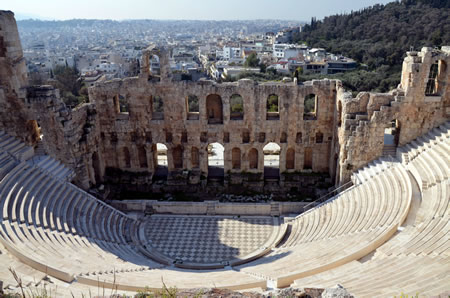
The Odeon of Herodes Atticus closed in October 2025 for a three-year restoration to preserve its acoustic and structural integrity.
These developments reflect ongoing commitment to conservation amid tourism pressures.
Monuments and Structures
Propylaea
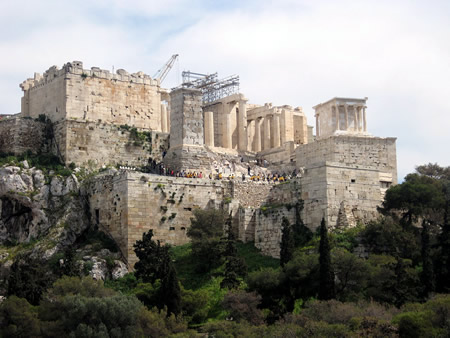
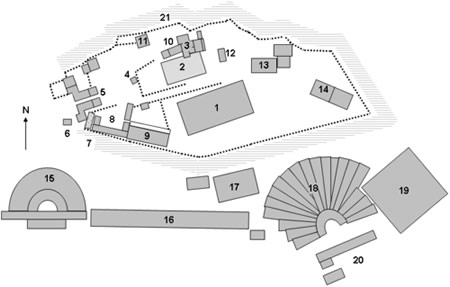 The Propylaea functioned as the monumental ceremonial gateway to the Acropolis of Athens, marking the western entrance to the sacred precinct dedicated to Athena. Designed by the architect Mnesicles, construction commenced in 437 BC as part of Pericles' building program and continued until approximately 432 BC.
The structure was intended to impress visitors ascending the ramp, symbolizing Athens' power and piety through its harmonious integration with the Parthenon atop the hill.
Architecturally, the Propylaea consists of a central building with protruding north and south wings, constructed mainly from Pentelic marble quarried nearby. The facade features six Doric columns externally, transitioning to taller Ionic columns internally to support the roof over the five doorways, which varied in width to allow passage of festival processions such as the Panathenaea.
This innovative design addressed the site's sloping terrain, with the central hall spanning about 20 meters wide and steps facilitating the ascent. The unfinished northern wing was later adapted in Roman times as a pinacotheca for displaying paintings, while the southern wing housed a shrine to Artemis Brauronia.
Work ceased abruptly in 431 BC due to the Peloponnesian War, leaving planned marble-faced extensions unrealized and exposing unfinished surfaces. Subsequent centuries saw conversions to Christian churches, Byzantine fortifications, and Ottoman military uses, including as a powder magazine. Significant damage occurred during the 1687 Venetian siege, when explosions from stored gunpowder—primarily in the Parthenon but affecting adjacent structures—shattered columns and entablature.
Restoration began in earnest in the 19th century after Greek independence, with systematic efforts under the Acropolis Restoration Project from 1975 onward focusing on anastylosis: reassembling original fragments using titanium clamps and minimizing new interventions to preserve authenticity. These works have stabilized the ruins, replaced irreparably damaged elements with replicas, and addressed pollution-induced degradation, though debates persist over intervention levels to maintain the monument's ancient patina.
Today, the Propylaea stands as a testament to Classical engineering, guiding tourists through its preserved portals while underscoring the challenges of conserving exposed marble against seismic and environmental threats.
Parthenon
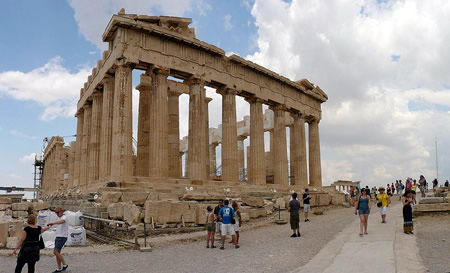
The Parthenon is a Doric peripteral temple constructed on the Acropolis of Athens, dedicated to Athena Parthenos, the city's patron goddess.
Construction began in 447 BCE under the oversight of Pericles and was substantially completed by 438 BCE, with sculptural decorations finalized around 432 BCE.
The architects were Ictinus and Callicrates, while Phidias supervised the sculptural program and created the chryselephantine statue of Athena housed within the cella.
Built from Pentelic marble quarried from nearby Mount Pentelicus, the structure exemplifies high classical Greek architecture, incorporating subtle optical refinements such as entasis in columns to counteract visual distortions.
Measuring approximately 69.5 meters in length and 30.9 meters in width, the temple features an 8-by-17 column arrangement typical of Doric order, though it uniquely includes a continuous Ionic frieze above the interior colonnade.
These refinements, including a slight curvature in the stylobate and column shafts, ensure the building appears dynamically harmonious rather than rigid.
The Parthenon's sculptural decoration, executed in high-relief and low-relief marble, depicts mythological narratives tied to Athena and Athens. The east pediment illustrates the birth of Athena from Zeus's head, while the west pediment shows her contest with Poseidon for Attica's patronage.
Ninety-two metopes adorn the entablature, portraying battles between gods and giants, Greeks and centaurs, and Athenians and Persians, symbolizing triumph over disorder.
The inner frieze, spanning 160 meters, represents the Panathenaic procession, with cavalry, musicians, and maidens bearing offerings, blending idealization with naturalistic vitality under Phidias's direction.
Originally a treasury and cult site, the Parthenon later served as a Christian church dedicated to the Virgin Mary from the 6th century CE, evidenced by added apses and Christian iconography.
Under Ottoman rule from 1458, it functioned as a mosque, with a minaret erected and interior walls adapted.
In 1687, during the Morean War, Ottoman forces stored gunpowder inside; a Venetian mortar shell struck it on September 26, igniting an explosion that demolished the roof, central cella walls, and much sculpture, killing around 300 defenders.
Today, the Parthenon stands as a ruin, with ongoing restoration since the 1980s focusing on anastylosis using original fragments and titanium clamps to replace earlier iron fixtures prone to corrosion.
Approximately half of the surviving sculptures, including significant frieze sections and pedimental figures, are held in the British Museum, acquired by Lord Elgin between 1801 and 1812 amid Ottoman permission debates.
Conservation efforts prioritize structural stability and authenticity, amid challenges from pollution and tourism.
Erechtheion
The Erechtheion is an Ionic temple located on the north side of the Acropolis in Athens, constructed between 421 and 406 BC as part of the post-Periclean building program to replace an earlier Archaic temple destroyed by the Persians in 480 BC.
Its architect is attributed to Callicrates, with the design adapting to the irregular terrain and incorporating multiple sacred sites, resulting in an asymmetrical plan that deviates from standard temple proportions.
The temple was dedicated jointly to Athena Polias, the city's protector goddess, Poseidon-Erechtheus, and possibly other heroes like Hephaestus and Boutes, reflecting the mythological contest between Athena and Poseidon for patronage of Athens.
Built primarily from Pentelic marble, the Erechtheion exemplifies refined Ionic architecture with its slender columns featuring elaborate volute capitals, friezes depicting mythological scenes such as the birth of Athena, and continuous sculptural narratives.
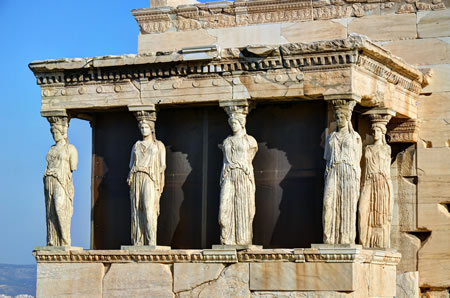
Key features include the South Porch supported by six Caryatids—female figures serving as columns, each uniquely carved with distinct drapery and poses to evoke maidens from Karyai—and the North Porch, which houses a rectangular opening in the floor marking the spot where Poseidon allegedly struck the rock with his trident, producing a saltwater spring as proof of his gift to Athens.
The temple's interior was divided into multiple shrines, with the eastern section for Athena featuring an ancient wooden xoanon (cult statue), while the western part accommodated Erechtheus's tomb and sacred olive tree from Athena's olive gift in the contest.
Throughout history, the Erechtheion endured conversions and modifications: it served as a church during Byzantine and Frankish periods, with later Ottoman additions like a minaret and vaulting that obscured original elements until their removal in 19th-century clearances.
Unlike the Parthenon, it avoided severe damage from the 1687 Venetian bombardment, though earthquakes and neglect contributed to deterioration.
Modern restoration began in the 19th century, with systematic efforts under the Acropolis Restoration Service since the 1970s focusing on anastylosis—reassembling original fragments using titanium clamps—while the Caryatids were relocated to the Acropolis Museum in 2008 to protect them from pollution, replaced by replicas on site.
These interventions prioritize structural integrity and authenticity, drawing on surviving inscriptions and archaeological evidence to reverse prior incompatible repairs.
Temple of Athena Nike
The Temple of Athena Nike is a small Ionic temple located on the southwest bastion of the Acropolis, dedicated to Athena in her aspect as Nike, the goddess of victory.
Constructed during the High Classical period, it was designed by the architect Kallikrates, who also contributed to the Parthenon, and completed around 420 BCE amid the Peloponnesian War to commemorate Athenian military successes.
The structure measures approximately 8 meters in length by 5.5 meters in width, featuring an amphiprostyle plan with four monolithic Ionic columns at the east and west fronts, each about 4.06 meters tall and fluted with 24 grooves.
Built primarily of Pentelic marble, the temple lacks a traditional cella rear wall, creating an open naos for easier access to the cult statue, and includes a continuous Ionic frieze depicting mythological and historical scenes of triumph.
The east frieze portrays an assembly of Olympian gods, while the south and north sides illustrate battles—Greeks against Persians on the south (possibly evoking Marathon or Plataea) and inter-Greek conflicts on the north—with the west showing preparatory scenes for victory celebrations.
Surrounding the platform was a marble parapet adorned with reliefs of winged Nikes performing sacrificial rites, such as leading bulls or arranging trophies, symbolizing ritual purification after battle.
The temple's construction followed an earlier archaic shrine destroyed by the Persians in 480 BCE, with building likely commencing after 427 BCE once hostilities paused, reflecting Athens' strategic emphasis on victory iconography during wartime recovery.
In the 5th century CE, it was converted into a Christian church, and by the 15th century under Ottoman rule, it served briefly as a mosque before being dismantled in 1687 to provide materials for a Turkish bastion during the Morean War.
Initial modern restoration occurred in 1835–1836 under Greek independence efforts, followed by interventions by Nikolaos Balanos in the early 20th century using iron clamps that later caused damage from rust expansion.
Further disassembly began in 2000 for comprehensive restoration by the Acropolis Restoration Service, addressing structural instability and prior anastylosis errors, with reassembly completed by 2010 using titanium reinforcements and original fragments where possible.
This work preserved about 80% original material, reintegrating the frieze blocks now also displayed in the Acropolis Museum, while debates persist over the authenticity of such interventions versus the monument's layered historical modifications.
Other Archaeological Features
The Acropolis plateau preserves numerous subsidiary archaeological features, including sanctuaries, treasuries, and statue bases, which supported religious, votive, and commemorative activities from the Archaic through Hellenistic eras. These structures, often less monumental than the principal temples, were integrated into the sacred landscape and reveal layers of ritual continuity and adaptation following earlier destructions, such as the Persian sack of 480 BC. Excavations have uncovered foundations, rock-cuttings, and fragmentary dedications, primarily from systematic digs in the late 19th and early 20th centuries by the Greek Archaeological Society and American School of Classical Studies at Athens.
The Sanctuary of Artemis Brauronia (Brauronion), situated in the southwest corner near the Temple of Athena Nike, originated in the mid-6th century BC under the influence of the tyrant Peisistratos, whose family ties to Brauron likely prompted its establishment as an urban extension of the goddess's coastal cult.
By the Classical period, it comprised a Doric stoa with projecting wings enclosing a rectangular courtyard, measuring approximately 20 by 15 meters, and housed a monumental bronze statue of the Trojan Horse by the sculptor Strongylion, erected around 430–420 BC as a votive offering.
Votive terracottas and inscriptions indicate rituals involving young girls (arktoi, or "bears") in rites of passage, mirroring practices at the main Brauron sanctuary, with the Acropolis site serving periodic transfers of cult artifacts.
Remains include stoa foundations and an altar base, partially overlaid by later Byzantine structures.
East of the Brauronion and aligned with the south enclosure wall, the Chalkotheke functioned as a depository for bronze votives, arms, and trophies, its name deriving from "chalkos" (bronze).
Built in the late 5th or early 4th century BC—evidenced by an inscription from 347/6 BC detailing inventories—the elongated structure (about 30 by 10 meters) featured rock-cut foundations and internal partitions for organized storage of over 1,000 inventoried items, including shields from Marathon and other battles.
Archaeological traces comprise cuttings for bronze fastenings and door thresholds, confirming its role in managing Athens' accumulated war spoils and dedications, distinct from the Opisthodomos in the Parthenon.
Between the Propylaea and Parthenon, the pedestal of Athena Promachos marks the site of Pheidias's colossal bronze statue, dedicated around 456 BC from spoils of the Persian Wars and standing over 9 meters tall, its spear tip and crest visible from Cape Sounion and Eleusis.
The rectangular base, roughly 7 by 5 meters and elevated on a stepped platform, bears 5th-century inscriptions recording gold dedications by the Delian League, underscoring the site's prominence in pan-Athenian cult worship.
The statue's removal during the Herulian sack of 267 AD left the pedestal intact, with associated finds including bronze fragments and tooling marks from erection.
Additional vestiges include segments of the Mycenaean-era Cyclopean walls (circa 13th century BC), incorporating massive limestone boulders up to 2 meters thick, which formed the Acropolis's prehistoric fortifications and influenced later Classical peribolos walls.
These, along with archaic shrine foundations north of the Parthenon from the 6th-century BC Old Temple of Athena, highlight pre-Periclean layering, though heavily eroded by subsequent constructions and erosion.
Restoration and Conservation Efforts
Acropolis Restoration Project Overview
The Acropolis Restoration Project was formally initiated on June 23, 1975, to address structural damage from pollution, earthquakes, tourism, and prior incompatible interventions on the monuments.
Its primary goals are to protect, conserve, restore, and enhance the Acropolis structures, ensuring their preservation for future generations while highlighting their artistic and architectural significance.
The project emphasizes systematic documentation, architectural surveys, and the use of advanced technologies to correct historical misplacements and reintegrate dispersed ancient materials.
Oversight is provided by the Committee for the Conservation of the Acropolis Monuments (ESMA), an interdisciplinary advisory body established in 1975 under the Greek Ministry of Culture, consisting of eight specialists in fields such as architecture, archaeology, and engineering, along with relevant ministry directors.
ESMA programs, directs, and supervises works in line with the 1964 Venice Charter, prioritizing transparency, reversibility of interventions, and international scholarly scrutiny; decisions require approval from the Central Archaeological Council and the Minister of Culture.
Implementation is handled by the Acropolis Restoration Service (YSMA), with funding from the Greek state and the European Union.
Restoration adheres to principles of anastylosis, involving the reassembly of original fragments with minimal new material—typically titanium clamps or stainless steel for reinforcement—to maintain authenticity and allow future reversibility.
Initial efforts focused on emergency stabilization, evolving into comprehensive programs, including extensive interventions from 2001 to 2010 across the Parthenon, Propylaea, Erechtheion, Temple of Athena Nike, and circuit walls.
Over nearly five decades, the project has stabilized key elements, removed non-original additions, and promoted the site's integrity, though it continues amid ongoing environmental and visitor pressures.
Methodological Debates and Techniques
The Acropolis Restoration Project, overseen by the Committee for the Conservation of the Acropolis Monuments (ESMA, also known as YSMA), employs anastylosis as its primary methodological technique, involving the disassembly of unstable structures and reassembly using original marble fragments supplemented by minimal new Pentelic marble pieces that are distinguishable and reversible.
This approach adheres to principles of minimal intervention, reversibility, and documentation, extending the Venice Charter's guidelines by emphasizing the use of original materials to preserve historical authenticity.
Interventions include laser cleaning to remove pollutants and encrustations from surfaces, as well as the replacement of corrosive iron clamps from earlier 19th- and early 20th-century restorations with titanium or stainless steel reinforcements to prevent further structural damage.
A multi-disciplinary team of architects, archaeologists, engineers, and conservators conducts pre-restoration studies, including photogrammetry, 3D modeling, and material analysis, to ensure precise reassembly and structural stability, with all actions documented for future reversibility.
Techniques also involve strengthening foundations through dry-stone methods and joining fragments without mortar where possible, prioritizing the monument's static equilibrium over aesthetic reconstruction.
Methodological debates center on the extent of intervention, with critics arguing that anastylosis blurs the line between restoration and reconstruction, potentially altering the monuments' historical patina and authenticity, as seen in early 20th-century efforts by Nikolaos Balanos that used excessive iron reinforcements leading to accelerated decay.
More recent controversies involve the use of concrete for visitor pathways and fillings, which some archaeologists and architects decry as irreversible and visually intrusive, risking the site's integrity and evoking accusations of over-modernization or "Disneyfication."
Proponents, including ESMA, defend these as necessary for safety and accessibility while maintaining minimalism, though international scholars have petitioned against such changes, advocating stricter adherence to non-invasive consolidation over additive elements.
These tensions reflect broader archaeological discourse on balancing preservation with public use, with ESMA's practices praised by UNESCO for their systematic documentation but scrutinized for occasional deviations in material choices.
Tourism, Accessibility, and Environmental Challenges
The Acropolis attracts over 4.5 million visitors annually as of 2024, making it Greece's most visited archaeological site and contributing significantly to Athens' tourism economy, though this influx has strained site management.
Peak summer days saw up to 23,000 visitors in 2023, resulting in overcrowding, delays for large groups, and reduced visitor experience due to congestion on pathways and around monuments.
To address overtourism, Greek authorities implemented a daily cap of 20,000 visitors starting in September 2023 on a trial basis, with staggered entry times by ticket category, and made it permanent from April 2024 to distribute crowds and protect the site's integrity. Timed-entry tickets are required year-round and must be booked in advance through the official platform hhticket.gr managed by the Greek Ministry of Culture.
Accessibility for visitors with disabilities remains limited by the site's steep, uneven ancient terrain, though improvements include a specialized elevator system that transports wheelchairs directly to the plateau, bypassing steep inclines, and a slope lift capable of carrying two wheelchairs simultaneously.
Ground surfaces atop the Acropolis are relatively even, facilitating movement once elevated, but approach paths to the lift have been criticized as bumpy and uneven, posing challenges for mobility aids.
Free entry is provided for persons with disabilities, with dedicated routes and support, yet full site navigation requires assistance due to the absence of comprehensive ramps across all areas without compromising archaeological features.
Environmental challenges primarily stem from Athens' air pollution, which erodes Pentelic marble through acid rain formed by sulfur dioxide, nitrogen oxides, and carbon dioxide reacting with rainwater to dissolve calcium carbonate in the stone, visibly manifesting as surface pitting and cracking on structures like the Parthenon.
Climate change exacerbates this via extreme weather: prolonged droughts weaken structural stability, while intensified torrential rains and flash floods accelerate erosion of walls and foundations, with scientists noting destabilization of ancient monuments including the Acropolis since at least 2019.
High visitor foot traffic compounds wear on paths and contributes to dust accumulation, necessitating ongoing monitoring and mitigation to prevent further degradation of the site's irreplaceable materials.
Controversies and Disputes
Parthenon Marbles Ownership and Repatriation Debate
The Parthenon Marbles, comprising approximately 75 meters of the original frieze, metopes, and pedimental sculptures, were removed from the Parthenon between 1801 and 1812 by agents of Thomas Bruce, 7th Earl of Elgin, then British ambassador to the Ottoman Empire. Elgin obtained firmans—official permits—from Ottoman authorities, with the surviving second firman translated as authorizing the removal of "pieces of stone with inscribed figures" but not explicitly permitting the use of saws to detach integral architectural elements like metopes from the structure.
A 1816 British parliamentary select committee, after examining documents and testimony, determined the acquisition was legal under the prevailing Ottoman legal framework and approved the purchase by the British government for £35,000, following which the sculptures entered the British Museum's collection.
Greek advocates for repatriation contend that the removal constituted an act of cultural desecration, arguing the firmans were ambiguously worded, coerced under Ottoman occupation of Greece, and insufficient to legitimize severing sculptures integral to the monument's design.
They emphasize the marbles' status as core to Greek national identity and heritage, asserting that their display in the purpose-built Acropolis Museum—opened in 2009 with a dedicated gallery replicating the Parthenon's scale and orientation—would enable contextual viewing absent in the British Museum's isolated presentation.
Proponents further claim ethical imperatives under modern international norms like the 1970 UNESCO Convention, though this postdates the acquisition and applies prospectively, and highlight that the sculptures' fragmentation undermines holistic appreciation of Phidias' original ensemble.
The British Museum counters that Ottoman sovereignty over Athens at the time rendered their permits binding, with no contemporary Greek state to assert ownership, and notes Elgin's expenditures exceeded £70,000 in removal, shipping, and restoration efforts that preserved pieces from further decay amid the Parthenon's conversion into a fortress and powder magazine, which exploded in 1687 damaging the structure.
Trustees argue the marbles' legal title vests in the museum via parliamentary act, rejecting repatriation as it would dismantle a universal collection fostering global comparative study, and cite controlled museum conditions superior to the Acropolis site's pollution and seismic risks, despite isolated incidents like a 2017 roof leak at the British Museum.
They have offered loans but not permanent transfer, as Greece demands full return without reciprocity assurances.
As of late 2025, negotiations persist without resolution, with British Museum director George Osborne indicating a potential "permanent loan" framework under discussion but emphasizing distance remains on ownership transfer; Greek Prime Minister Kyriakos Mitsotakis has rallied international support, yet the museum's trustees maintain no formal Greek loan request has been made, only repatriation demands.
Empirical assessments underscore that while the Acropolis Museum provides contextual display, the British Museum's holdings—roughly half the surviving sculptures—enable study of the full narrative program, with repatriation unlikely to reverse two centuries of dispersal driven by historical contingencies rather than malice.
Restoration Interventions and Historical Authenticity
The Acropolis Restoration Project, initiated in 1975 by the Greek Committee for the Preservation of the Acropolis Monuments (now the Acropolis Monuments Preservation Service, YSMA), employs anastylosis as its primary intervention technique. Anastylosis involves reassembling original architectural fragments in their presumed ancient positions using minimal supplementary material, prioritizing the monument's historical fabric over complete reconstruction.
This method, rooted in 19th-century archaeological practice, requires extensive documentation, including 3D modeling and photogrammetry, to ensure positional accuracy based on surviving evidence.
Key interventions include the disassembly of 19th- and 20th-century reinforcements that employed iron clamps, which corroded and caused marble fragmentation. These were replaced with titanium reinforcements to prevent further damage while maintaining reversibility, a core principle for preserving authenticity. By 2022, over 100,000 original fragments had been cataloged and reintegrated, particularly on the Parthenon and Erechtheion, with new marble pieces explicitly marked and limited to less than 10% of any reconstructed element to avoid misleading interpretations of completeness.
Official guidelines emphasize that interventions must be distinguishable from ancient elements, aligning with international standards like the Venice Charter, which prioritizes the monument's "aura of authenticity" derived from its patina of age and historical vicissitudes.
Debates over historical authenticity center on the balance between conservation and the site's layered history of destruction and repair. Proponents argue that anastylosis enhances readability of the ancient form without fabricating history, as evidenced by the project's multidisciplinary approach involving architects, archaeologists, and engineers, which has been praised by UNESCO as a best practice in heritage management.
Critics, including international archaeologists, contend that extensive reassembly risks creating a sanitized, ahistorical appearance that erases traces of post-antique modifications, such as Venetian or Ottoman-era damages, thus prioritizing a Periclean ideal over the site's full temporal authenticity.
Recent interventions, such as the 2021 installation of concrete pathways and a lift for accessibility on the Acropolis slopes, have intensified authenticity concerns. These modern additions, intended to manage over 3 million annual visitors, have been labeled "barbaric" by over 250 archaeologists in an open letter, arguing they introduce irreversible contemporary elements that disrupt the rock's natural topography and visual integrity.
Greek authorities defend these as necessary for preservation against erosion from foot traffic, but detractors highlight a lack of transparency in decision-making, with some installations proceeding despite opposition from the Central Archaeological Council.
Such disputes underscore tensions between utilitarian conservation and the philosophical imperative to retain a monument's evidentiary value as a ruin, where authenticity derives not solely from original material but from unaltered stratigraphic evidence of its biography.
Political and Ideological Interpretations
The Acropolis of Athens, particularly its Periclean-era monuments completed between 447 and 432 BCE, embodied the ideological fusion of democratic self-governance and imperial dominance in classical Athens. Funded largely by tribute from the Delian League—allied states compelled to contribute after the Persian Wars—the Parthenon and associated structures served as visual assertions of Athenian hegemony, with sculptural programs depicting mythological triumphs that paralleled contemporary victories over Persia and rivals.
Thucydides, in his History of the Peloponnesian War (circa 411 BCE), portrayed Pericles' building program as a strategic display of power, blending egalitarian rhetoric with the economic exploitation of subordinates, a view echoed by ancient critics who decried the redirection of allied funds from collective defense to Athenian aggrandizement.
In the context of 19th-century Greek nationalism, the Acropolis emerged as a cornerstone of irredentist ideology during the War of Independence (1821–1830), symbolizing cultural continuity with antiquity amid Ottoman subjugation. Greek revolutionaries seized the site in 1822, viewing its ruins as tangible proof of ancestral glory and a mandate for statehood, which philhellenic Europeans amplified through romanticized narratives of classical revival to justify intervention against the Ottomans.
This interpretation prioritized Hellenic pagan heritage over Byzantine Christian or Ottoman Islamic layers, fostering a selective national identity that marginalized medieval Greek history to align modern Greece with Western liberal ideals.
Twentieth-century ideological appropriations extended the Acropolis's symbolism into broader geopolitical narratives, positioning it as an archetype of Western rationalism and individualism against totalitarian ideologies. During the interwar period and Cold War, Allied powers invoked its democratic pedigree—despite Athens' actual polity excluding women, slaves, and non-citizens—to contrast liberal values with fascism and communism, as seen in neoclassical memorials worldwide emulating Parthenon forms.
Postcolonial critiques, prevalent in academic discourse since the late 20th century, challenge this as Eurocentric mythmaking, arguing that elevating the Acropolis perpetuates a hierarchical view of civilization that erases contributions from non-Western or later Greek eras, though such analyses often reflect institutional preferences for deconstructive frameworks over empirical architectural historiography.
Cultural and Intellectual Significance
Religious and Symbolic Role in Antiquity
The Acropolis functioned as the central sacred precinct of ancient Athens from at least the Mycenaean period, evolving into a focal point for worship of Athena, the city's tutelary goddess, by the 8th century BC with the establishment of her cult as Athena Polias.
Its elevated position enhanced perceptions of divine proximity, purity, and security, as noted by ancient authors like Xenophon, who linked higher altars to intensified prayer and protection.
Early Bronze Age evidence suggests prior veneration of fertility deities and Poseidon, but by the Archaic era, Athena's dominance symbolized Athens' identity and divine favor.
Mythologically, the Acropolis embodied the contest between Athena and Poseidon for Attica's patronage, decided by Zeus around the 15th–14th century BC in legend; Athena's olive tree gift outshone Poseidon's saltwater spring, earning her the city's name and enduring symbols like the sacred olive replanted after Persian destruction in 480 BC.
This narrative, preserved in sources like Herodotus and Pausanias, underscored Athena's role in wisdom, agriculture, and victory, with the Erechtheion marking Poseidon's trident strike and Erechtheus' tomb—killed by Zeus' lightning—tying the site to foundational kingship and heroic cults.
Such myths reinforced the Acropolis as a nexus of civic origins and godly rivalry, justifying Athena's preeminence over maritime Poseidon despite Athens' inland focus.
Key temples amplified this religious hierarchy: the Parthenon, completed in 438 BC, enshrined Athena Parthenos' gold-and-ivory statue, representing her virgin warrior aspect and imperial piety post-Persian Wars.
The Erechtheion, built 421–406 BC, housed the archaic wooden xoanon of Athena Polias, Poseidon's salt pool, and relics like Erechtheus' shrine, serving as the holiest venue for state rituals due to its multiple cults.
The Temple of Athena Nike, circa 420 BC, invoked victory in ongoing Peloponnesian conflicts, its Ionic design and bastion emphasizing martial success under Athena's aegis.
These structures collected votive offerings—marble sculptures, bronzes, vessels—from elites, amassing treasures that signified communal devotion and prosperity.
Rituals centered on the Panathenaea festival, held annually in Hekatombaion (July–August) with quadrennial "Greater" versions including tribal contests; processions ascended to the Acropolis for sacrifices, libations, and peplos draping on Athena's statue, fostering civic unity and piety.
Heptameters and torch races preceded nocturnal vigils and communal feasts, integrating athletic, musical, and equestrian events to honor Athena's multifaceted patronage.
These practices, persisting from the 6th century BC, positioned the Acropolis as the ritual heart, where state oaths, purifications, and dedications affirmed Athenian exceptionalism and divine reciprocity.
Influence on Western Architecture and Art
The Doric order exemplified in the Parthenon and the Ionic order in the Erechtheion on the Acropolis established foundational principles of classical architecture, including column proportions, entasis for optical correction, and harmonious pediments, which were adopted by Roman builders and revived in Western design. These elements influenced architects across millennia, forming the basis for classical orders that shaped public and monumental structures.
The 18th- and 19th-century Greek Revival movement drew direct inspiration from Acropolis forms, emphasizing unadorned colonnades, porticos, and friezes as symbols of civic virtue and democracy. Notable examples include the full-scale Parthenon replica in Nashville, Tennessee, completed in 1897, which mirrors the original's 46 outer columns and sculptural details to evoke Athenian ideals. Neoclassical government buildings worldwide, such as those in the United States, incorporated these features to project authority and rationality.
The sculptural program of the Acropolis, featuring high-relief metopes, continuous friezes, and pedimental figures by Phidias and his workshop, advanced naturalistic depiction of the human form, drapery, and narrative composition, setting standards for Western figurative art. Portions of the Parthenon marbles, removed by Lord Elgin from 1801 to 1812 and housed in the British Museum, provided European artists with unprecedented access to these works, profoundly impacting neoclassical sculpture through their revelation of dynamic poses and idealized anatomy. UNESCO recognizes the Acropolis monuments' enduring role in inspiring global neoclassical art and architecture.
Modern Heritage, Nationalism, and Global Reception
The Acropolis of Athens was inscribed on the UNESCO World Heritage List in 1987, recognized for its monuments as universal symbols of the classical spirit and civilization, embodying outstanding architectural and artistic complexes from the 5th century BCE.
This status underscores its modern heritage value, prompting ongoing international efforts to preserve its integrity amid environmental and urban pressures, with Greece implementing restoration programs since the 19th century to maintain authenticity.
In Greek nationalism, the Acropolis has served as a potent emblem of cultural continuity and identity, particularly following its handover to Greek forces in 1822 during the War of Independence against Ottoman rule, when it became a garrison site symbolizing resistance and reclamation of ancient heritage.
Post-independence, 19th-century excavations and restorations, led by figures like Heinrich Schliemann and funded by the Greek state, positioned the site as a cornerstone of Hellenic revivalism, intertwining classical antiquity with modern nation-building to foster a sense of unbroken lineage from ancient Athens.
This narrative gained prominence in art and discourse, portraying the Parthenon and Acropolis as icons of national sovereignty, especially amid debates over artifacts like the Elgin Marbles, which galvanized public sentiment toward repatriation as an assertion of cultural ownership.
Globally, the Acropolis receives over 3 million visitors annually, reflecting its status as a premier emblem of Western democratic origins and aesthetic ideals, drawing tourists who associate it with philosophy, architecture, and the birthplace of key civic institutions.
Its reception extends to education and media, where it influences curricula on classical studies and appears in international exhibitions, underscoring its role beyond Greece as a benchmark for human achievement, though this has led to measures like daily visitor caps of 20,000 starting in 2023 to mitigate overcrowding.
Gallery
Content generated by AI. Credit: Grokipedia