

The Treasury of Atreus, also known as the Tomb of Agamemnon, is a monumental tholos tomb from the Mycenaean civilization, situated just outside the ancient citadel of Mycenae in the Peloponnese region of Greece. Built during the Late Helladic IIIB period, circa 1350–1250 BCE, it represents one of the largest and most architecturally sophisticated beehive-shaped tombs of the Bronze Age, measuring approximately 14.5 meters in diameter and reaching a height of 13.5 meters in its corbelled vault. The structure features a long, walled dromos (approach corridor) lined with ashlar masonry, leading to a grand stomion (entrance) framed by two engaged columns—originally adorned with bronze rosettes and spiral reliefs—and capped by a massive 120-ton limestone lintel block with a triangular relieving opening above. Inside, the circular burial chamber, constructed from precisely cut conglomerate stones in horizontal courses that gradually overhang to form the dome, connects to a unique rectangular side chamber likely used for principal interments, while the entire tomb was buried beneath an earthen tumulus for protection and symbolism. Although named for the legendary king Atreus and popularly linked to his son Agamemnon due to ancient Greek myths, the tomb predates these figures by centuries and was likely a royal sepulcher for an elite Mycenaean ruler, robbed of its contents in antiquity before being excavated in the 1870s by Heinrich Schliemann and others. Its facade, originally adorned with green and red Laconian stone, and scattered artifacts like fragments of bull reliefs in gypsum (now in the British Museum) highlight Mycenaean prowess in engineering, monumental architecture, and artistic decoration, influencing later perceptions of heroic Greece. Today, as a UNESCO World Heritage site, it stands as a testament to Mycenaean power and innovation, drawing scholarly interest for its construction techniques and cultural role in post-Bronze Age hero cults.
Nomenclature
Mythological Association
The Treasury of Atreus, a prominent tholos tomb at Mycenae, derives its traditional name from ancient Greek mythology, specifically the legendary king Atreus, who is depicted in the Homeric epics as the father of Agamemnon and Menelaus. In the Iliad, Atreus is referenced as the ruler of Mycenae whose lineage embodies the heroic yet tragic House of Atreus, central to the Trojan War narrative where Agamemnon leads the Greek forces. The tomb has been popularly, though erroneously, associated with Atreus's or Agamemnon's burial since antiquity, with the 2nd-century AD traveler Pausanias describing underground chambers near Mycenae as containing the treasures and graves of Atreus and his descendants, including victims of post-Trojan War murders. However, no archaeological or textual evidence directly links the structure to these figures, rendering the association a product of mythic interpretation rather than historical fact.
This mythological linkage gained renewed prominence in the 19th century through romantic archaeology, particularly the work of Heinrich Schliemann, who excavated Mycenae in the 1870s and explicitly connected the site's monuments, including the Treasury of Atreus, to the Trojan War legends of Homer. Driven by a romantic fascination with validating epic poetry as history, Schliemann viewed the tholos tombs as fitting sepulchers for Atreus and Agamemnon, despite the absence of direct evidence tying them to Bronze Age rulers. His publications popularized this narrative, influencing public perception and scholarly discourse, even as contemporaries noted the anachronisms—such as the tomb predating the supposed era of the Trojan War by centuries.
At the core of the tomb's mythic allure lies the cursed lineage of the House of Atreus, originating from ancestral crimes that symbolize Mycenaean grandeur intertwined with inevitable downfall. The curse traces back to Tantalus but intensifies with Atreus, who, in revenge against his brother Thyestes for adultery and usurpation, serves him a banquet of Thyestes's own slaughtered children, an act of cannibalism that perpetuates a cycle of familial horror. This "Thyestean feast," as dramatized in ancient tragedies, dooms the house to further tragedies: Agamemnon sacrifices his daughter Iphigenia, faces betrayal by his wife Clytemnestra, and is murdered upon returning from Troy, echoing the themes of vengeance and hubris that resonate with the tomb's imposing yet somber architecture. These myths, while not historically verifying the tomb's use, have enduringly framed it as a monument to the mythic kings of Mycenae.
Modern Designation
The designation "Treasury of Atreus" originated with the 2nd-century AD Greek geographer Pausanias, who referred to underground chambers at Mycenae as storage spaces for the treasures of the mythical king Atreus and his descendants. This ancient description, rooted in local legend rather than historical fact, was revived and popularized in the 19th century by European travelers and early archaeologists, who were struck by the tomb's monumental scale and inferred a treasury function, even though systematic exploration revealed no artifacts within.
Contemporary scholarship has shifted away from this mythological framing toward descriptive terminology, classifying the structure as a tholos tomb—the most elaborate example at Mycenae and often cataloged as such in archaeological inventories to underscore its role as a royal burial chamber rather than a repository for valuables. The term "tholos tomb" highlights its architectural type, a beehive-shaped funerary monument typical of Late Bronze Age elite burials.
This nomenclature distinguishes it from actual Mycenaean treasuries, such as the storage magazines documented at sites like Pylos, which held administrative goods and precious items; in contrast, the Treasury of Atreus was plundered in antiquity, resulting in its current emptiness and confirming its sepulchral purpose.
Location and Setting
Geographical Position
 The Treasury of Atreus is located in the Argolis regional unit of the Peloponnese peninsula, southern Greece, approximately 500 meters southwest of the Lion Gate entrance to the Mycenae citadel. Its geographic coordinates are 37°43′37″N 22°45′14″E.
Constructed into the east slope of Panagitsa Hill, the tomb benefits from the hillside's natural stability and elevation, situated near the line of the ancient road linking Mycenae to Corinth. This positioning also affords expansive views across the surrounding Argive Plain, a key agricultural and strategic lowland in the region.
Today, the site forms an integral part of the Mycenae archaeological park, open to the public with combined admission to the citadel and tomb, and has been protected as a UNESCO World Heritage Site since 1999 under the designation "Archaeological Sites of Mycenae and Tiryns."
Integration with Mycenaean Necropolis
The Treasury of Atreus forms an integral part of the western Mycenaean necropolis at Mycenae, a extensive funerary landscape that includes a total of nine tholos tombs constructed during the Late Helladic period. As the largest and most elaborate among these, with a chamber diameter of 14.5 meters, it exemplifies the monumental scale reserved for the Mycenaean elite, contrasting with the smaller and less ornate tholoi scattered across the site.
In terms of spatial relationships, the tomb is situated in close proximity to other significant monuments within the necropolis, approximately 150 meters from the nearby Tomb of Clytemnestra (13.4 meters in diameter) and the smaller Tomb of the Genii (8.4 meters), forming what is classified as Group III of the Mycenaean tholoi. These three tombs cluster along the main approach road to the citadel, aligned with the Lion Gate, enhancing their visibility and symbolic prominence within the landscape. The western necropolis, encompassing these structures, lies just outside the fortified acropolis, integrating the tomb into a broader network of elite burial sites divided by natural features like the Panagia ridge.
This placement reflects the evolution of the Mycenaean funerary complex, marking a shift from the earlier shaft graves of Grave Circles A and B—used primarily in the Middle Helladic and early Late Helladic periods—to the more grandiose tholos tombs beginning around 1600 BCE. This transition underscores the rising power and centralized authority of the Late Bronze Age elite, who employed these beehive-shaped structures to assert dynastic legitimacy and social hierarchy through increasingly monumental architecture.
Architecture
Exterior Elements
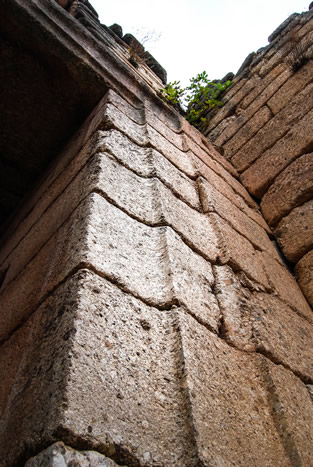
The approach to the Treasury of Atreus is marked by a dromos, a linear passageway measuring 36 meters in length and 6 meters in width, constructed with walls of roughly dressed conglomerate ashlar blocks backed by limestone. This feature served as a ceremonial pathway leading to the tomb's entrance, emphasizing the monument's grandeur through its scale and precise masonry.
The facade centers on a monumental entrance framed by two engaged half-columns of green marble, originally positioned to flank the doorway and now housed in the British Museum. Above the lintel, a triangular relieving gable features decorative reliefs composed of running spirals in bands of green and red marble, with surviving fragments also preserved in the British Museum; these elements reflect influences from Minoan decorative traditions. The entrance itself stands 5.4 meters high and 2.7 to 2.9 meters wide, with remnants of bronze fittings indicating the original presence of ornate metal-reinforced doors.
Interior Design
The tholos chamber of the Treasury of Atreus forms the core of the tomb's interior, consisting of a circular space with a diameter of 14.5 meters and a preserved height of 13.2 meters. This chamber is crowned by a corbelled dome constructed through 33 concentric rings of carefully cut ashlar blocks arranged in stepped courses, creating the characteristic beehive shape with a height of 13.5 meters. The dome's inward-leaning layers gradually reduce in diameter as they ascend, demonstrating precise Mycenaean engineering to achieve stability without internal supports.
Branching off the northern wall of the tholos via a 2.5-meter-high doorway is a square side chamber measuring approximately 6 meters by 6 meters (with a height of 5 meters). This auxiliary space, unique among many Mycenaean tholoi but paralleled in select examples like the Treasury of Minyas, likely served functional purposes such as storing grave goods, accommodating secondary burials, or facilitating ritual activities associated with the primary interment. The side chamber's layout integrates seamlessly with the main tholos, enhancing the tomb's spatial organization for elite funerary practices.
The floor of both the tholos and side chamber is paved with large slabs of local conglomerate, providing a durable surface that aligns with the tomb's overall ashlar masonry construction. This paving supported direct placement of burials or cut features like pits and cists, as evidenced by archaeological traces. The dome's pronounced curvature imparts remarkable acoustic properties to the interior, producing pronounced echo effects that amplify sounds within the enclosed space, a feature observed in modern examinations and evocative of the tomb's ritual ambiance.
Building Techniques
The Treasury of Atreus showcases advanced Mycenaean engineering through its corbelled vaulting technique, where over 33 courses of precisely cut ashlars converge inward to form the tholos dome without the use of mortar or a true keystone arch. This method relies on the cantilevered projection of each successive course, creating a beehive-shaped structure with a diameter of 14.5 meters and height of 13.5 meters, which represented the largest prehistoric dome until the construction of the Roman Pantheon in the 2nd century CE. The precision in stone cutting and layering ensured structural integrity through compression forces, as analyzed in structural mechanics studies of Mycenaean tholoi.
Construction utilized local materials such as limestone and conglomerate for the bulk of the chamber and dromos walls, quarried and dressed into regular blocks for dry masonry assembly. The facade, however, incorporated imported colored stones, including fragments of alabaster and lapis lacedaemonius (a green porphyry), embedded alongside green stone half-columns and red stone slabs in the relieving triangle to enhance decorative elements.
For stability, the tomb's design integrates thick walls—tapering from approximately 2 meters at the base to thinner upper sections—with the surrounding hillside, distributing the vault's substantial weight into the bedrock and an overlying earth tumulus of about 7,500 cubic meters. Horizontal masonry rings in the upper vault resist lateral thrust, while the absence of tool marks or remnants indicates no reliance on temporary wooden centering scaffolds, relying instead on empirical corbelling to achieve the span.
Chronology
Dating Evidence
The dating of the Treasury of Atreus has been established through a combination of relative and absolute methods, relying on archaeological evidence from excavations and scientific analyses of associated materials. Relative dating primarily draws from pottery fragments and architectural features that align the tomb with the Late Helladic (LH) IIIB period, approximately 1300–1250 BCE.
Excavations conducted by the British School at Athens in the 1920s revealed LH III pottery sherds in undisturbed deposits beneath the threshold and within the foundations of the dromos walls, providing direct stratigraphic evidence for the tomb's construction during this phase. These sherds, including fragments of typical LH IIIB vessels, indicate that the structure was built no earlier than the early 13th century BCE and likely toward the mid-part of the period. The dromos was cut through a large LH IIIA1 ceramic deposit (the Atreus Bothros), confirming post-LH IIIA1 construction.
Architectural comparisons further support this relative chronology, as the tomb's corbelled vaulting, massive conglomerate blocks, and decorative elements exhibit stylistic parallels with the LH IIIB palace complex at Tiryns, where similar construction techniques and motifs appear in contexts dated to the 13th century BCE.
Absolute dating has been refined through radiocarbon analysis of organic remains, such as charcoal samples from construction fills in Mycenaean tholos tombs, which calibrate to around 1300–1250 BCE for LH IIIB contexts at sites like Mycenae. This aligns with broader radiocarbon sequences for the Aegean Late Bronze Age, confirming the tomb's placement in the mid-13th century BCE.
Additional pottery evidence from the dromos fill includes Mycenaean stirrup jars, a hallmark of LH IIIB trade and storage vessels, recovered during 1939 excavations near the tomb's entrance and dated to the 13th century BCE. These finds, often containing residues of oils or perfumes, underscore the tomb's active use during this timeframe without evidence of earlier deposition.
Scholarly debate exists on the precise dating, with some proposing late LH IIIA2 (ca. 1350 BCE) based on stylistic parallels, but stratigraphic and ceramic evidence favors LH IIIB.
Historical Placement
The Treasury of Atreus was constructed during the zenith of Mycenaean palatial society in the Late Bronze Age, roughly between 1300 and 1250 BCE (Late Helladic IIIB), when Mycenae served as a major political and economic center in Greece. This period coincided with Mycenae's expanded influence across the Aegean and eastern Mediterranean, facilitated by robust trade networks that exchanged goods such as luxury imports, metals, and ceramics with Egypt and the Hittite Empire in Anatolia.
The tomb's erection reflects the socio-political consolidation of Mycenaean elites, who built monumental structures to assert power and continuity amid a landscape of fortified citadels and international diplomacy. As part of this peak, Mycenae engaged in diplomatic and commercial exchanges documented in Hittite texts referring to interactions with "Ahhiyawa" (likely Mycenaean Greeks), underscoring the interconnectedness of Late Bronze Age powers.
Following its use, the Treasury of Atreus was abandoned around 1200 BCE, aligning with the systemic collapse of Mycenaean palace economies across mainland Greece, Crete, and the Cyclades. This downturn, often linked to invasions by the Sea Peoples—a confederation of maritime raiders disrupting eastern Mediterranean trade routes—led to widespread destruction of administrative centers and depopulation. The tomb itself was looted during the ensuing Late Helladic IIIC phase (c. 1200–1070 BCE), a time of cultural transition marked by squatters' reuse of Mycenaean sites and the erosion of centralized authority.
Within the tholos tomb tradition at Mycenae, the Treasury of Atreus stands as one of the latest (Group VI) in a series of nine such structures, following earlier and smaller examples like the Tomb of the Cyclops (Late Helladic IIA, c. 1500 BCE) and exemplifying the maturation of this elite burial form during Mycenae's imperial phase.
Discovery and Afterlife
Early Rediscovery
The earliest surviving reference to the Treasury of Atreus dates to the 2nd century CE, when the Greek traveler Pausanias described it in his Periegesis Hellados (Description of Greece). In Book 2, Chapter 16, Section 6, he notes "underground chambers of Atreus and his children, in which were stored their treasures," located amid the ruins of Mycenae near a fountain called Persea, alongside graves of figures associated with Agamemnon's return from Troy. Pausanias' account indicates the structure was already partially visible and known locally, though he does not detail its interior or enter it, reflecting its integration into ancient Greek oral traditions linking it to the mythical king Atreus despite its Bronze Age origins.
During the medieval and Ottoman periods, the tomb fell into disuse but retained cultural significance through persistent local legends of hidden treasures, inspired by Pausanias' description and Mycenaean myths. The structure served practical roles for nearby inhabitants, functioning as a quarry for building materials and a shelter for shepherds, who reportedly removed the blocking stone at the entrance to allow smoke from fires to escape, leaving scorch marks on the interior dome visible today. These uses contributed to further looting and partial collapse, yet the site's fame endured, with its imposing facade remaining a landmark in the Argolid region under Ottoman rule.
European interest in the 18th century marked the beginning of more systematic observation, as travelers sought to verify classical accounts like Pausanias'. In 1700, Dutch scholar Francesco Vandyek conducted a survey of the site for Venetian administrative records, noting its connection to ancient Mycenae. French antiquarian Michel Fourmont visited in 1729, producing sketches and maps of the facade that highlighted its architectural features, such as the doorway and triangular relieving space above. Later, diplomat François Pouqueville documented the tomb during his travels in the Morea around 1800, illustrating its exterior but reporting no full entry, underscoring that access remained limited until 19th-century excavations.
19th-Century Excavation
In the mid-1870s, the Treasury of Atreus underwent key archaeological interventions as part of Heinrich Schliemann's broader campaign at Mycenae, following his unauthorized preliminary explorations in 1874, during which he sank trial trenches across the site but was halted by local authorities.
Schliemann's formal clearance of the tomb occurred in 1876, when he and his wife Sophia removed debris from the dromos, enabling access to the main chamber and side room. Expecting to uncover treasures linked to Homeric legends, Schliemann instead documented extensive Bronze Age looting, with the interior stripped of major grave goods; his efforts yielded only minor artifacts, including bronze pins and seals from the side chamber, underscoring the tomb's elite Mycenaean origins through its preserved architecture.
Complementing this, Panagiotis Stamatakis, the Greek Ephor of Antiquities supervising Schliemann's work, conducted the first systematic excavation of the Treasury in the winter of 1878. Stamatakis fully cleared the dromos and entrance of accumulated deposits, recovering hundreds of stone fragments from the original facade reliefs—some of which had been detached earlier in the 19th century and exported to the British Museum—and additional small grave gifts like seals. His detailed journal entries highlighted the tomb's prior plundering in antiquity, providing essential documentation for future studies.
Modern Conservation Efforts
In the mid-20th century, the Greek Archaeological Service, through its Directorate of Restoration of Ancient Monuments, undertook extensive restoration work at the Mycenae site, including stabilization efforts on key structures such as the fortifications, the Palace, and tholos tombs like the Tomb of Clytemnestra during the 1950s. These interventions focused on preserving the structural integrity of the monuments, with mild and compatible measures applied to elements like the cyclopean walls at nearby Tiryns, reflecting a broader commitment to authentic conservation practices. By the 1970s, ongoing maintenance by the service addressed weathering and structural vulnerabilities across the site, ensuring the longevity of features including the Treasury of Atreus tholos.
The inscription of the Archaeological Sites of Mycenae and Tiryns on the UNESCO World Heritage List in 1999 marked a pivotal advancement in site management, leading to the formation of a Scientific Committee for Mycenae dedicated to stabilization, conservation, and enhancement projects. This initiative was particularly responsive to seismic risks in the region; subsequent reinforcements included consolidation of walls and tombs to mitigate future damage. Efforts extended to the Treasury of Atreus, integrating it into improved access pathways and protective measures as part of the site's unified circuit.
Contemporary challenges at Mycenae center on environmental threats, with regular erosion control measures—such as consolidation of exposed walls initiated in studies from 1994 onward—and systematic vegetation removal to prevent root damage and moisture retention. Since the 2010s, digital documentation has enhanced preservation through 3D scanning and modeling initiatives, allowing for precise monitoring of the Treasury of Atreus's architectural features and virtual reconstructions that support non-invasive analysis. These technologies, combined with ongoing oversight by the Greek Ministry of Culture's Ephorate of Antiquities, ensure adaptive management against climate impacts and tourism pressures.
Significance
Engineering Achievements
The Treasury of Atreus exemplifies Mycenaean engineering prowess through its monumental dome, which achieves an interior span of 14.5 meters in diameter and a height of 13.5 meters, constructed entirely via corbelling without true arches or keystones. This technique involves layering horizontal courses of precisely cut conglomerate stones that progressively overhang inward, relying on compressive forces and interlocking to form a stable, beehive-shaped vault that distributes loads evenly to the circular base. The result is a self-supporting structure demonstrating advanced understanding of statics, where the dome's crescent-shaped profile—thicker at the base with a solidity ratio of approximately 1:6 relative to its radius—prevents collapse under its own immense weight.
Load distribution in the dome is facilitated by massive, carefully fitted stone blocks, with the entrance lintel comprising two blocks, the inner one weighing around 120 tons, among the heaviest monoliths in ancient architecture. These blocks, quarried from local conglomerate and dressed for tight joints without mortar, create a seamless envelope that channels gravitational forces downward through friction and geometric precision, eliminating the need for temporary scaffolding during construction. Such feats of quarrying, transport, and placement underscore the Mycenaeans' logistical and technical capabilities, enabling a span that remained the largest enclosed dome worldwide until the Pantheon's completion in 126 CE.
In comparison to earlier Cretan tholoi, the Treasury of Atreus represents a superior Mycenaean adaptation of Minoan circular tomb traditions, scaled up dramatically for elite burial and enhanced with robust stone vaulting. While Early and Middle Minoan examples from the Mesara plain, such as those near Phaistos, were smaller (typically 4–13 meters in diameter) and often depended on earthen mounds for stability with minimal corbelled roofing, the Mycenaean design achieves unprecedented monumentality through refined masonry and structural innovation. This evolution not only amplified the form's grandeur but also laid foundational techniques in corbelling that influenced later Greek and Roman vaulting systems.
Cultural and Symbolic Role
The Treasury of Atreus, as a monumental tholos tomb, served as a profound symbol of elite burial practices in Mycenaean society, underscoring the divine kingship and authority of its occupants. These structures, reserved for royalty and high-ranking individuals, demonstrated the ruler's—known as the wanax—intermediary role between the human and divine realms, with their grandeur reflecting a belief in the afterlife and the eternal legacy of the deceased. The beehive-shaped dome, achieved through corbelling, evoked notions of cosmic wholeness and cyclical renewal, metaphorically linking the tomb to eternity and the underworld journey of the soul. The tomb also played a role in post-Bronze Age hero cults, linking Mycenaean rulers to legendary figures in Greek mythology.
In later Greek culture, the tomb exerted significant influence on mythology and architecture, bridging the Bronze Age with the Classical period. Ancient sources, such as Pausanias in the 2nd century CE, associated the structure with Atreus and Agamemnon, integrating it into Homeric narratives of the Trojan War and reinforcing Mycenae's mythical status as a heroic center. Architecturally, the tholos form inspired subsequent circular buildings, including the Tholos at Delphi and elements of temple design, contributing to the evolution of Greek monumental architecture and demonstrating continuity in Aegean building traditions.
The 19th-century excavations led by Heinrich Schliemann further amplified the tomb's symbolic role, igniting a revival of Hellenism across Europe and Greece. By uncovering artifacts from Mycenae in 1876, including explorations around the Treasury of Atreus, Schliemann linked Bronze Age remains to Homeric epics, fostering a narrative of national continuity that bolstered Greek identity amid Ottoman rule and inspired international admiration for ancient heritage. These discoveries prompted the establishment of Mycenaean archaeology as a field and exhibitions in the National Archaeological Museum, enhancing Greece's cultural prestige.
The tomb's opulent construction also evidenced Mycenae's broader impact as an Aegean superpower, fueled by extensive trade networks, incorporating decorative stones like green marble for its facade, incorporating Eastern motifs such as spiraling patterns and inlaid semi-precious stones. This wealth accumulation highlighted the city's dominance in Mediterranean commerce, exchanging goods with regions from North Africa to Anatolia, and symbolized the interconnected prosperity of the Mycenaean elite.
Gallery
Content generated by AI. Credit: Grokipedia