

The Tarxien Temples (Ħal Tarxien) are a complex of four prehistoric megalithic structures in southern Malta, constructed during the late Neolithic period between approximately 3600 and 2500 BC as part of the broader Megalithic Temples of Malta, a UNESCO World Heritage site recognized for its exceptional testimony to early monumental architecture. These temples represent some of the world's earliest free-standing stone buildings, built by a highly organized prehistoric society using locally quarried limestone to create sophisticated ritual centers with symmetrical layouts, semi-circular apses, and corbelled roofing elements.
The site was discovered in 1913 by local farmer Lorenzo Despott and systematically excavated between 1915 and 1919 under the direction of archaeologist Sir Themistocles Zammit, revealing three well-preserved temples and remnants of a fourth, with the oldest featuring a distinctive concave facade and the central structure notable for its rare six-apsed plan. Artifacts unearthed include elaborate bas-relief decorations on orthostats depicting spirals, drilled-hole motifs, and animals such as goats, bulls, pigs, and rams, alongside evidence of prehistoric art, animal bones, large statues (including a famous figure with a pleated skirt), and hearths suggesting ritual use of fire. The temples were later adapted during the Early Bronze Age (c. 2400–1500 BC) as a cremation cemetery, indicating shifts in cultural practices over time.
Architecturally, the complex employs hard coralline limestone for durable external walls and softer globigerina limestone for interiors, with features like passage barriers implying restricted access to inner sanctuaries, underscoring the site's role as a focal point for communal rituals in Neolithic Maltese society. Its significance lies in demonstrating advanced technical prowess—such as precise stone alignment and decoration—without metal tools, providing crucial insights into Europe's prehistoric megalithic culture and influencing later interpretations of ritual architecture across the Mediterranean. Today, the site is managed by Heritage Malta with protective shelters to combat erosion, and vulnerable artifacts are housed in the National Museum of Archaeology in Valletta for preservation and study.
Site Overview
Location and Layout
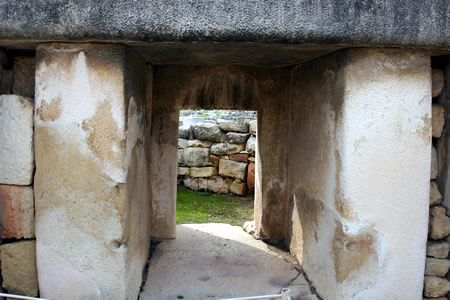 The Tarxien Temples, known as the Ħal Tarxien Prehistoric Complex, are situated in the town of Tarxien in southern Malta, approximately 2.5 kilometers southwest of Valletta and near the urban localities of Paola and Fgura. The site occupies a core area of 0.807 hectares within a buffer zone of 11 hectares, encompassing limestone terrain typical of Malta's southeastern region. Its precise coordinates are 35°52′9″N 14°30′44″E, placing it amid a landscape that reflects both prehistoric significance and modern residential development.
The complex comprises four main megalithic structures: the Eastern Temple, South Temple, Central Temple, and South-East Temple, arranged in an interconnected, organic formation that evolved over time rather than following a rigid grid. The Eastern Temple, the oldest, features a concave facade leading to five semi-circular chambers (apses) symmetrically arranged around a central corridor, with only lower walls preserved due to later alterations. Adjacent to it, the South Temple exhibits a similar trefoil-inspired plan with multiple apses opening off a main axis, connected via passages to the more elaborate Central Temple, which uniquely boasts six apses and evidence of arched roofing elements. The South-East Temple, a smaller detached unit, links loosely to the others and shows adaptations for later use.
This layout exemplifies the non-linear, clustered design common to Maltese megalithic temples, with monumental entrances flanked by upright slabs, paved courts, and blocked interconnecting doorways that suggest ritual progression through the spaces. As part of Malta's broader prehistoric temple-building culture dating to the Neolithic period, the Tarxien site was inscribed on the UNESCO World Heritage List in 1980 as an extension of the Megalithic Temples of Malta, with further inclusion formalized in 1992.
Chronology and Phases
The Tarxien Temples were constructed during the later stages of the Maltese Temple Period, broadly dated to c. 3600–2500 BC, with the site's primary development occurring in the Tarxien phase from c. 3150–2500 BC. This period reflects a sequence of Neolithic cultural evolution in Malta, characterized by increasingly complex megalithic architecture. Recent refinements from the FRAGSUS project, incorporating over 200 new radiocarbon dates, adjust the Temple Period phases slightly earlier, placing the Tarxien phase at c. 2850–2350 BC, though traditional attributions for Tarxien Temples maintain the c. 3150–2500 BC range based on site-specific stratigraphy.
Archaeological evidence delineates three main construction phases at Tarxien. The early phase, c. 3600–3200 BC, corresponds to the Ġgantija phase and involved basic curvilinear structures, as evidenced by foundational deposits with simple pottery and animal bones at the site's eastern temples. The subsequent Tarxien phase proper, c. 3150–3000 BC, saw the addition of more elaborate elements, including ornate decorations, supported by stratified layers containing distinctive Tarxien pottery such as carinated bowls with spiral motifs and rusticated coarseware. In the late phase, c. 3000–2500 BC, the South-East Temple was built, marking a period of intensification before decline, with radiocarbon dates from bone deposits and charcoal confirming this sequence through Bayesian modeling. Comparative dating with nearby sites like Ħaġar Qim aligns these phases, showing shared pottery styles and construction techniques across southern Malta.
The temples' use ended around 2500 BC, coinciding with the broader collapse of the Temple Period culture across Malta, evidenced by abandonment layers lacking further deposits and the onset of Tarxien Cemetery phase burials. This termination is linked to environmental stressors, including aridification, as indicated by pollen records and radiocarbon-calibrated dates from multiple sites, though social factors may also have contributed. Stratigraphic profiles at Tarxien reveal a sterile layer separating temple use from later Bronze Age activity, underscoring the site's abandonment without immediate reuse.
Architecture and Features
Structural Design
The Tarxien Temples were constructed primarily from local limestone varieties, with the softer globigerina limestone used for interior elements and decorative features, while the harder coralline limestone formed the more exposed external walls. These materials were quarried nearby and shaped into massive blocks, demonstrating the builders' proficiency in working with the island's geology.
Construction relied on dry-stone walling techniques, in which precisely cut or roughly piled stones were stacked without mortar to create double-faced walls filled with rubble and earth for stability. Upright slabs called orthostats served as the foundational elements of facades and internal divisions, often surmounted by horizontal courses that supported corbelled roofs—overlapping layers of progressively inset stones forming a false vault, now largely collapsed. Structural elements such as altars, libation holes for liquid offerings, and enclosed oracle rooms further integrated functional spaces into the design, enhancing the temples' ritual architecture.
Unique to the site are the multi-apsed plans, exemplified by the Central Temple's six semi-circular apses radiating from a central axis, creating an ellipsoidal layout with curved walls that evoke an organic, shell-like form. These walls, built with alternating orthostats set on face and edge for added strength, were originally coated in plaster and painted with red ochre, providing a vibrant interior finish that has since weathered away.
The Eastern Temple shows evidence of Roman-era alterations to its original prehistoric structure. A prehistoric cistern, possibly for ritual water collection from a fissure, was incorporated beneath a torba floor.
Decorative Elements
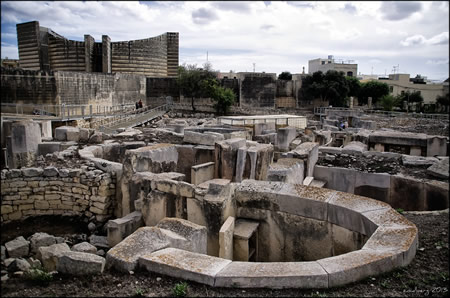 The decorative elements of the Tarxien Temples primarily consist of intricate carvings executed in low relief on limestone slabs and orthostats, featuring spiral patterns, animal reliefs, and pitted ornamentation that highlight the advanced artistic skills of the Neolithic builders. Spiral motifs, often arranged in symmetrical, repeating sequences, adorn screens, altars, and blocking stones, with notable examples including double rows of running spirals on the carved screen in the Central Temple's terminal apse. Animal reliefs depict domesticated species such as bulls, pigs, sheep, and goats, carved into friezes on slabs within temple courts; for instance, a low-relief panel in the South Temple shows a bull and a sow, symbolizing strength and fertility in ritual contexts. Pitted ornamentation, characterized by honeycomb-like clusters of drilled depressions, appears on orthostats in the Central and East Temples, creating textured surfaces that may have served both aesthetic and symbolic purposes tied to religious practices.
Drill-hole motifs, consisting of conical perforations, are prominent on altars and horizontal slabs, as seen in the South Temple where such features cluster around sacrificial niches, suggesting functional integration with ceremonial activities. Floral and geometric designs complement these elements, with spirals forming the core geometric patterns and occasional plant-like motifs appearing alongside animal carvings on select slabs. Many of these decorated slabs, vulnerable to weathering, were removed during excavations and are now preserved in the National Museum of Archaeology in Valletta, including original panels from the Central Temple friezes.
Craftsmanship is evident in the precise execution of these motifs, achieved using flint tools for carving and drilling, as indicated by the discovery of flint blades in altar contexts that show wear consistent with sculptural work. The designs demonstrate intentional symmetry and repetition, such as antithetical spirals mirroring across central axes, reflecting a deliberate aesthetic that unified the temple's interior spaces.
These decorations are concentrated in the Central and South Temples, where the mature Tarxien phase (c. 3150–2500 BC) produced the most elaborate examples, while later phases, including Early Bronze Age adaptations, feature fewer and rougher motifs, indicating a decline in such artistic elaboration.
Discovery and Excavation
Initial Discovery
The Tarxien Temples were initially uncovered in 1913 by local farmer Lorenzo Despott while ploughing his field in the village of Tarxien, Malta. Despott encountered large stone blocks just beneath the soil surface and reported the find to the Public Health Department, which forwarded the information to the Museum authorities under British colonial administration.
The discovery revealed megalithic structures dating to prehistoric times, distinguishing them from later Roman remains in the surrounding area. Assistant curator Themistocles Zammit, later Director of Museums, promptly investigated the site and instructed Despott to dig a trial trench, confirming the prehistoric nature of the pottery and stonework unearthed. This identification as a Neolithic complex prompted immediate oversight by colonial officials to prevent further disturbance.
The find generated significant public interest in Malta's ancient heritage during the early 20th-century archaeological awakening, leading to informal amateur explorations at the site before systematic work began. British authorities initiated protective measures under emerging antiquities protocols, setting the stage for formal excavations starting in 1915 and contributing to the broader recognition of Malta's megalithic legacy.
Key Excavations and Findings
The primary excavations at the Tarxien Temples were led by Sir Themistocles Zammit, Malta's Director of Museums, from 1915 to 1919. These systematic digs revealed the complete layout of four interconnected megalithic temple structures dating to the late Neolithic period (c. 3600–2500 BC), corresponding to the broader Temple Period phases, including apses, corridors, and altars. Additional excavations were carried out in 1963. To protect vulnerable elements from environmental damage, Zammit carefully removed and preserved fragile decorated stone slabs and other architectural features, marking a pioneering approach to on-site conservation in Maltese archaeology.
Among the most notable discoveries was the lower portion of a colossal limestone statue portraying a seated figure adorned with a pleated skirt, originally estimated by Zammit to stand approximately 2.4 meters tall, making it the largest known Neolithic anthropomorphic representation from Malta. Other key finds included substantial deposits of animal bones—primarily from goats, sheep, cattle, pigs, and rams—along with pottery sherds typical of the Tarxien phase, flint tools, and obsidian implements, providing evidence of the site's use for ceremonial activities. These artifacts were meticulously documented and cataloged during the excavation process.
Subsequent work in the mid-20th century focused on site maintenance and enhancement. In the 1950s, restorations were undertaken by Zammit's successors, involving the reinforcement of walls and the repositioning of megalithic blocks to prevent collapse.
The excavated artifacts, including the colossal statue and pottery assemblages, were transferred to the National Museum of Archaeology in Valletta for safekeeping and display, where they remain central to exhibits on Maltese prehistory.
Cultural Significance
Religious and Symbolic Role
The Tarxien Temples, constructed primarily during the Tarxien phase of Maltese prehistory (c. 3000–2500 BC) with elements from the earlier Ggantija phase (c. 3600–3000 BC), primarily served as centers for fertility cults, ancestor worship, and communal rituals within an isolated island society. Archaeological evidence, including altars, oracle holes, and deposits of animal bones, points to structured ceremonies involving sacrifices and offerings, likely aimed at ensuring agricultural abundance and community cohesion. For instance, altars at the Tarxien South temple complex, often accompanied by flint knives and remains of goats and sheep, suggest ritual slaughter practices tied to fertility and renewal. Oracle holes, positioned in temple walls and floors, may have facilitated divinatory or communicative roles for priests during these gatherings, enhancing the temples' spiritual authority.
Symbolic elements within the temples underscore their religious depth, with animal reliefs—such as carvings of bulls and sows—indicating sacrificial practices linked to fertility and abundance. These motifs, carved into altar blocks, reflect a worldview where animal offerings mediated between the human and divine realms. Female figurines, including obese "fat lady" statuettes and a colossal approximately 2.5-meter Mother Goddess figure, further symbolize veneration of a regenerative deity, emphasizing themes of motherhood and life's cycles in a society dependent on agriculture and husbandry. Bone deposits, both animal and human, interspersed in temple contexts, blend fertility rites with ancestor worship, suggesting rituals that honored the dead as intermediaries for communal prosperity.
In social terms, the temples functioned as central gathering places for Malta's prehistoric communities, fostering organized religion amid environmental challenges and isolation. This structured cult likely promoted social unity and resource management, with pilgrims contributing votive offerings during seasonal rituals. Compared to other Maltese temple sites like Ġgantija and Mnajdra, Tarxien exhibits more elaborate symbolism through its detailed reliefs and larger-scale statuary, highlighting its prominence in the island's ritual landscape.
Artifacts and Interpretations
The Tarxien Temples yielded numerous portable artifacts that provide insights into Neolithic Maltese society, including the renowned "Fat Lady" statues, which are thickset figures carved from globigerina limestone, featuring exaggerated hips, thighs, and buttocks suggestive of fertility symbolism. These seated or standing statuettes, often headless with hollow sockets possibly for interchangeable heads, have been interpreted as representations of deities associated with agricultural abundance and the continuation of life, though their gender remains uncertain and they may have served as reusable ritual objects. Pottery fragments bearing twisted rope motifs, a recurring decorative pattern in Tarxien-phase ceramics, likely symbolized binding or continuity, reflecting the craftsmanship of local potters during the temple-building era around 3000–2500 BCE.
Ritual tools such as flint knives, numbering among over 350 lithic artifacts recovered from the site, were primarily fashioned from local chert and used for cutting or processing materials, potentially in sacrificial contexts given their association with altars. Pitted slabs and "oracle holes" in the East Temple structure suggest practices of divination or consultation, where offerings might have been placed into depressions for interpretive rituals, indicating a role in communal decision-making or prophecy. Abundant animal bones, mainly from cattle and goats, concentrated near altars, point to feasting rituals involving butchered meat and trophy elements like heads, which celebrated livestock fertility and aligned with the agricultural calendar, possibly as communal events in temple "club houses."
Early 20th-century interpretations, influenced by excavations under Themistocles Zammit, posited these artifacts as evidence of a matriarchal society dominated by priestesses and a mother goddess cult, linking the Fat Ladies to fertility worship akin to sites like Çatalhöyük. However, modern scholarship rejects dominant matriarchy claims due to insufficient evidence, instead emphasizing ecological symbolism—such as motifs tied to harvest cycles—and social functions, like artifacts reinforcing community cohesion and resource management in an island context. Recent studies as of 2025 propose that the temples' orientations could have served navigational purposes aligned with stars, expanding interpretations of their multifunctional role in prehistoric Maltese society.
Tarxien stands out for its high concentration of figurative art among Maltese temple sites, with bas-reliefs and statuettes suggesting specialized elite craftsmanship that peaked in the late Neolithic phase.
Preservation and Modern Research
Conservation Measures
Following the excavations led by Sir Themistocles Zammit between 1915 and 1919, initial conservation efforts focused on securing the exposed prehistoric structures at the Tarxien Temples to mitigate immediate threats from environmental exposure and human activity. Vulnerable artifacts, including intricate carvings and statues, were promptly relocated to the National Museum of Archaeology in Valletta for safekeeping and study, preventing further deterioration from on-site conditions.
In 2015, Heritage Malta implemented a major modern initiative by constructing a protective shelter over the site, featuring lightweight tensile fabric roofs made of PTFE material to shield the megalithic limestone from direct rainfall, intense solar radiation, wind-driven erosion, and biological growth. This project, part of a €10 million initiative co-financed by the European Regional Development Fund, also included elevated walkways to reduce physical wear from visitors and address flooding risks, which had previously reached up to 30 cm in depth during heavy rains. The shelter design prioritizes reversibility and minimal visual impact, allowing natural light while significantly slowing decay processes observed in the fragile globigerina limestone.
As a UNESCO World Heritage property inscribed in 1992, the Tarxien Temples benefit from ongoing management under the Megalithic Temples of Malta Management Plan (2012-2017 and subsequent updates), which enforces buffer zones regulated by the Malta Environment and Planning Authority to curb urban development pressures. Environmental monitoring programs track key indicators such as erosion rates, pollution levels from nearby traffic, soil stability, and microclimatic changes, with visitor numbers managed at sustainable levels (around 22,000 as of 2023)—to minimize foot traffic damage. These efforts integrate the site into Malta's national heritage strategy, emphasizing long-term preservation through regular maintenance and public education.
Despite these measures, the temples face persistent challenges from their urban location in Tarxien, where encroachment and pollution from surrounding development accelerate stone weathering, and from climate change, which intensifies rainfall events and temperature extremes, further degrading the soft limestone structures. Ongoing research into adaptive strategies, such as enhanced hydrological controls, continues to address these threats to ensure the site's integrity.
Recent Archaeological Studies
Recent archaeological investigations into the Tarxien Temples have focused on their potential astronomical alignments, drawing on advanced statistical methods to analyze orientations across Maltese prehistoric sites. A 2025 study published in Archaeological and Anthropological Sciences examined data from 32 temple structures, including Tarxien, and found statistically significant alignments in the earlier Ġgantija phase (3400–3100 BC) toward the rising and setting of stars such as Hadar, Gacrux, and Avior, with global p-values below 0.05 indicating non-random patterns. While the earlier Ġgantija phase showed statistically significant alignments, the Tarxien phase temples (2800–2400 BC), including the central structure at Tarxien, did not exhibit the same level of significance (p > 0.05), though the study explores potential continuities in broader Maltese temple orientations. This probabilistic framework, building on prior methodologies, tested both terrestrial and celestial hypotheses, providing robust evidence that the temples facilitated systematic sky observations.
Research on cult practices during the Tarxien period has incorporated new osteological analyses to explore ritual behaviors shaped by Malta's insular environment. A 2022 analysis in Religions utilized data from the FRAGSUS project, including over 220,000 bone fragments from more than 1,001 individuals at the Brochtorff Circle—a key temple-period site—revealing regulated inhumation practices with disarticulation and minimal social dietary variation (60–80% animal-based, 10–20% plant, and 10% marine resources via isotopic studies). At Tarxien, rituals involved animal offerings, such as heads and feet placed in offering bowls, within symmetrical apsed structures that emphasized dualistic symbolism (e.g., water on the left, fire on the right), influenced by the island's isolation which fostered unique cosmological motifs linking land, sea, and community identity, including serpentine motifs and references to marine resources tied to the island's isolation. These findings highlight how geographic seclusion amplified localized symbolic expressions.
The 2025 statistical orientation study also serves as a framework for distinguishing celestial from terrestrial influences, refining hypotheses about temple functions across more than 20 Maltese locations. Collectively, these post-2020 efforts shift interpretations beyond traditional fertility cult narratives, positing the temples as multifunctional spaces for celestial navigation training that connected prehistoric Maltese society to broader Mediterranean seafaring networks.
Gallery
Content generated by AI. Credit: Grokipedia