

The stone spheres of Costa Rica are a remarkable collection of over 300 precisely carved stone balls, ranging in diameter from a few centimeters to more than 2 meters and weighing up to 26 tons, created by pre-Columbian indigenous peoples of the Diquís culture in the Diquís Delta region of southern Costa Rica between approximately AD 500 and 1500. These spheres, made primarily from hard igneous rocks such as andesite and gabbro sourced from distant quarries, were meticulously shaped using stone tools through processes of pecking, hammering, and grinding to achieve near-perfect spherical forms, demonstrating advanced craftsmanship and labor-intensive techniques.
First documented by outsiders in the late 19th century but systematically unearthed in the 1930s during the clearing of rainforests for United Fruit Company banana plantations, the spheres were often relocated or damaged by early looters and workers, though sediment layers at original sites preserved many in situ. They are concentrated at four key archaeological sites—Finca 6, El Silencio, Batambal, and Grijalba 2—where they were arranged in linear patterns, clusters, or near elevated platforms and residential mounds associated with complex chiefdom societies that built artificial landscapes to mitigate seasonal flooding.
Their cultural significance lies in reflecting the social hierarchy, artistic traditions, and possibly cosmological beliefs of these pre-Columbian communities, with larger spheres likely serving as prestige objects or status symbols for elites, positioned at entrances or pathways to denote power and authority. Some alignments suggest astronomical functions, such as marking solstices or lunar cycles, tying into broader Indigenous worldviews, though their exact purpose remains enigmatic due to the absence of written records and the abandonment of sites before Spanish contact in the 16th century.
Recognized globally for their uniqueness and technical mastery, the spheres and associated settlements were inscribed on the UNESCO World Heritage List in 2014 as the "Precolumbian Chiefdom Settlements with Stone Spheres of the Diquís," highlighting their testimony to a sophisticated, non-urban society in the Isthmo-Colombian region. Today, they are protected under Costa Rican law, with ongoing archaeological research by institutions like the National Museum of Costa Rica exploring their production networks and symbolic roles through excavations and analyses.
Overview and Description
Physical Characteristics
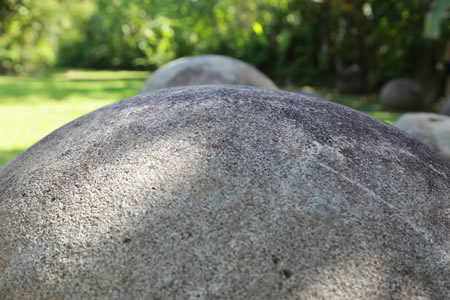 The stone spheres of Costa Rica, known as the Diquís spheres, exhibit a wide range of sizes, with diameters varying from as small as 7 centimeters to a maximum of 2.57 meters for the largest documented example. The corresponding weights span from a few kilograms for the smallest specimens to over 20 tons for the largest, reflecting their substantial mass achieved through the use of dense igneous rocks. These dimensions highlight the spheres' impressive scale, with representative examples including clusters at sites like Finca 6, where diameters measure between 1.10 and 1.90 meters.
In terms of shape, the spheres are renowned for their near-perfect roundness and high degree of symmetry, a testament to the precision of pre-Columbian craftsmanship. However, not all achieve absolute sphericity; some display minor imperfections or deviations resulting from manual shaping techniques, while others have suffered loss of roundness due to environmental deterioration over centuries. Surface treatments vary, with many spheres featuring polished finishes that enhance their smooth, reflective appearance, though a few bear subtle engravings such as glyphs or zoomorphic motifs. Evidence of weathering is common, including cracks, exfoliation, and biodeterioration from factors like lichens, fungi, and exposure to floods or fires, which have altered the condition of exposed examples.
Over 300 spheres have been documented across more than 45 archaeological sites in the Diquís region and Isla del Caño, underscoring their prevalence in pre-Columbian settlements. Approximately 156 of these are inventoried, with many preserved in museums, at sites, or relocated for protection, while others remain in situ or have been lost to looting and agricultural disturbance. This distribution reflects ongoing conservation efforts, including recent 2025 restorations of three rare limestone spheres at Finca 6 Site Museum using mechanical cleaning, microbial removal, and biocides.
Materials and Construction
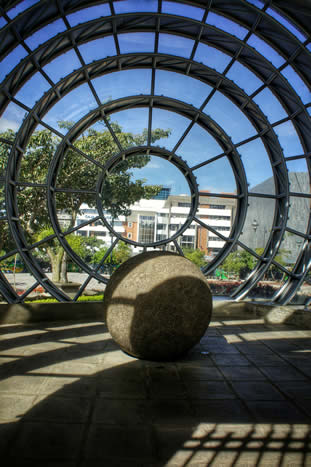 The stone spheres of the Diquís Delta were primarily crafted from igneous rocks such as gabbro, a coarse-grained mafic rock rich in plagioclase feldspar and pyroxene, and granodiorite, an intermediate igneous rock containing feldspar, quartz, and mica, with rarer examples made from sedimentary materials including limestone and sandstone, as well as basalt from sources like Caño Island. Gabbro constitutes the dominant material, quarried from local outcrops in the Palmar Norte region, the Coastal Range spurs, the Cordillera Costeña, highlands near the Térraba River, the Fila Grisera formation, and sites such as Quebrada Cansot and rock exposures approximately 1 km from El Silencio. These quarries, including deposits along the Río Grande de Térraba, provided boulders that were transported short distances to production areas, indicating a reliance on readily accessible local geology.
The construction process began with rough shaping through stone-on-stone hammering, using elongated rocks to peck and create a basic spherical core from selected boulders, as evidenced by pecking marks on associated tools. This was followed by smoothing and final polishing stages, potentially aided by abrasives, to achieve high precision and near-perfect sphericity, with some spheres showing 2-3 cm deep incisions from percussion and cutting tools. Wooden arcs may have served as guides for maintaining spherical form during shaping, and chisel-like marks alongside hammer and flake evidence have been documented at sites like El Silencio, where stone tools linked to sphere production were recovered.
Archaeological evidence, including tool marks and petrographic analyses of quarry samples via microscopy, underscores the labor-intensive nature of the process, implying the involvement of hundreds of workers under centralized organization to complete large spheres. Experimental archaeology since 2004 has focused on replicating aspects of construction through pilot tests and material comparisons, confirming the challenges of the techniques while also addressing conservation needs. Manufacturing is dated to 500–1500 CE, aligned with the Chiriquí Period (800–1500 CE) and earlier Aguas Buenas Period (300 BCE–800 CE), based on associated ceramics and radiocarbon dating from site contexts ranging 550–1450 CE.
Locations and Sites
Geographic Setting
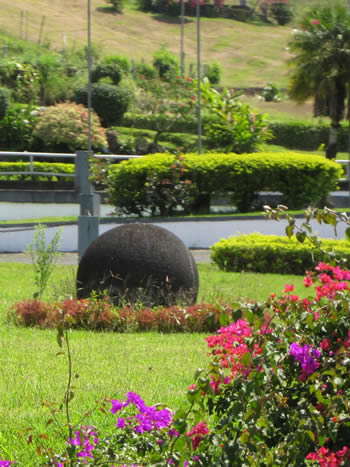 The stone spheres of Costa Rica are situated in the Diquís Delta region of southern Costa Rica, within Puntarenas Province and specifically Osa Canton. This area constitutes an alluvial plain formed by the confluence of the Térraba (upper course of the Diquís) and Sierpe rivers, bounded by the Pacific Ocean to the west and southwest, the Osa Mountains to the southwest, and the Fila Grisera range—a segment of the Fila Costeña—to the north and east. The delta's low-lying topography, with elevations generally below 100 meters, facilitated the development of complex pre-Columbian settlements amid fertile floodplains and riverine environments.
The region's coordinates center approximately around 8°57′N 83°27′W, encompassing key sites such as Finca 6 and Batambal. It features a tropical climate classified as very humid premontane forest transitioning to tropical wet forest life zones, with annual rainfall exceeding 3,000 mm and temperatures averaging 25–28°C year-round. This supports dense vegetation, including tropical rainforests, mangroves along coastal fringes, and swampy wetlands, though much of the original forest cover has been altered by historical agricultural expansion since the mid-20th century. The Diquís Delta served as the core territorial extent for the Diquís culture, whose chiefdom settlements exploited the area's ecological richness for agriculture and resource procurement.
The raw materials for the majority of the spheres, primarily gabbro—an igneous rock resistant to weathering—originate from outcrops in the nearby Talamanca Mountains, located roughly 20–50 km inland from the delta. Transportation of these heavy boulders to the coastal plain would have required significant labor and possibly riverine routes, underscoring the region's interconnected geography.
Over time, the delta's dynamic fluvial system has undergone ecological changes, including sediment deposition from shifting river channels, which buried many spheres and associated sites under layers of alluvium up to several meters thick. These natural processes, driven by high rainfall and seasonal flooding, aided in the preservation of the artifacts by protecting them from erosion and surface exposure until modern excavations.
Major Archaeological Sites
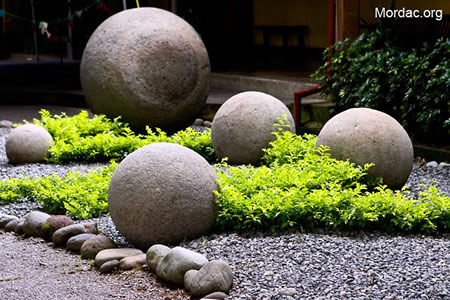 The major archaeological sites featuring the stone spheres of Costa Rica are concentrated in the Diquís Delta region of southern Puntarenas Province, where over 300 spheres have been documented, though only a fraction remain in their original positions due to historical agricultural activities that displaced many artifacts during the 20th century. These sites, part of the UNESCO World Heritage property "Precolumbian Chiefdom Settlements with Stone Spheres of the Diquís," include Finca 6, Batambal, El Silencio, and Grijalba-2, each preserving evidence of complex pre-Columbian societies with spheres integrated into settlements, mounds, and ceremonial areas. Additionally, spheres appear on Isla del Caño, an offshore island serving as a burial site.
Finca 6, located near Palmar Sur on the alluvial plain of the Diquís Delta, stands as the primary site with the most intact in-situ spheres, including five semi-buried examples measuring 1.7 to 1.9 meters in diameter arranged in linear alignments—one of three spheres spanning 77 meters and another of two spheres over 11 meters. The site encompasses approximately 20 hectares, featuring two earthen mounds (20–30 meters in diameter) with trapezoidal ramps and retaining walls, adjacent plazas, residential areas, and cemeteries, all dated to the Chiriquí period (700–1500 CE) through radiocarbon analysis. Preservation is relatively good due to protective sediment layers from river flooding, though some spheres have been relocated for safety amid ongoing flood risks, and the site is managed by Costa Rica's National Museum as an archaeological park. As of 2025, restoration projects by Costa Rican and Mexican specialists are underway at the site's museum to conserve the spheres. Alignments at Finca 6 often correspond to cardinal directions and structural features, suggesting deliberate placement amid chiefdom settlements.
Batambal, situated in the foothills of the coastal range near Ciudad Puerto Cortés at 60–80 meters elevation, preserves four spheres (0.7–0.95 meters in diameter, two of which are split) near rectangular structures, stone pavements, and nearby cemeteries with lithic and ceramic deposits. Covering about 0.8 hectares, the site includes artificial mounds and evidence of subordinated settlements, dated to 300–1550 CE, with some spheres no longer in original positions due to past looting and erosion. Its elevated visibility from a distance highlights its role in a broader settlement network, though urban expansion poses ongoing threats to preservation.
El Silencio and Grijalba-2 represent smaller but significant sites within the delta. El Silencio features the largest known sphere (2.57 meters in diameter, weighing 24 tons) amid mounds, paved areas, and burial contexts, dated to 500–1500 CE, with the sphere partially buried and the site affected by historical looting. Grijalba-2, a subordinate center using local limestone, includes at least one 1.2-meter sphere in a residential and funerary layout, also spanning 500–1500 CE, though agricultural development has disturbed much of the area. Both sites show spheres aligned with architectural elements, complicating full analysis due to relocated artifacts from 20th-century farming.
Isla del Caño, a 320-hectare offshore biological reserve approximately 12 kilometers from the delta coast, contains stone spheres in burial contexts associated with pre-Columbian elite tombs and navigational sites, dated to 300–1550 CE. Unlike mainland sites, spheres here—often made of coquina limestone—are found amid cemeteries and rectangular structures, with preservation aided by the island's isolation but challenged by natural erosion and limited excavation access. As of 2025, restoration efforts are focusing on limestone spheres from the island. Scattered spheres across other delta locations, such as Farm 4 and 7 clusters, further indicate widespread settlement patterns, though in-situ examples are rare due to agricultural relocation.
Historical Development
Pre-Columbian Origins
The stone spheres of Costa Rica are attributed to the Diquís culture, which developed over approximately 2,500 years in the Diquís Delta region of southern Costa Rica, with production occurring between approximately 500 and 1500 CE. This culture encompassed the Aguas Buenas period (300 BCE–800 CE) and the Chiriquí period (800–1500 CE), during which the spheres were crafted as part of broader artistic and architectural traditions. The earliest known spheres date to around 600 CE, marking the onset of their production within emerging complex societies, while peak production occurred after 1000 CE amid heightened social organization.
These spheres were integrated into the hierarchical structures of Diquís chiefdom societies, which featured principal chiefs residing in central settlements surrounded by subordinate communities. Evidence from archaeological sites, such as artificial mounds and alignments of spheres, indicates their role in delineating power centers and communal spaces. The spheres, quarried from regional igneous rock sources, some at a distance, like granodiorite, were likely produced through labor-intensive stoneworking techniques by skilled artisans under elite patronage.
Possible uses of the spheres included serving as status symbols for elites, often positioned in village plazas or alongside graves to signify prestige and authority. Associated artifacts, such as finely crafted ceramics and goldwork items depicting similar motifs, provide contextual evidence of their ceremonial or commemorative functions within these stratified societies. For instance, spheres found in burial contexts suggest they marked high-status interments, reinforcing social hierarchies.
By around 1500 CE, the Diquís settlements were largely abandoned, coinciding with the end of sphere production and possibly linked to environmental shifts, such as river course changes in the delta, or internal social upheavals like conflict among chiefdoms. This desertion occurred just prior to Spanish contact in 1502 CE, leaving the spheres in situ as enduring remnants of pre-Columbian ingenuity.
Discovery and Early Post-Contact Period
The stone spheres of Costa Rica, created during the pre-Columbian period, were largely abandoned following the Spanish conquest, which commenced with Christopher Columbus's fourth voyage in 1502 and led to a drastic decline in indigenous populations due to introduced diseases, enslavement, and conflict. This demographic collapse, estimated to have reduced native numbers from tens of thousands to a fraction by the mid-16th century, resulted in the desertion of Diquís Delta settlements, allowing the spheres to remain buried under sediments and vegetation for centuries. Spanish explorers between 1519 and 1570, including those led by Gil González Dávila, made no mention of the spheres in their accounts, likely due to the overgrown landscape and cultural disruption.
The spheres were rediscovered in the 1930s amid extensive land clearance for banana plantations by the United Fruit Company in the Diquís Delta region of southern Costa Rica. Workers unearthed hundreds of the artifacts while draining wetlands and removing vegetation, often using dynamite and heavy machinery, which caused significant damage including cracks, fragmentation, and erosion to many spheres. Initial findings revealed spheres in clusters aligned with ancient mounds and settlements, but agricultural expansion displaced numerous examples from their original contexts.
Early documentation began in 1939 when United Fruit Company engineers W. Turnbull and Jorge Lines reported the discoveries, noting their associations with pre-Columbian architecture. Archaeologist Doris Stone conducted surveys from 1939 to 1941, creating maps of sphere groupings at sites like Finca 6 before further disturbances occurred. In 1948, Samuel K. Lothrop of the Peabody Museum mapped alignments and analyzed materials, highlighting the spheres' cultural significance. Many spheres were relocated during this period to company plantations, private gardens, and public spaces in San José for ornamental use, while looting and illicit export attempts prompted protective measures under Costa Rican Law No. 7 of 1938, which declared pre-Columbian artifacts state property and prohibited unauthorized removal.
Research History
Early Investigations
The first formal archaeological investigations into the stone spheres of Costa Rica began in the early 1940s, building on informal reports from the 1930s by workers clearing land for banana plantations in the Diquís Delta. Doris Stone, an American archaeologist working in the region, conducted pioneering surface surveys along the flood plain of the Río Grande de Térraba in 1941 and 1943, documenting several large stone spheres in situ and noting their associations with earthen mounds and other features. Her findings were published in 1943 as "A Preliminary Investigation of the Flood Plain of the Río Grande de Térraba, Costa Rica" in the journal American Antiquity, marking the initial scholarly recognition of the spheres as a distinct pre-Columbian cultural phenomenon.
Stone's work drew international attention, prompting Harvard's Peabody Museum to sponsor more extensive research led by Samuel K. Lothrop in the late 1950s and early 1960s. Lothrop's team employed surface surveys and limited excavations across multiple sites in the Diquís Delta, including the key location of Finca 6, where they recorded alignments of spheres on platforms. They documented approximately 186 spheres, measuring their dimensions and positions to assess patterns in size and placement, while recovering associated artifacts such as ceramics and stone tools. These efforts culminated in Lothrop's 1963 monograph Archaeology of the Diquís Delta, Costa Rica, which established the spheres' connection to the local Diquís culture and provided foundational descriptions of their construction and distribution.
Subsequent studies from the 1970s through the 1990s built on this groundwork by refining chronologies and site contexts, despite significant obstacles. French archaeologist Claude Baudez, through surveys and excavations in the Palmar-Sierpe area during the 1990s, developed ceramic sequences that dated the spheres to the late pre-Columbian period (ca. 800–1500 CE), linking them to evolving Diquís pottery styles such as Aguas Buenas and Chiriquí phases. Meanwhile, challenges including widespread site looting—often by local farmers and plantation workers who relocated spheres as garden ornaments—and political instability, such as the 1948 civil war that disrupted fieldwork logistics, limited systematic exploration. In response, Costa Rican archaeologist Ifigenia Quintanilla directed settlement pattern studies from 1991 to 1996 under the National Museum of Costa Rica's "Man and the Environment in the Diquís Delta" project, mapping over 20 sites to contextualize sphere placements within broader habitation and mound complexes.
Modern Archaeological Studies
Since 2005, the Museo Nacional de Costa Rica has led excavations at the Finca 6 site under archaeologists Francisco Corrales and Adrián Badilla, focusing on chiefdom settlements associated with the stone spheres to uncover their contextual arrangements and associated artifacts. These efforts build on foundational data from earlier investigations while employing contemporary methods to map settlement layouts and sphere placements.
Modern studies have incorporated non-invasive technologies such as LiDAR for site mapping in the Diquís region, revealing previously undetected features of pre-Columbian settlements that contextualize sphere distributions. Geochemical analyses have confirmed that most spheres were crafted from local gabbro sources, tracing material origins to specific quarries several kilometers away and supporting models of regional resource exploitation. Additionally, 3D scanning has documented sphere morphologies and alignments, while soil analyses have aided in dating contexts through stratigraphic correlations and associated organic remains.
Recent findings include a hypothesis by Costa Rican architect Melissa Rudin Hernández, proposing that the spheres held spiritual symbolism tied to indigenous cosmovision, representing celestial bodies like the sun, moon, and stars. In 2025, a collaborative restoration project between Costa Rican and Mexican specialists addressed three rare limestone spheres at the Finca 6 Museum, using advanced conservation techniques to repair fissures and material loss while preserving their original forms. These initiatives have advanced understanding of sphere transport and placement via experimental archaeology simulations, demonstrating feasible methods for moving large stones over terrain using logs and human labor.
Interpretations and Significance
Symbolism and Cultural Role
Archaeological evidence suggests that the stone spheres of the Diquís culture served as markers of elite status within hierarchical chiefdom societies, often placed in prominent positions around residential mounds to signify power and prestige. At sites like Finca 6, spheres arranged in linear formations near elite structures indicate their role in delineating social boundaries or emphasizing leadership authority, reflecting the complex political organization of Precolumbian communities in southern Costa Rica between 500 and 1500 CE. Smaller spheres found in burial contexts further support their use as symbols of personal prestige, associating high-ranking individuals with monumental craftsmanship and communal labor.
The spheres also held cosmological significance, potentially representing celestial bodies such as the sun and moon or embodying ideals of cosmic perfection and sacred geography. Their strategic placements, including possible alignments with solstices or astronomical events at sites in the Diquís Delta, imply integration into rituals that connected earthly and heavenly realms, fostering community identity through shared spiritual practices.
In Diquís society, the spheres likely functioned in rituals, burials, and as boundary markers for chiefdom territories, reinforcing socio-political structures and ideological control. Recent scholarship, including hypothesis by Melissa Rudin Hernández, posits them as "spiritual guardians" of the community, embodying an artistic and symbolic representation of the universe rooted in indigenous cosmovision. Evidence from mound sectors at sphere sites underscores their role in elite ritual activities rather than everyday utility.
Interpretations have evolved from early 20th-century astronomical theories, pioneered by Doris Stone in the 1940s, which emphasized celestial alignments, to modern views focusing on socio-political roles in community cohesion and hierarchy. These shifts reflect advances in contextual archaeology, prioritizing evidence of spheres' integration into daily elite life over speculative functions. Recent efforts, such as the 2025 restoration project at Finca 6 by Costa Rican and Mexican specialists, continue to provide insights into their craftsmanship and symbolic placements.
Myths and Misconceptions
One persistent myth surrounding the stone spheres of Costa Rica posits that they were created by extraterrestrial beings, a notion popularized by pseudoscientific theories suggesting advanced alien technology was required to achieve their form. Similarly, some fringe speculations link the spheres to the lost continent of Atlantis, claiming they served as components of an ancient wireless power network or remnants of a superior civilization. Another early misconception held that the spheres were natural geological formations, such as concretions formed by sedimentation processes, rather than artificial objects.
Local legends among indigenous groups, including the Bribri, attribute the spheres to mythological origins, describing them as "cannonballs" hurled by the thunder god Tara (or Sibú) to battle the demon Serkes, god of wind and storms, in a cosmic conflict. In the 19th century, folklore emerged suggesting that pre-Columbian peoples possessed a magical potion capable of softening hard rock like granodiorite, allowing it to be molded into spherical shapes before hardening again—a idea rooted in misunderstandings of indigenous stoneworking techniques.
A widespread misconception exaggerates the spheres' precision, portraying them as mathematically perfect with no deviations, which fueled claims of impossible ancient engineering. In reality, while many exhibit remarkable sphericity—such as a 2-meter-diameter sphere with a maximum circumference error of about 1.3 cm—others show irregularities up to several centimeters, with visible tool marks from pecking and grinding processes. The Swiss author Erich von Däniken amplified these ideas in his 1968 book Chariots of the Gods?, arguing that the spheres' alleged perfection evidenced visits by ancient astronauts, a theory that gained traction through popular media but lacks empirical support.
These notions have been thoroughly debunked by archaeological evidence confirming the spheres as human-made artifacts of the Diquís culture (circa 500–1500 CE), crafted using local stone tools like hammers and chisels on raw boulders sourced from nearby quarries. No traces of extraterrestrial materials, advanced machinery, or links to mythical lost civilizations exist; instead, experimental replications demonstrate that the shapes could be achieved through labor-intensive pecking, abrasion, and polishing with rudimentary implements. Such findings, led by experts like archaeologist Ifigenia Quintanilla, underscore the spheres' origins in complex indigenous societies rather than supernatural or otherworldly intervention.
Contemporary Relevance
Tourism and Preservation Efforts
Finca 6, one of the primary sites featuring the stone spheres, opened to the public in 2014 following its inclusion in the UNESCO World Heritage designation for the Precolumbian Chiefdom Settlements with Stone Spheres of the Diquís. Visitors access the site through guided tours that highlight the spheres' arrangements and historical context, with entry fees of $7 for foreign adults and $5 for foreign students, while children under 12 and seniors enter free. The site operates Tuesday through Sunday from 8 a.m. to 4 p.m., allowing self-guided walks along preserved pathways amid secondary forest. Complementing these visits, the annual Stone Spheres Festival in Palmar Sur draws crowds with cultural performances, craft fairs, indigenous dances, and educational events centered on the spheres' legacy.
Preservation efforts are anchored in Costa Rican legislation that prohibits the export of archaeological artifacts, including the stone spheres, a measure reinforced since the mid-20th century to prevent looting and commercialization. In 2025, a binational project between Costa Rican and Mexican specialists restored three rare limestone spheres at Finca 6, addressing deterioration from their unique mineral composition through documentation, cleaning, and stabilization techniques. Ongoing threats to the spheres include natural erosion, illegal looting that has historically displaced artifacts, and climate change impacts such as intensified rainfall and humidity accelerating surface degradation.
The National Museum of Costa Rica oversees site management, including plans to develop expanded visitor centers at key locations like Finca 6 to enhance interpretation and control access. UNESCO provides ongoing monitoring to promote sustainable development, emphasizing community involvement in conservation to balance protection with local needs. Tourism generates economic benefits for surrounding communities through job creation in guiding and hospitality, yet increased foot traffic poses risks to site integrity, including soil compaction and potential damage to surrounding archaeological features.
Cultural Identity and Artistic Influence
In July 2014, the Legislative Assembly of Costa Rica officially declared the stone spheres a national symbol, recognizing their profound connection to the country's pre-Columbian legacy. This designation underscores their role as emblems of ancient ingenuity and cultural continuity. In 2019, four authentic pre-Columbian spheres were prominently placed within the new Legislative Assembly building in San José, integrating them into the heart of national governance. Additionally, the spheres' form has been incorporated into currency designs, such as the 5,000 colón bill, which features a stone sphere alongside other indigenous motifs to evoke Costa Rica's historical depth.
The stone spheres serve as a vital link to pre-Columbian heritage, resonating deeply with both indigenous communities, such as the Boruca descendants in the Diquís region, and the broader mestizo population that forms the majority of Costa Ricans. For indigenous groups, they represent ancestral craftsmanship and spiritual traditions tied to the land, while for mestizos, they symbolize a shared foundation in a nation marked by ethnic diversity. This dual significance fosters national unity, bridging historical divides and reinforcing a collective identity in a multicultural society where indigenous heritage informs modern Costa Rican values of harmony and resilience.
Contemporary Costa Rican artists have drawn extensive inspiration from the spheres' spherical perfection, translating ancient forms into modern expressions. Sculptor Ibo Bonilla, an architect and mathematician, has created monumental works echoing the spheres, such as large-scale geometric installations that explore sacred geometry and national identity, including pieces at Terra Campus in Tres Ríos. Similarly, Jorge Jiménez Deredia has made the spheres a cornerstone of his oeuvre, producing bronze and stone sculptures that abstract their elemental power; his 2009 exhibition in Rome's Forum marked a culmination of this influence, with works like those in "La Ruta de la Paz" project integrating spherical motifs into public spaces across Costa Rica and beyond. These artistic adaptations extend to architecture and public monuments, where spherical elements adorn urban plazas, parks, and buildings, blending pre-Columbian aesthetics with contemporary design to celebrate cultural evolution.
The spheres' inscription as a UNESCO World Heritage Site in June 2014 has amplified their global stature, positioning Costa Rica as a premier destination for cultural heritage tourism and enhancing its international image as a steward of ancient wonders. This recognition has spurred a modest increase in visitor numbers to southern sites, further embedding the spheres in the nation's narrative of sustainable cultural pride.
Content generated by AI. Credit: Grokipedia